
The UN documents deepening repression in Venezuela amid escalating tension with the US
The fact-finding mission found arbitrary arrests, sexual abuse in prisons, and disappearances of human rights activists and politicians. Caracas rejected the accusations and discredited the mission’s work

Reports of arbitrary arrests and disappearances of political activists, human rights defenders and their families have overlapped in recent weeks with rising tensions between the United States and Venezuela over military maneuvers in the Caribbean. On Monday, the United Nations Independent Fact-Finding Mission revealed in a report new patterns of repression against opponents following the presidential elections and during this complicated year.
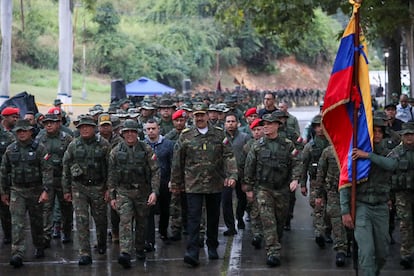
In Venezuelan prisons, NGOs report, there are still 823 people behind bars for political reasons. About 100 are women. Of the total, 89 are citizens of another country. At least 70 are seriously ill. Despite the government decreeing dozens of releases, this Monday in Geneva officials warned that the persecution of opponents has not stopped. Thus, the human rights situation in Venezuela has returned to the spotlight after weeks of debate over the alleged links between the Venezuelan government and drug trafficking, amid increasing military pressure from U.S. President Donald Trump with the attack on boats in the Caribbean, to which the government of Nicolás Maduro has responded by militarizing the country and training civilians in the use of combat weapons.
The South American country has a thick caseload of human rights violations in international forums. And a year after the institutional crisis sparked by allegations of fraud in the presidential elections of July 28, 2024, the need for negotiations to find a solution to Venezuela’s deadlock has re-emerged.
During the debate on the report in Geneva, Spain called for the release of 20 of its citizens imprisoned in Venezuela. “Spain demands the immediate and unconditional release of all political prisoners in Venezuela, including dual nationals and foreign citizens. Spain has four nationals detained and 16 dual nationals arbitrarily detained in Venezuela,” stated Marcos Gómez, the Spanish government representative to the UN. The official denounced that all of them have been denied consular visits, the right to legal defense, and a fair trial. “We demand an end to enforced disappearances, to all practices of torture or inhuman and degrading treatment, including the acts of sexual and gender-based violence you have described. Spain joins the Mission’s demand and denounces the serious lack of judicial guarantees.”
Switzerland has offered to build bridges to mediate in the Venezuelan conflict, an issue in which half a dozen international mediation efforts have failed. Turkey, Maduro’s political and commercial ally, once again called for dialogue. Venezuela, for its part, rejected the accusations and discredited the mission’s work.
Within Venezuela, opposition leaders such as Henrique Capriles Radonski—a lawmaker elected in the last parliamentary elections in which the majority opposition abstained—also called for the release of all political prisoners. “All government spokespersons agree that they are not attacking another country and they are calling for a de-escalation from the United States. But to demand an external de-escalation, you have to de-escalate internally. Here, the continued imprisonment of people must stop. If they truly want peace, they must stop the persecution.” The politician rejected “hostage diplomacy,” referring to the prisoner exchanges Maduro agreed to with the United States, and insisted on establishing new political negotiations. “No one here wants an armed conflict, but it seems the government is preparing us for war, and that must be rejected.”
Sexual violence
The Fact-Finding Mission’s report comprehensively documents the repression over the past year, starting from July 28, 2024. Researchers point to two peaks in the increase in cases during that period: in January of this year, after Nicolás Maduro took office; and beginning in July.
The mission highlighted cases of sexual and gender-based violence, identifying 22 documented incidents in six Venezuelan states. The victims include women, girls, adolescents, and male prisoners. The patterns include coercive transactional sex, possible acts of sexual slavery or forced prostitution, electric shocks to the genitals, and forced nudity. One of the cases reported is that of a detainee at a National Guard detachment who said that military guards demanded that the women have sex in exchange for benefits such as making phone calls to their families. Another involves a group of more than 100 teenagers who were arrested during protests against the election results between late July and early August 2024, four of whom are still in prison. Several of the girls, ages 15 to 17, told investigators that while detained in a Bolivarian National Police office, they were victims of sexual abuse, including transactional sex to allow them to go to the bathroom or receive hygiene products brought to them by their relatives.
The report adds testimony from a detained man who indicated that the guards circulated among the male detainees a list of fees for the sexual services of the female inmates. “These events could constitute sexual slavery and/or forced prostitution and merit an effective investigation by the competent authorities and this Mission.” In another case, the mother of a detained teen reported that she was repeatedly insulted during visits. They told her: “Here comes the mother of the fascist, the delinquent child.” The woman reported that she was forced to remove all her clothes during the search and that on one occasion the commissioner called all the officers on duty to look at her naked. The reason for this treatment, she was told, was that she made too many statements demanding her son’s release and denouncing his situation.
The security officers, says the report—which includes diagrams of the isolation cells— used plastic bags to suffocate detainees and beat, kick, and hit them with their fists or with bats. Acts of sexual torture, including threats of rape and the application of electricity to genitals, were also perpetrated. The courts ignored complaints of these acts, as did the Ombudsman’s Office and the Public Prosecutor’s Office, which did not launch any investigations, according to the UN mission. This is the sixth report submitted by the group of experts since it was established in 2019.
“The arrests of individuals who were perceived as opponents or those who were opposed to the government continued in 2025, as they did in 2024, without legal basis or warrant, carried out on multiple occasions by masked individuals without official identification. Criminal files also continue to be fabricated, seriously violating the principles of a fair trial with total impunity and judicial collusion,” stated Francisco Cox, an expert with the Fact-Finding Mission. “Given the subservience of justice to the executive branch, the only hope of finding justice for the victims in Venezuela lies in international bodies.”
Sign up for our weekly newsletter to get more English-language news coverage from EL PAÍS USA Edition









































