
Venezuela expands ties with Russia amid escalating tensions with the United States
The Maduro regime also released images of fighter jets armed with anti-ship missiles
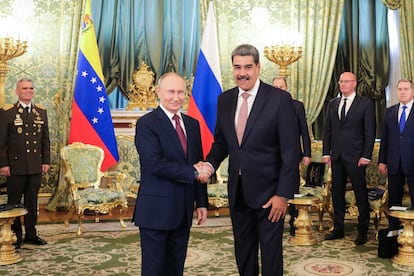
Venezuela’s National Assembly, overwhelmingly controlled by the Chavista bloc, is set to approve in a first reading what has been called the Law Approving the Strategic Association and Cooperation Treaty between Venezuela and Russia, as stated in the agenda. This alliance emerges amid a military escalation with the United States, which has already destroyed three vessels departing from Venezuelan coasts and has repeatedly stated that Venezuelan President Nicolás Maduro should face U.S. justice for allegedly leading a drug cartel.
The measure establishes a legal instrument that would expand the scope for political and economic cooperation with Russia, a country with which Venezuela already maintains significant military agreements. For instance, a factory producing AK-103 Kalashnikov rifles under a national license operates in Venezuela.
Russian President Vladimir Putin and Nicolás Maduro have held a couple of personal meetings this year, during which the former KGB agent praised Maduro’s continued presence in power, lauded the current state of cooperation between the two countries, and expressed the willingness of both governments to deepen it.
The ruling United Socialist Party of Venezuela (PSUV) is advancing this initiative as military and political tensions with the United States escalate. Some of the most prominent members of Donald Trump’s administration — such as Secretary of State Marco Rubio — do not hide their animosity toward Maduro and the rest of the Chavista leadership. Rubio has been emphatic in calling for the overthrow of the Venezuelan president, who is accused of committing electoral fraud at last year’s election. Putin has remained silent on the tensions between Caracas and the Trump administration, which has resulted in an unprecedented political crisis.
The Venezuelan government has denied the accusation that Maduro is leader of the Cartel of the Suns and behind the criminal organization Tren de Aragua. It argues that the country is free of such criminal activity and maintain that these claims aim to provoke an incident to force a regime change in Venezuela.
Venezuela sought to display its firepower on Thursday. The Bolivarian Military Aviation released images of Russian-made fighter jets, Sukhoi Su-30s, equipped with anti-ship missiles. In Instagram footage, the jets are lined up on a runway before taking off. Meanwhile, 2,500 elite personnel from the Bolivarian National Armed Forces, along with a significant portion of the Venezuelan Navy’s military equipment, have been deployed to the island of La Orchila in the Venezuelan Caribbean. There, a series of three-day military exercises will be conducted at a heightened state of alert, reportedly simulating hostile scenarios at sea. The operation has been dubbed Sovereign Caribbean 200 by the Chavistas.
Tensions in Caracas have reached their peak amid fears of an invasion. Maduro established what he calls the National Council for Sovereignty and Peace, a forum composed of Chavista and independent (but still Chavista-aligned) civil actors, businesspeople linked to the regime, private and public universities, labor unions, and opposition politicians tolerated by the government, in which a renewed call was made to pursue peace and defend the country’s integrity.
As often happens under pressure, the Chavista leadership adopted a plural and unitary discourse. At the same time, the PSUV has made a major effort to engage the population in the issue, organizing multiple political events under the banner of national defense.
Maduro and Diosdado Cabello, the two top Chavista leaders in power, have repeatedly warned that “an attack on Venezuela” would bring “a scenario of armed conflict, under the criteria of prolonged permanent resistance.” Such a scenario could see military demands spill over into everyday civilian life.
Cabello has made some very specific references to his adversaries within the current Venezuelan political framework: “The internal enemies of the homeland, the Trojan horses, must know that they will be treated as such in a scenario of foreign aggression. I don’t know where they’re going to go.”
Rubio and Republican senators have warned Chavista leaders that taking any action against María Corina Machado, the opposition leader, would be fatal for them.
Sign up for our weekly newsletter to get more English-language news coverage from EL PAÍS USA Edition









































