
Trump says the United States attacked third vessel in the Caribbean
The US president disclosed a new operation on a boat allegedly carrying drugs from Venezuela, but offered no further details
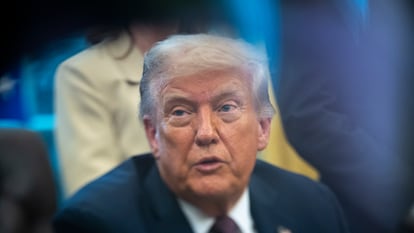

U.S. President Donald Trump told reporters in Washington on Tuesday that the United States had attacked a third vessel. “We knocked off, actually, three boats, not two, but you [the press] saw two,” he said, without providing further details on the circumstances of this third military operation against ships that, according to the White House, are involved in drug trafficking between Venezuela and the United States.
On Monday, Trump announced an attack on an alleged drug boat originating from Venezuela, which left three dead — “three male terrorists,” he wrote on his social media platform, Truth Social. Tuesday also marked two weeks since the U.S. military sank another vessel, this time with 11 crew members, who were all killed in the attack.
The announcement came shortly before Trump and First Lady Melania boarded the presidential helicopter, Marine One, at the start of his state visit to the United Kingdom — the second such visit he has made as president.
Before flying out, Trump sent a message to Venezuelan President Nicolás Maduro from the White House lawn. “Stop sending drugs into the United States,” he warned. “Stop sending people from your prisons into our country,” he added, before boasting about the fall in undocumented crossings since his return to office. During this period, apprehensions of undocumented migrants along the U.S.-Mexico border have fallen sharply.
Trump also repeated a point he made the day before. He said that U.S. military operations in the Caribbean — whose international legality is questionable — are being carried out as part of the drug war. U.S. authorities consider these actions a legitimate act of defense, and Trump claimed that they are causing ships to disappear from those waters. “There are not a lot of boats out in the water. I can’t imagine why. Not even fishing boats,” he said.
The Trump administration considers drug cartels, especially those linked to Venezuela, a threat to “national security, foreign policy, and vital U.S. interests,” he wrote on Truth Social on Monday. In February, Washington designated the Venezuelan criminal organization Tren de Aragua as a foreign terrorist organization.
Because Trump views drug trafficking as an “imminent threat” to the United States, he believes he has the right to order military strikes against such threats without seeking congressional approval.
The first of these attacks remains shrouded in mystery and has sparked debate in Washington over its legality. A bipartisan group of senators has demanded official explanations in a letter to Trump, while human rights advocates claim that “the administration is normalizing extrajudicial killings.” Trump stated that the military, which carried out the operation, has ample evidence that the vessel was involved in drug trafficking, though it has not yet been made public. The Venezuelan government denies that the 11 crew members were traffickers.
Regarding the second operation in “international” waters of the Caribbean, Trump said Monday: “We have proof. All you have to do is look at the cargo that was spattered all over the ocean — big bags of cocaine and fentanyl all over the place.”
In a casual encounter with reporters on Sunday, while returning from a weekend playing golf in New Jersey, Trump had spoken of two attacks when only one was publicly known, but again provided no details. Venezuelan authorities have yet to respond to the U.S. president’s announcement on Tuesday.
In addition to Venezuela, Trump spoke at the foot of Marine One about a range of hot topics, as he often does.
He confirmed that Washington has reached an agreement with China over TikTok that will be signed on Friday, after a conversation with President Xi Jinping; said he had “heard” that Hamas plans to use hostages still in its custody as “human shields” in Gaza; warned Ukrainian President Volodymyr Zelenskiy that he “is going to have to make a deal” to end Russia’s invasion of Ukraine; threatened to deploy troops in Chicago to combat crime (after Los Angeles, Washington, and now Memphis); and told an Australian journalist to be quiet when asked about apparent conflicts of interest between his private business dealings and his role as president of the United States.
State visit to the UK
Trump’s state visit to the U.K. was set to be the most significant event of the new British political season, but recent developments have complicated diplomacy. Trump will arrive in the U.K. amid the fallout from the dismissal of Britain’s ambassador to the U.S. Peter Mandelson over his friendship with billionaire pedophile Jeffrey Epstein, as well as the murder of far-right U.S. activist Charlie Kirk. Both events have disrupted Downing Street’s plans and foreshadow a week of heightened political tension and unprecedented security measures.
The Trumps are scheduled to stay at Windsor Castle, arriving Tuesday night as guests of King Charles III. U.K. authorities have been preparing a major security operation for weeks, including up to 55 drones constantly patrolling Windsor, armed response vehicles, and specialized riot-control equipment for officers maintaining 24-hour surveillance from Tuesday through Thursday, when the Trumps’ visit is set to conclude.
Trump traveled to Scotland in late July, but that was a private trip to inspect two golf courses he owns in the U.K. As usual, he blended personal and political matters, meeting with British Prime Minister Keir Starmer and using the opportunity to announce a tariff agreement with the European Union, which he staged with a visit by European Commission President Ursula von der Leyen to his golf course in Turnberry.
Sign up for our weekly newsletter to get more English-language news coverage from EL PAÍS USA Edition









































