
Does the United States have enough munition for a prolonged war?
Despite Trump’s assurances, Washington could face a missile shortage if the conflict with Iran drags on. Ukraine has offered to help with its interceptor technology

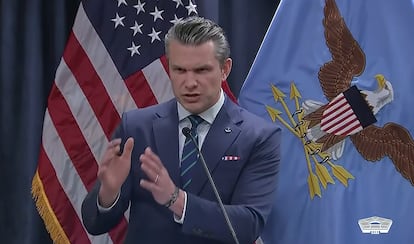
U.S. Defense Secretary Pete Hegseth boasted this week about the military advantage that the U.S. and Israel hold in their coordinated offensive against Iran. According to Hegseth, the enemy is having to conserve the munitions it fires. On the first day of the conflict, their launches dropped by 86%. “America is winning decisively,” he said.
But Washington, despite the Trump administration’s categorical denials, faces a similar problem: a shortage of munition after the intense barrages of the first days of Operation Epic Fury.
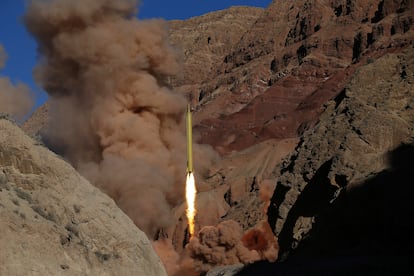
Iran has launched thousands of Shahed 136 drones (“Martyr” in Persian and Arabic) and hundreds of cruise missiles against U.S. targets in the Persian Gulf. To neutralize them, the United States and its allies require interceptors. They have been using munitions from their Patriot and THAAD air defense systems, with each missile costing millions of dollars— far more than the mere tens of thousands required to produce a single Iranian “suicide” drone.
Meanwhile, according to data from U.S. Central Command, which oversees U.S. forces in the Middle East, the United States has struck over 2,000 Iranian targets with tens of thousands of rockets since the launch of Operation Epic Fury last Saturday.
The Pentagon claims that it has ample supplies and that there is no need to worry about shortages. “We’ve got no shortage of munitions,” said Hegseth during a visit to the headquarters of Central Command in Tampa, Florida. “Our stockpiles of defensive and offensive weapons allow us to sustain this campaign as long as we need,” he added, arguing that the fight has only just begun. “Iran is hoping that we cannot sustain this, which is a really bad miscalculation.”
A day earlier, the top U.S. military officer, Chairman of the Joint Chiefs of Staff General Dan Caine, had also reassured the public about munition levels. “We have sufficient precision munitions for the task at hand, both on the offense and defense,” he promised. The general also noted that, having established air superiority over Iranian skies using those precision missiles, U.S. pilots can now fly at lower altitudes and employ conventional bombs — of which they have a much larger arsenal — rather than relying solely on the more advanced projectiles.
In a closed-door session with U.S. lawmakers earlier this week, Hegseth and Caine indicated that Iranian Shahed drones present a “major challenge” and “a bigger problem than anticipated,” since air defenses cannot intercept them all, according to reports leaked to U.S. media.
The most advanced munitions have begun to be rationed more carefully: experts warn of the need to maintain a reserve in case complications arise in other scenarios, such as a potential Chinese attack on Taiwan. Or in the event that this war, as U.S. President Donald Trump and Hegseth have suggested, drags on — the Pentagon chief has already said it could go on for “eight weeks.”
Trump himself stepped in to assure the public that there is a sufficient stockpile of munitions. In a post on his social media platform Truth Social on Monday, the president wrote: “The United States munitions stockpiles have, at the medium and upper medium grade, never been higher or better.” The president did, however, acknowledge a shortfall in the highest-grade munitions. “We have a good supply, but are not where we want to be. Much additional high grade weaponry is stored for us in outlying countries.”
The administration closely guards its munition figures — and how long it expects to sustain its intense pace of long-range guided missile launches. According to CNN, some regional allies are already beginning to see their interceptor stocks decline. “Each intercept represents hundreds of hours of training, readiness, and technology all coming together to work as designed,” Caine noted at the press briefing on Monday.

According to retired U.S. Fifth Fleet commander General Kevin Donegan, it is not an immediate problem. “Of course, you have to replenish what you fire, but that is already accounted for in Central Command’s plans. The forces deployed there have ample munitions and reserves; the preparations behind the scenes before launching the operation took care of that,” he recalled on Thursday during a roundtable organized by the Middle East Institute in Washington.
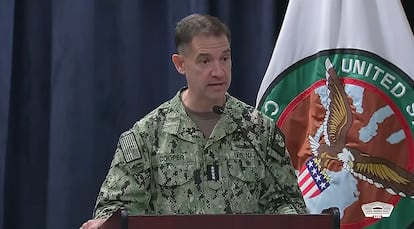
The former military leader stresses that in a conflict, the key is not to “intercept every single projectile thrown at you,” but to have the capacity to withstand the barrage until you can “go not only after what is being fired at you, but also after the means used to fire at you and the people firing them.” That, he says, is the strategy being followed by Admiral Brad Cooper, head of Central Command.
According to Donegan, the key issue with munitions, however, is how quickly U.S. arsenals can be restocked for a potential future conflict once this campaign ends. “It takes time, but you don’t want to have to wait,” he said.
On the eve of the attack on Iran launched last Saturday, Caine had expressed concern about the ability to restock munition supplies if Trump chose to green-light an intervention against the Islamic Republic that could be prolonged, according to U.S. media reports at the time.
Part of the problem stems from Iran’s production capacity: “They manufacture far more ballistic missiles and far more drones than we can build interceptors,” noted Tom Karako, director of the missile defense program at the CSIS think tank, during a presentation on Thursday.
Another part of the issue comes from the fact that the U.S. had already used a portion of its production over the past years in military operations against the Houthis in Yemen, in last year’s Operation Midnight Hammer against Iran, and in other interventions. Trump has blamed his predecessor, Joe Biden, for sending some of that inventory to Ukraine to help defend against the Russian invasion. The United States also supplied part of its arsenal to Israel during that country’s offensive in Gaza.
The capacity to manufacture munitions has been a longstanding problem, and it became especially clear after the outbreak of the war in Ukraine. Since then, Washington has sought to strengthen its military industrial base and has urged defense companies to accelerate production. On Friday, the White House is hosting a meeting with leaders from some of the most prominent firms.
Strategic agreements with these companies aim to increase production of THAAD interceptors from fewer than 100 per year to 400, and Patriot missile systems from 600 per year in 2025 to over 2,000 in seven years, among other targets. But, as Karako explained, “strategic agreements are not the same as contracts.”
We received a request from the United States for specific support in protection against "shaheds" in the Middle East region. I gave instructions to provide the necessary means and ensure the presence of Ukrainian specialists who can guarantee the required security. Ukraine helps…
— Volodymyr Zelenskyy / Володимир Зеленський (@ZelenskyyUa) March 5, 2026
Facing shortages, the United States has turned, of all places, to the Ukrainian government that Trump has frequently criticized. In a series of social media posts on Thursday, Ukrainian President Volodymyr Zelenskiy revealed that he had “received a request from the United States for specific support in defending against ‘shaheds’ in the Middle East.”
The post continued: “I gave instructions to provide the necessary means and ensure the presence of Ukrainian specialists who can guarantee the required security. Ukraine helps partners who help ensure our security and protect the lives of our people. Glory to Ukraine!”
Sign up for our weekly newsletter to get more English-language news coverage from EL PAÍS USA Edition









































