
The Shahed 136 drone, Iran’s advantage in warfare
The mass production of these unmanned attack aircraft, which cost far less than the missiles that intercept them, gives the Islamic Republic’s army a difficult weapon to counter
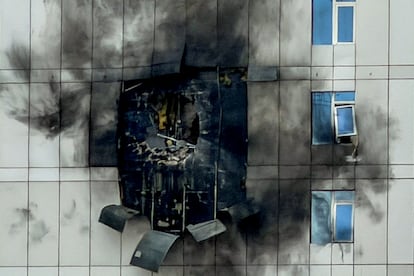

When a moped icon and exclamation marks appear in a Ukrainian Telegram channel, the message is clear: a drone is approaching. These unmanned aerial vehicles, used by the Russian military as projectiles, glide with a whirring sound similar to that of a motorcycle or lawnmower. Their speed before impact, averaging around 185 kilometers per hour in flight — lower than that of a missile — has made it easy for Ukrainian society to detect this type of weapon, capable of destroying four floors of a residential building in a single hit. Ukrainians generally refer to these suicide drones as “shahed,” a reference to the Iranian-made model used by Moscow and now replicated in Russian factories.
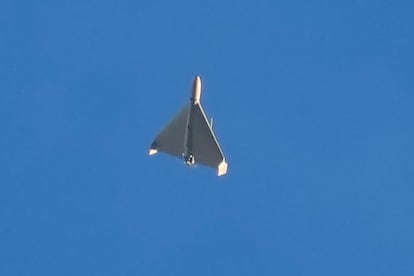
The most well-known of these kamikaze drones is the Shahed 136, the same one that Iran’s armed forces have been using since last Saturday against Gulf countries allied with the United States. This weapon offers the Islamic Republic a competitive advantage in warfare for two reasons: its low production cost and the difficulty of shooting it down.
In the first three days of the escalating conflict in the Middle East, which began on Saturday with the coordinated Israeli-American attack on Iran, Tehran launched over 1,000 drones against the territory of the Jewish State, its primary enemy, and Arab countries in the region that host U.S. military assets. The United Arab Emirates has been the hardest hit, with more than 600 Iranian drones flying toward it, followed by Kuwait (nearly 300) and Israel (with about 50). The drones have also reached Qatar (a dozen), as well as Bahrain and Jordan.
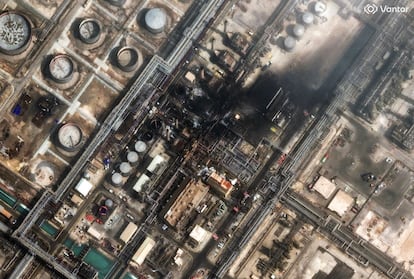
Most of these projectiles have been intercepted by the defenses of those countries, but some have managed to reach urban centers, as in the case of Manama, the capital of Bahrain, and the emirate of Dubai. On Tuesday, Saudi Arabian authorities reported that two of these attack vehicles struck the U.S. Embassy in Riyadh, the capital.
Costing around $35,000 per unit, the Shahed 136, the crown jewel of the Iranian state-owned Shahed Aviation Industries Research Center, linked to the Revolutionary Guard, has become a crucial weapon of war. Its price, very low compared to the cost of one of the missiles used to intercept it (which range from between $1.1 million and $2.3 million), facilitates large-scale production.
The exact number of drones currently in Iran’s arsenals is unknown, but it certainly numbers in the thousands. Last January, an Iranian military commander reported the arrival of a shipment of 1,000 of these unmanned aerial vehicles (UAVs) for immediate use. Russia, in its exclusive economic zone in Tatarstan, manufactures more than 18,000 Geran drones annually, with Tehran’s assistance. The Russian model has copied the internal components and fuselage of the Iranian drone.
Since the start of the large-scale invasion of Ukraine in February 2022, Moscow has launched more than 60,000 of these missiles against Ukrainian territory, an estimate based on monitoring by two analysis centers: the Institute for the Study of War (ISW) and the Center for Strategic and International Studies (CSIS). Again, most are hit by Ukrainian air defense systems, but not all: sometimes due to a lack of resources or errors in targeting, and occasionally because their trajectory poses no risk and it is better to conserve ammunition.
The saturation of military defense shields, however, creates gaps for these projectiles, which are lethal when they impact residential areas due to the mixture of explosives and fuel they carry. Standing over three meters tall, with an explosive payload of around 50 kilograms and a range of approximately 2,000 kilometers (1,240 miles) — the latest Russian variants exceed all these figures — the Shahed drones pose a significant challenge for interception: they fly low, slowly, and on an irregular trajectory that sometimes appears erratic, as shown in videos recently recorded in Dubai and Manama.
Until now, defensive batteries were designed to intercept high-speed missiles with less irregular trajectories. “These drones are inexpensive,” said Yasir Atalan of CSIS in a recent exchange of messages. “Defending against them with high-end assets, such as fighter jets or advanced surface-to-air missiles, is economically unsustainable in the long run. The cost-benefit ratio favors the attacker if the defender relies solely on premium systems.”
In this context, Tehran has the advantage, as demonstrated on Monday by the Iranian drone attack on a UK military base in Cyprus. France will send defense systems against these types of drones and missiles to defend the island, Reuters reported on Tuesday.
Kelly A. Grieco, an analyst at the Stimson Center, has quantified the efficiency of these Shahed drones in wartime. In a recent thread on the X network, where she dissects the production costs of the attack aircraft and their interceptors, she reaches this conclusion: for every euro Iran spent on drones, the UAE, the country most affected, spent between €20 and €28.
“The main lesson [from Ukraine] is the need for layered, low-cost air defense solutions that can absorb massive drone attacks without depleting reserves or budgets,” Atalan points out. “Efficient counter-drone systems, electronic warfare, more affordable interceptors, and resilient infrastructure must become essential elements of territorial defense planning.”
Translated to the battlefield: a shield is required that combines more or less sophisticated radars, anti-missile batteries, trained fighter jets, but also dynamic systems to disconnect these aircraft from the network and, finally, mobile artillery units. This is what the Ukrainian army has developed, and even so, it cannot counter all the drones that Moscow launches daily against its territory.
Sign up for our weekly newsletter to get more English-language news coverage from EL PAÍS USA Edition









































