
Trump administration makes contradictory statements about its war plans in Iran
The US president initially spoke of seeking regime change, then of preventing Tehran from acquiring nuclear weapons. He has repeatedly changed the timeline for the offensive, and said ‘the big wave’ of attacks is coming soon
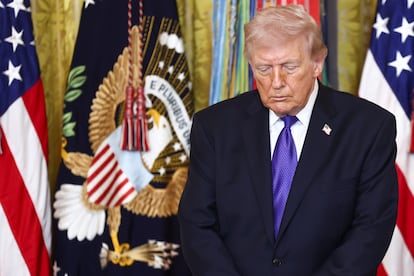

As the days go by, the goal and expected duration of the offensive against Iran is increasingly unclear. The conflict is expanding across the Middle East, and despite Washington’s enthusiastic pronouncements, seems to be growing ever more entangled. U.S. President Donald Trump, on the one hand, suggests that his objective is regime change, but on the other, he also asserts that the goal is to prevent Iran from acquiring nuclear weapons. And he is offering increasingly long timeframes. If on Monday he spoke of four or five weeks, now he is warning that this deadline could be extended and added that “we have the capability to go far longer than that.”
The Pentagon, for its part, says the war will require “time” and has announced the deployment of reinforcements. And before a closed-door briefing with lawmakers, Secretary of State Marco Rubio repeated his administration’s argument that the reason for the attack was “preventive.” But this time he added a new piece of information: that Israel was going to strike Iran first and that Tehran, in that case, would have bombed U.S. positions in retaliation.
That the operation is going to be longer than a euphoric Trump suggested on Saturday seems to be one of the conclusions the White House is reaching, despite the president insisting that the campaign is progressing faster than expected and that successes are accumulating by the hour. Trump even claimed Operation Epic Fury could be concluded in “two or three days.” On Sunday, he said the estimate had always been “four or five weeks.” At a veterans’ medal ceremony at the White House this Monday, the Republican once again extended the timeline.
“Right from the beginning, we projected four to five weeks, but we have the capability to go far longer than that,” Trump declared during the ceremony at the White House, in the presence of his Chairman of the Joint Chiefs of Staff, General Dan Caine, and his Secretary of Defense, Pete Hegseth.
Since the operation began on Saturday, Trump’s explanations have come through unorthodox channels. Unlike previous military interventions, he has not held a televised press conference. Instead, he has released two videos announcing the launch and continuation of the attacks, posted a few messages on social media, and made numerous comments to various media outlets in telephone interviews. The result has been a peculiar mix of conflicting accounts, in which the White House occupant has contradicted himself and the reports coming from the Pentagon.
This weekend, senior U.S. officials speaking on condition of anonymity justified the offensive as a “preemptive” strike because, they said, Iran was planning to bomb U.S. targets imminently. On Sunday, representatives of the Trump administration informed congressional staff in closed-door briefings that U.S. intelligence services did not believe Iran was preparing preemptive attacks against the U.S., according to the Associated Press, which cited three sources familiar with those briefings.
In a closed-door briefing at the Capitol to inform key lawmakers from both parties about the conflict, State Secretary Rubio offered a new variation on the reason for the preemptive strike: the U.S. believed that Israel was preparing to bomb the Islamic Republic and, in that case, Tehran would in turn strike U.S. forces in the Middle East. “We knew that there was going to be an Israeli action. We knew that that would precipitate an attack against American forces, and we knew that if we didn’t preemptively go after them before they launched those attacks, we would suffer higher casualties,” he said.
Over the weekend, the U.S. president and his inner circle offered divergent objectives. In his opening remarks, Trump urged the Iranians to rise up and seize control of their government. A day later, the White House issued a statement asserting that the goal of the attacks was in fact to dismantle Iran’s nuclear and ballistic missile programs. Senator Lindsey Graham, a staunch Trump supporter who frequently acts as his informal spokesperson, expressed similar sentiments in various appearances on U.S. television programs.
The president himself also hinted at his willingness to keep the new leaders of the ayatollahs’ regime in power, following the death of Iran’s Supreme Leader, Ali Khamenei, in bombings on Saturday. This would be a solution very similar to the formula used in Venezuela, where after the capture of former president Nicolás Maduro, the old Chavista leaders remain in power. According to a telephone interview with The Atlantic, the Republican leader is prepared to engage in talks with these new leaders.
Later, Trump pointed out that the same missiles that killed Khamenei also eliminated 48 high-ranking regime officials, including some names he had considered to take over the country. Hours later, in a second video, he again urged Iranians to “take back their country” and wrest control from the regime, and called on the armed forces to lay down their weapons under the promise of immunity. The United States will be there to help, he promised. This Monday, however, he made no mention of those appeals.
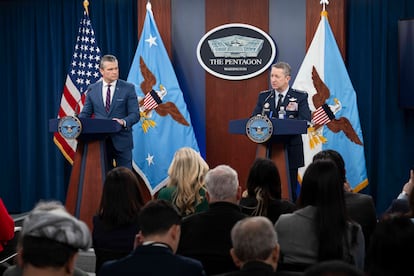
And in another news conference on Monday, the first by the U.S. government since the bombing began, the Pentagon reiterated that the objectives do not include the end of the theocratic system. “This is not a so-called regime change war, but the regime sure did change and the world is better off for it,” Hegseth maintained.
“They have a goal, but it’s not regime change. It’s regime implosion,” says Trita Parsi, vice president of the Quincy Institute for Responsible Statecraft. “The hope is to degrade Iranian capabilities, or the repressive capabilities of the state, as much as possible, in the hope that miraculously the Iranian people will rise up and seize power. And that whatever remains of support for the Iranian system will somehow dissolve.”
For now, the Pentagon is preparing for a prolonged conflict. At the news conference, the administration warned a public with very little tolerance for combat casualties that there will be more deaths and injuries among its soldiers. On Monday, the Department of Defense announced the death of one of the service members wounded on Sunday by an Iranian missile at a U.S. military base in Kuwait, bringing the number of American deaths to six. Another 18 soldiers are seriously wounded, triple the number that Central Command provided on Sunday.
It is unclear whether Washington plans to deploy troops on Iranian soil as part of the operation, something experts consider essential if the objective is to seize control of the country or impose regime change. The Pentagon has stated that it currently has no soldiers on the ground, but has declined to clarify whether it plans to do so in the future. Trump, for his part, has not ruled it out. And in statements to CNN, he warned that the conflict could still escalate: according to him, “we haven’t even started hitting them hard. The big wave hasn’t even happened. The big one is coming soon.”
Sign up for our weekly newsletter to get more English-language news coverage from EL PAÍS USA Edition









































