
The Iranian community in the US, caught between euphoria and criticism: ‘A political solution is needed’
More than 400,000 people of Iranian descent live in the country. Some celebrate Washington’s attacks, while others warn that regime change will be very difficult
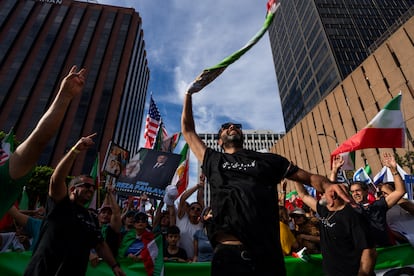
The attack on Iran launched by the United States and Israel last weekend has elicited a mixed reaction from the Iranian diaspora in the United States. Some people have been euphoric since the early hours of Saturday, when the strikes began, while others have a more critical view of a conflict that the Trump administration has unilaterally unleashed without consulting Congress or taking the international community into account.
“It’s a dream come true,” says Mike Oveysi, speaking from his restaurant, Amoo’s. Located in McLean, Virginia, this small, family-run establishment serving traditional Iranian food is a favorite among the Iranian community in the Washington, D.C., metropolitan area. “This isn’t an attack against Iran. This attack is for Iran,” he asserts. “It’s to help the 90 million people who are being held hostage by a group with a brutal ideology. They use our wealth, our money, our country just to enrich themselves and mass-murder anyone who doesn’t subscribe to their narrative.”
Mike Oveysi’s family arrived in the United States in 1994, fleeing the ayatollahs’ regime. Mike’s father was a pilot for Shah Mohammad Reza Pahlavi, the last monarch of Iran, dethroned by the Islamist revolution in 1979. He spent seven years in prison before escaping to Turkey. From there, he traveled to the United States in 1994, where he sought refuge with his wife and children. Mike Oveysi was 16 years old at the time. As an adult, he has become one of the most vocal critics of the ayatollahs’ regime. He organizes and participates in numerous protests, which he promotes through his Instagram page, where he has approximately 250,000 followers.
Like him, more than 400,000 people of Iranian descent live in the United States, according to 2020 census data. More than half of them live in California, primarily in the city of Los Angeles, in an enclave known as Tehrangeles. They are also scattered throughout the Washington, D.C. metropolitan area, which includes Maryland and Virginia, and in New York.
Oveysi still has family in Iran, including a sister, uncles, and cousins, but he is confident that civilian deaths from the conflict will not be high because “they say the attacks are very precise.” Through his social media and a podcast, he stays in touch with Iranians who remain in the country and asserts that 90% of the population supports change. In his opinion, it will happen: “There will definitely be a revolution.”
Since the weekend, protests have taken place across the country, both celebrating and condemning the U.S. and Israeli attacks on Iran. In DC, a group of demonstrators gathered in the area of Georgetown on Saturday to celebrate the death of Iran’s Supreme Leader, Ali Khamenei, and to pay tribute to the thousands of Iranians killed by the ayatollahs’ regime during protests last month. A day later, in New York, a crowd marched from the United Nations headquarters in Manhattan to Times Square, carrying red, green, and white flags, some bearing the Arabic word “Allah.”
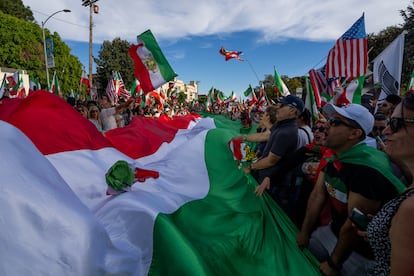
Reza Ebrahimi participated in that protest. The young man, who belongs to the Lion Sun NY group, a movement “for a free Iran” led by Prince Reza Pahlavi, says that, like him, other Iranians in the United States have begun to have hope of regaining their homeland. “It’s been 47 years, we were fighting for this regime change, we lost many lives, [people] have paid a high price for this, but we are finally getting it,” he says. “The feeling is one of emotion; Iranians inside and outside Iran are happy, we are finally getting our freedom. People are so happy, you have no idea, we can’t sleep at night. We are worried about our families, but we finally did it.”
Bombs are not the solution
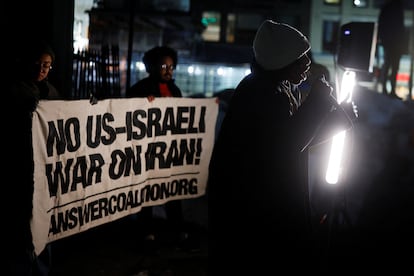
Others, however, are more critical of the Trump administration’s actions. This Monday, dozens of people gathered at Columbus Circle in Manhattan, holding signs that not only called for a halt to “a new war in the Middle East,” but also demanded that the Iranians “decide their own future,” not the United States or Israel.
Yehuda Litan arrived at the site after being called upon by the National Iranian American Council and other organizations to protest a conflict that, they say, “has the potential to rapidly escalate into a devastating regional war that will bring unimaginable death and destruction.” “Civilized people are fed up with war,” he asserts. “There is no reason to kill thousands of people for no reason. Americans are fed up with war. So we came here to show our solidarity with all the people of the region who have been subjected to the relentless Zionist American and Israeli attacks. The United States should mind its own business.”
For Majid Sadeghpour, political director of the Organization of Iranian American Communities (OIAC), which unites the Iranian diaspora that advocates for a democratic and secular republic in Iran, “bombing Iran is not the solution.” “A political solution is needed,” he points out.
Sadeghpour left his country when he was 17 and spent a year in Turkey before seeking refuge in the United States in 1984. He experienced the brutality of the Ayatollahs’ government firsthand when his brother was executed in 1988. The OIAC brings together many Iranians who have had similar “or worse” experiences, he says, but they do not support international intervention like the one being carried out by the U.S. and Israel. “If you come from a culture that is at least 3,000 years old, you should be outraged when your country is bombed from abroad, regardless of who is in charge,” he asserts. “I want the fight against these bastards to be waged by Iranians,” he explains.
Sadeghpour defends the legitimacy of Iran’s National Council of Resistance (NCRI), which has opposed the Islamist regime for years, to lead a transitional period. His feelings about the current situation are mixed, because he admits he is pleased to see Iran’s Revolutionary Guard “feeling the pain they have inflicted on the people all these years,” but insists that a political solution is necessary.
“Regime change is very difficult to achieve from the air. After all, this is Iran. This isn’t Gaza. This isn’t Venezuela,” Sadeghopour emphasizes. “This country is twice the size of Texas. It has an impenetrable geography, and those sitting there right now are wounded animals cornered by their opponents, with only their teeth left, ready to bite until they’re destroyed. This has to be fought on the ground.”
Sign up for our weekly newsletter to get more English-language news coverage from EL PAÍS USA Edition









































