
Trump and Maduro, on the warpath
The Venezuelan government has announced a massive recruitment drive, while Washington has stepped up its warnings after a week of heightened tensions
Doña Rosita fled Colombia more than 50 years ago due to poverty and violence. She arrived in 1970s Caracas, a cosmopolitan city with far more luxuries than in her hometown. It was like landing on another planet. In the Venezuelan capital, luxury cars cruised the highways, and the upper-middle class spent weekends in Miami. At that time, petrodollars, brought in by the country’s massive crude oil exports, were pouring in.
In 1992, rumors began to circulate that a coup was being planned against president Carlos Andrés Pérez. She went to the supermarket to stock up on rice, lentils, and canned food. Her neighbors told her she was overreacting and that nothing would happen. But it did. Commander Hugo Chávez attempted to overthrow Pérez, though he did not succeed. Still, it was a time of fear and anxiety. Not for her — she could have survived for months without leaving the house.
Now Venezuela is facing a similar situation. She turns on the television and sees President Nicolás Maduro dressed in military uniform. She sees missiles, ships, men with rifles. She goes outside, heart pounding, and people tell her there’s nothing to worry about. “What war, Doña Rosita? All show,” they joke. She doesn’t trust them, so she has stocked up on supplies again. The end of the world won’t take Doña Rosita by surprise.
Over the past week, the United States and Venezuela have traded increasingly hostile actions. U.S. President Donald Trump has deployed ships, guided-missile destroyers, and even a nuclear submarine in international waters near Venezuelan territory. He says it’s to fight drug trafficking, but Maduro — whom Washington labels the leader of a “narco-terrorist” cartel — believes it is a precursor to an invasion of his country. Such a military intervention would, if it occurred, be the first large-scale U.S. operation in a Latin American country since the invasion of Panama in 1989.
The Chávez government has mobilized millions of militia members and new recruits to join the hundreds of thousands of soldiers it already commands, according to its leaders. These figures are impossible to verify, and analysts consider them unrealistic.
The U.S. fleet deployed south of the Caribbean has already opened fire. Earlier last week, it targeted a boat that had left Venezuelan waters and was allegedly carrying drugs. A Venezuelan minister claimed that the video showing the missile striking the vessel, which carried 11 people — none of whom survived — had been created with artificial intelligence, and that the attack was therefore fake. However, behind closed doors, Caracas has treated it as an act of hostility and has not remained idle.
On Thursday, the Pentagon reported that two Venezuelan Air Force F-16 fighter jets flew over one of its ships, the USS Jason Dunham. Trump has authorized his military commanders to shoot them down next time if deemed necessary.
At the Miraflores Palace, the seat of the Venezuelan government and occasional presidential residence, confusion reigns, according to one of the Chavista leaders closest to Maduro. “They want to destroy this country with missiles,” he complains.
The Maduro government has been resisting for more than a decade. It has not stepped aside, despite the fact that Venezuela’s GDP has suffered a severe decline during this period — a drop of 80%, comparable to nations at war. Nor did it give up power this year, when it became clear to the international community that Maduro lost the 2024 presidential elections to the opposition. Despite this, he still declared himself president. Maduro and his inner circle are unwilling to step down or carry out a democratic transition, even when urged by theoretical allies such as Colombian President Gustavo Petro or Brazilian President Luiz Inácio Lula da Silva.
At Miraflores, they have navigated U.S. and European economic sanctions as best they could. “We are capable of withstanding anything. This is a free and dignified people” is Maduro’s message. The Trump administration’s State Department has offered a $50 million reward for information leading to Maduro’s arrest, $15 million for Defense Minister Vladimir Padrino López — a four-star general who says he is willing to die for the cause — and $25 million for Diosdado Cabello, the regime’s number two, the most radical of them all, and the other name Chávez considered as his successor before choosing Maduro in 2013. Politically, the power brokers are siblings Delcy and Jorge Rodríguez. She is a lawyer who studied labor law in Paris; he is a psychiatrist and former mayor of Caracas. Both are sanctioned by the U.S. Treasury Department.
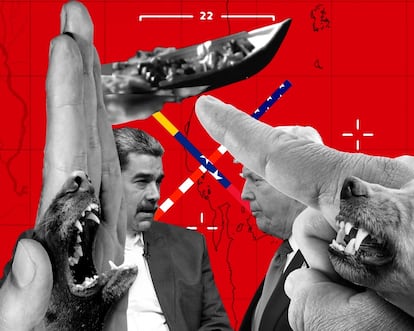
Calls for calm continue. Carolina Jiménez Sandoval, president of the Washington Office on Latin America (WOLA), a human rights organization, wonders what would happen if the United States overthrew the Maduro regime. “I’m convinced there’s no large-scale plan to achieve that. Partly because if you broke it, you own it,” she explains by phone. The question remains whether these are nations ready for armed confrontation — or just two dogs barking at each other over a fence.
“We would all like to see a peaceful transition to democracy,” she adds. “Venezuelans have already voted against Maduro; there is a democratic fabric in the country. This military threat can also be interpreted as a form of pressure, to induce defections, and an internal breakdown.” Sandoval believes the situation is driven largely by an infodemic, an overload of information that spreads confusion, and also by psychological pressure — a tactic Chavismo has used successfully in the past, but which is now working against them.
And what if U.S. ships are suddenly no longer stationed near Venezuela? “It will stop generating media exposure, but it will have a political cost for Washington. People will wonder what all this was for,” the expert says.
Venezuelan analyst Andrei Servin adds: “I don’t think Washington is seeking a democratic transition. They don’t reject Maduro because of his status as a dictator or tyrant, but rather because of his ties to illicit activities. They want to create instability within the regime.”
U.S. Secretary of State Marco Rubio has been the most insistent that the Venezuelan president is, in fact, a criminal leading a cartel — the Cartel of the Suns, a criminal organization allegedly involved in drug trafficking and led by members of the Bolivarian Armed Forces (so far, there is no conclusive evidence that Maduro is personally involved).
In recent years, Venezuela has experienced peaks of extreme tension, with a constant sense that something imminent was about to happen — just like now. But these peaks have always been followed by periods of calm, after which everything returned to normal: that is, to Chavismo’s supremacy.
On January 10 of this year, Maduro declared himself president. That day, María Corina Machado, the undisputed leader of the opposition, insisted that it would be Edmundo González — her chosen presidential candidate, who had achieved a strong result — who would don the presidential sash in Caracas. González was living in exile, so many wondered how he would do it: would he cross the border by car? Arrive on a plane escorted by U.S. fighter jets? Would the CIA manage to infiltrate him so he could interrupt Maduro’s swearing-in? Chavismo, just in case, deployed troops and missile defense systems across the country. However, when the clock struck 11:00, Maduro swore in before the Constitution without any issues. Many Venezuelans are now convinced that these tensions are just political theater.
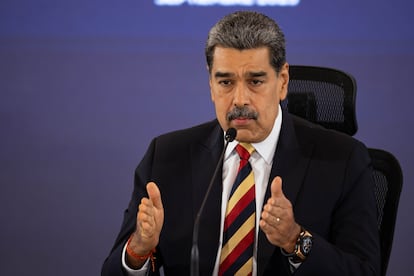
Chavista leaders know their task is to endure, resist, and entrench themselves in power. They are sometimes caricatured as banana-republic-style politicians in tracksuits — party-goers, unpunctual, and lacking reflection. Yet, in the midst of crises, they display restraint and remarkable strategic thinking. They can call someone a murderer and an imperialist monster one day, and sit down with them for coffee the next. For instance, Maduro said on Friday that he respects Trump and is willing to negotiate — the Chavistas accuse Rubio of poisoning Trump’s mind with ideas to push him toward starting a war. “I hope he reconsiders,” Maduro said.
An example is what happened in 2023, when, amid a period of maximum instability, Jorge Rodríguez met in Qatar with a member of the Joe Biden administration, in a meeting revealed by EL PAÍS. Between the United States and Venezuela, no scenario is definitive; everything is subject to negotiation. Doña Rosita, just in case, is keeping her pantry stocked. The future remains unpredictable.
Sign up for our weekly newsletter to get more English-language news coverage from EL PAÍS USA Edition









































