
Threat of military intervention against drug trafficking escalates tensions between the US and Venezuela
Maduro is increasing the pressure on critical voices within Chavismo, while the White House assures that it will use ‘every element’ of power to curb the narco trade
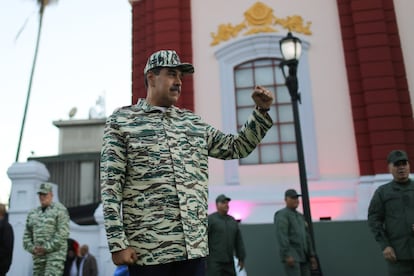
Just weeks after the renewal of the U.S. oil company Chevron’s license to operate in Venezuela and the agreement to exchange political prisoners, tensions between Washington and Caracas have escalated dramatically. The tensions now have a military component that has few bilateral precedents.
After promoting a détente between the two countries, the Donald Trump administration reversed course. On August 7, the White House raised the reward for information leading to the capture of Venezuelan President Nicolás Maduro to $50 million. It accuses of the Chavista leader of leading the Cartel of the Suns. This week, the U.S. began deploying three destroyers, 4,000 marines, combat aircraft, and submarines along Venezuela’s maritime borders as part of an operation against drug trafficking.
White House spokeswoman Karoline Leavitt said that the United States is determined to use “every element of American power” to curb drug trafficking from Venezuela. “The Maduro regime is not the legitimate government of Venezuela, it is a narco-terror cartel, and Maduro, it is the view of this administration, is not a legitimate president. He is a fugitive head of this cartel who has been indicted in the United States,” Leavitt said.
The Venezuelan government — long accustomed to exchanging barbs and volleys with the White House — seems to have calibrated its reactions more carefully this time. The Chavista leadership has taken this latest escalation very seriously, as the harsh tone and gravity of the accusations are evident.
Venezuelan Foreign Minister Yvan Gil said in a statement that the U.S. threats “not only affect Venezuela, but also endanger the stability of the entire region, including the zone of peace declared by CELAC [Community of Latin American and Caribbean States].” For the Chavista government, the U.S. accusations “are a sign of its lack of credibility.”
“We are witnessing the development of a narrative to justify an attack,” said Defense Minister Vladimir Padrino López, who has been seen alongside Maduro in all of his public speeches these days. “We have seen it before, many times. In the absence of arguments, lies are invented and repeated to transform them into truths, even if they are not.” Padrino and other official spokespersons have called the accusations against Maduro “ridiculous” and “absurd.”
Two days ago, Maduro announced the nationwide mobilization of four million members of the National Militia, the fifth component of the Bolivarian National Armed Forces, founded by Hugo Chávez in 2007 and greatly strengthened institutionally since then.
The Militia is a mixed branch of the military sector, made up of reservists, soldiers, paramilitaries, and civilians, trained under the principle of loyalty to Hugo Chávez and the Bolivarian Revolution, and inspired by the foundations of asymmetric warfare.
“The first to come forward and express their support for this working-class president were the nation’s military,” said Maduro, satisfied and surrounded by soldiers and police. “They came forward with their rifles, their missiles, their tanks, their planes. The Bolivarian National Armed Forces, at the forefront,” he proclaimed amid applause.
Meanwhile, Maduro has been tightening the pressure on critical voices within Chavismo. The president questioned what appeared to be internal dissent among his followers: “There are people who are weak, and when faced with a circumstance, they react immediately. It’s easy to attack Maduro and the revolution, how easy. There are many cowards hiding, who are incapable of telling me things to my face out of cowardice. Well, I wasn’t born on the day of cowards. If we’re here, it’s because we’ve been loyal to the sacred oath we swore to Commander Chávez.”
From hiding, María Corina Machado, the main opposition leader, and her collaborators — all in exile — appear to be assuming responsibility for shaping this U.S. siege against Chavismo.
The language they use describes what appears to be a developing situation. Many Venezuelans abroad seem once again excited about the possibility of political change. Machado has considered it a victory for the democratic cause that the United States has, in her view, managed to clearly identify the threat of Chavismo.
Machado, who has long asserted that the Maduro government’s structures are weaker than previously thought, expressed her “deep gratitude” to President Trump for raising the reward for Maduro’s capture. She also repeatedly stated that Chavismo is a threat to the entire region.
Although the police and military presence in the streets of the country has visibly increased, daily life for the population continues with complete normality, without any sense of imminence or expectations. Worn out from expecting.
While it’s clear that police and military presence has been redoubled on the country’s streets, among the population, however, life proceeds completely normally, without any sense of imminence, without any greater expectations. Tired of having expectations.
The moderate sectors of the opposition, still tolerated under the legality of Chavismo, are skeptical of Machado’s promises of change. They also flatly rule out the possibility of foreign intervention.
In the broad currents of local pessimism that flow through social networks, those who persist in predicting, every few days, the imminent return of democracy are often accused of being nothing more than “peddlers of empty promises.”
Sign up for our weekly newsletter to get more English-language news coverage from EL PAÍS USA Edition









































