
The US maintains its hostilities against Venezuela
Washington increases its pressure against Chavismo, which believes an invasion is imminent
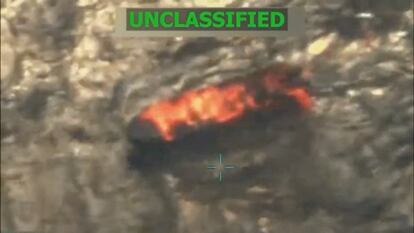

The United States is keeping up its hostilities against Venezuela. At the Miraflores Palace, Nicolás Maduro’s residence and the seat of government, nerves are frayed. The U.S. fleet anchored in the Caribbean Sea destroyed a second vessel that sailed off the Venezuelan coast this Monday. This is a clear signal to Chavismo that, far from easing, the pressure is increasing with each passing day.
Uncertainty reigns among politicians, analysts, and experts in Venezuelan politics. Individuals accustomed to passing judgment have remained silent. No one knows what will happen. Donald Trump claims that the destroyers and amphibious assault ships, which satellite images place on the border with Venezuelan waters, are intended to end the drug trafficking headed to the U.S. Twelve days ago, they sank a boat with 11 people on board, and this Monday, they destroyed another vessel with three people inside. According to the White House, both ships were loaded with drugs, and that was the justification for destroying them with missiles. However, a very small amount of drugs leave Venezuela—5%, according to the United Nations—compared to other neighboring countries, such as Colombia or Ecuador.
The general feeling, and one that also conveyed by U.S. Secretary of State Marco Rubio, is that this deployment is a direct threat to Maduro and his circle, a step toward overthrowing the authoritarian regime ruling Caracas. Chavismo itself is convinced of this. Maduro said on Monday, a few hours before the latest attack became known, that these incidents were being caused by the United States “to justify” an invasion. Rubio asserts that Maduro is a narco-dictator, the leader of a criminal organization that emerged from the armed forces, known as the Cartel of the Suns. Maduro proclaimed himself president last year, despite clear evidence that he did not win the election.
In recent days, various reports have circulated claiming talks were underway between Jorge Rodríguez, Maduro’s political right-hand man, and U.S. officials. “It’s not true, there are no talks,” says a source familiar with these talks, which have been ongoing intermittently since 2019, without producing any political change in Venezuela. “This is the most difficult time we’ve ever experienced. Trump is unpredictable. I don’t think this will end in war, but no one dares to make any assurances anymore,” says the same source.
The situation is unprecedented in the Caribbean, according to the Washington Office on Latin America (WOLA), a leading U.S. organization promoting human rights, social justice, and democracy. “What we have seen so far suggests that the U.S. military has done something that, to our knowledge, it has never done in more than 35 years of military involvement in drug interdiction in the Caribbean Sea: an instant escalation to disproportionate lethal force against a civilian vessel without any apparent justification of self-defense,” WOLA said in a report.
The forceful actions against these vessels — it is unknown whether the crew members received a warning — raise legal questions. The Trump administration defends them by arguing that these cartels are terrorist groups that threaten the national security of their country, like ISIS or the Iranian Revolutionary Guard. However, a number of legal experts point out that this is a misinterpretation of the law. “This new military action could constitute an extrajudicial execution and must be investigated. Drug trafficking activities linked to Maduro’s illegitimate and authoritarian government in Venezuela do not justify the use of lethal force,” Carolina Jiménez Sandoval, president of WOLA for Latin America.
The world is watching events unfold in suspense. Rubio insists that Maduro must be deposed and tried in the United States, where two courts have opened investigations against him for drug trafficking. At first, the Secretary of State’s words seemed like an empty threat, just another of the harsh statements he has directed at the governments of Cuba and Venezuela—the leitmotif of his political career—over the years. Now everything is seen in a different light. Caracas has deployed troops throughout its territory and is recruiting militiamen whom it is teaching how to use a rifle. Its leaders say they are prepared to die if necessary in defense of their homeland. If they looked out to sea, they would see nothing, but on the horizon, they know that the largest army on the planet is hiding.
Sign up for our weekly newsletter to get more English-language news coverage from EL PAÍS USA Edition









































