
Venezuela launches offensive to show the US and the world it is fighting drug trafficking
The Venezuelan government says it has deployed troops to the border and insists that the flow of drugs through its territory is minimal
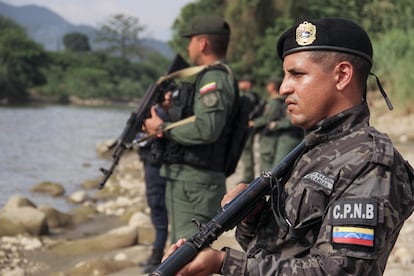
As tensions with the United States grow over the U.S. armed fleet deployed in the Caribbean Sea near Venezuelan territory, the Venezuelan regime is making a special effort to publicize in detail its anti-narcotics operations in the country’s border and coastal areas, carried out by the Armed Forces and security agencies.
Venezuela’s narrative about responsibility in the fight against drug trafficking — much more frequent now — is accompanied by a vigorous nationalist campaign aired on television and radio, calling on citizens to enlist for the defense of the country, with constant references to national dignity and the sacred nature of sovereignty.
Nicolás Maduro’s government insists on presenting itself as a legitimate administration, the result of a democratic decision it considers indisputable, and does everything possible to align the interpretation of its presence in power with the promotion of national values. Maduro has never shown the official records certifying his alleged victory at the polls in the national election of July 2024; meanwhile, the opposition published the paper vote tallies, validated by the Carter Center and the Organization of American States, that showed their candidate — Edmundo González — won overwhelmingly.
Maduro ordered the deployment of 25,000 soldiers to Venezuela’s borders. He stated that this was “to reinforce the operations of the Rapid Reaction Units in the binational area with Colombia and the Caribbean front, from the La Guajira peninsula to Falcón state, and to reinforce all operations on the eastern front in the states of Nueva Esparta, Sucre, and Delta Amacuro.” These maneuvers are, militarily speaking, highly significant.
According to the country’s military authorities, the operation’s objectives are “to verify the absence of illicit crops” and “block the area from potential drug trafficking.”
In addition to Maduro, Vice President Delcy Rodríguez; Minister of Interior and Justice Diosdado Cabello; and Defense Minister Vladimir Padrino have held press conferences outlining military operations, the enlistment of volunteers for national defense, river and drone patrols in Apure state, and the recent downing of 40 aircraft carrying narcotics over Venezuelan airspace.
Government spokespeople maintain that drugs are neither produced nor trafficked in Venezuela, and that the so-called Cartel of the Suns does not exist. Maduro’s government argues that 87% of South American drug trafficking passes through the Pacific (this figure is correct), and that all recent United Nations reports on the matter exclude Venezuela from the critical zones of drug production and distribution in the region, which is true.
Delcy Rodríguez has criticized “the hypocrisy and double standards” of Washington regarding global drug trafficking, stating that “85% of drug trafficking profits remain in the United States, according to United Nations reports, especially in its financial system.” “Several U.S. banks have been fined for receiving drug money to launder it,” she added.
Like other spokespeople for the Maduro government, Rodríguez claimed that the U.S. Drug Enforcement Agency (DEA) “has known connections with the drug trafficking world,” insisting that in Venezuela “there is not a single square meter of drug cultivation, neither of coca leaves nor of cannabis. Nor are amphetamines or synthetic drugs in circulation.”
Commenting on the “unprecedented military threat” that the United States poses to Venezuela, Padrino said that Washington’s political statements and military maneuvers are not aimed at combating drug trafficking, but rather “to destabilize from within, provoke a division in the Bolivarian National Armed Forces so traitors emerge, and force a regime change. They will not succeed.”
While announcing the involvement of the ruling United Socialist Party of Venezuela (PSUV) in the activities of the Militia’s Community Units, Cabello — who is also the party’s first vice president — stated that “a psychological warfare operation against the country” is underway.
U.S. Secretary of State Marco Rubio and other White House officials (and others such as Salvadoran President Nayib Bukele) have posted ambiguous messages on social media suggesting that something imminent is about to happen.
Por el reencuentro de las familias venezolanas pic.twitter.com/dVwAyZKhbb
— Presidente Bukele News (@NayibBukeleDice) September 9, 2025
“They won’t be able to defeat the people, they won’t be able to defeat the Bolivarian Revolution,” said Cabello. “Years, centuries will pass, and this history will be told by the revolution. History is written by the victors, and this history will be told by us, not them — neither those inside nor those outside.”
Sign up for our weekly newsletter to get more English-language news coverage from EL PAÍS USA Edition









































