
Peru’s Congress appoints José María Balcázar as president, the eighth in a decade
The ousting of José Jerí through a motion of censure pushes the 83‑year‑old into the presidency just two months before the elections. The appointee belongs to the party of convicted former leader Pedro Castillo
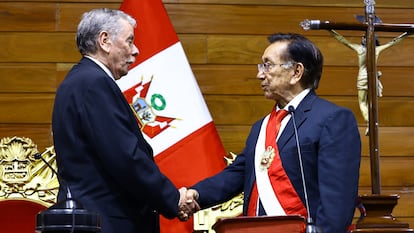

José María Balcázar is the new president of Peru. Congress determined this on Wednesday night in an extraordinary session following the censure of José Jerí over his suspicious ties to Chinese businessmen and a group of women who were allegedly favored with government contracts. Peru now has a new head of state who was not chosen by popular vote, but by a parliamentary one.
José María Balcázar, 83, from the left‑wing political group Perú Libre, secured majority support in the chamber to become the new president. He will govern for the next five months, until he must hand over power on July 28 to a new leader — this time elected at the polls — in the upcoming April 12 election.
Balcázar — a member of the party of Pedro Castillo, the former president convicted for his self‑coup in 2022 — is a lawyer from Cajamarca and a former judge whose career has not been free of controversy. He has openly defended child marriage. He even claimed that “early sexual relations help a woman’s future psychological development,” statements that sparked widespread condemnation from the Ministry of Women and from the public at large.
Peru’s institutional weakness is highlighted by the fact that there isn’t even consensus on how many presidents the country has had in the past decade. Most people start counting with economist Pedro Pablo Kuczynski, the first president who failed to complete his term. Others include retired military officer Ollanta Humala, because he governed until mid‑2016 — though he did finish his mandate. What is certain is that, if one counts from the start of the institutional crisis, using a stricter measure, José María Balcázar is Peru’s eighth president.
Social scientists have yet to name this period of shifting sands, during which Peru had a president (Manuel Merino) who lasted five days back in November 2020, and a couple of others who didn’t make it past a year. Nor is there agreement on what to call the new occupant of the presidential palace. Peru has become a country of acting presidents or transitional presidents — transitions that are often cut short, as in the case of José Jerí, who was unable to complete the nine months he had ahead of him when he was appointed to replace Dina Boluarte, who, like him, was removed by Congress last October.
Some had expected Jerí to appear at Wednesday’s plenary session. When the motion of censure was approved, and he was expelled from the presidential palace, the former president regained his congressional seat, since he had not lost his status as a lawmaker. His reinstatement meant that he could have taken part — with voice and vote — in the session to choose his successor. But his prime minister up until his fall, Ernesto Álvarez, put an end to any speculation about an appearance, a statement, or a farewell from Jerí: “In politics, as in love and war, you shouldn’t inspire pity.” He then offered one last piece of advice to the ousted leader: “May he never again in his life wear a hood,” he said, referring to the attire Jerí used in the clandestine meetings with Chinese businessmen that cost him his position.
Formally, Peru was leaderless — with no president in charge — for 24 hours. Although Jerí’s ministers remained in their posts, their role was limited to administrative tasks. It was a risky power vacuum had any major emergency arisen.
Four names were scrutinized by the public eye from Tuesday afternoon until the last rays of Wednesday: María del Carmen Alva (Acción Popular), Héctor Acuña (Honor y Democracia), Edgar Reymundo (Bloque Democrático), and José María Balcázar (Perú Libre). The pool of candidates to replace Jerí consisted of a right‑wing representative, a pragmatist, and two left‑wing contenders.
Apparently, the political groups with the most influence in Congress were expected to determine the outcome. María del Carmen Alva, a former speaker of the chamber, seemed like the favorite from the start. She was not only the choice of Renovación Popular — the party of former Lima mayor Rafael López Aliaga, who appears in recent polls as the frontrunner for the April 12 presidential election — but also of Fuerza Popular, the party led by Keiko Fujimori. It was thought that the Fujimoristas might opt for Héctor Acuña as a form of vendetta to irritate his brother, César Acuña, president of Alianza para el Progreso, who abandoned them in their support for Jerí. But that didn’t happen.
Just minutes before the plenary session began, Fuerza Popular issued a statement endorsing Alva’s candidacy. “We believe the country cannot withstand more improvisation or political calculations. We’ve learned our lesson. Today the priority must be the future and the peace of mind of citizens. For that reason, we will support María del Carmen Alva, hoping that her administration preserves stability and national security.”
However, just when it seemed the die was cast, something unexpected happened: veteran lawyer Balcázar of Perú Libre surged with a large number of votes and suddenly became competitive. Everything indicates that the Fujimoristas’ public support ultimately did not materialize. In the first round, Alva received 43 votes and Balcázar 46. Since neither list reached the simple majority (59 out of 117 votes), the election went to a second round, where Balcázar won with 60 votes to 46.
Sign up for our weekly newsletter to get more English-language news coverage from EL PAÍS USA Edition









































