
Dina Boluarte, the president who reached rock bottom of popularity
In 2022, the lawyer became the first Peruvian woman to hold the top office, but saw her approval ratings drop to record lows by the time of her removal on Thursday
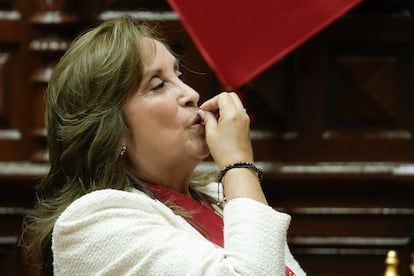

“I am a woman of peace, of dialogue, an agreement-maker who believes in democracy,” said Dina Boluarte in 2023. She had been president of Peru for just over six months, but her words were already falling on deaf ears for a large part of the population. Her administration had begun with a lie: she had claimed she would resign if Pedro Castillo were impeached or removed from office. This unfulfilled promise was seen as a betrayal of her followers in Perú Libre, the party that brought them to power, and it represented a break with a left that had been seeking a revolution.
Dina Ercilia Boluarte Zegarra, 63, the first woman to wear the presidential sash in Peru, enjoyed no respite. Her appointment on that turbulent December 7, 2022, sparked a backlash. When she completed 100 days in power, her disapproval rating hovered around 80%. Today, as she leaves the post, her support is below 2%. There are even some polls, such as the CPI, that give her 0% popularity among Peruvians aged 18 to 24. These are figures never seen for any other head of state.
Of the initial peace Boluarte offered, she got little of it. “How many more deaths do you want?” she said defiantly, after the police and armed forces had already killed 50 citizens who had taken to the streets to express their discontent at the start of her term. Deaths for which she has not apologized or shown any empathy. At the beginning of 2024, a woman broke through her security detail and grabbed her by the hair in Ayacucho, one of the regions with the highest number of deaths. Ruth Bárcena had lost her husband in the protests.
Boluarte also failed to offer any kind of dialogue. Not only did she dodge questions, but her silences with the press were prolonged, several of them exceeding three months. What’s more, she impeded journalists’ work with intimidation. At the diplomatic level, she showed her shortcomings: she quarreled with several leaders across the continent, isolating the country. Among these were Colombia’s Gustavo Petro and Mexico’s former president Andrés Manuel López Obrador, who called her a “spurious president” and refused to cede her the temporary presidency of the Pacific Alliance trade bloc.
Her Andean origins, which she often resorted to when in trouble, didn’t work either: “The protest has an Indigenous voice and face, and we’ve been treated as manipulable subjects incapable of transforming the country, or as violent individuals. Dina Boluarte doesn’t honor her Andean origins. She may speak Quechua, but she’s attacked our dignity,” says Tania Pariona, executive secretary of the Human Rights Commission.
Feminist groups also distanced themselves from Boluarte, marched against her, and some groups claimed that her administration was allied with the patriarchy and violent against women. A scene illustrates this: Aymara mothers carrying their children, their eyes red, amidst toxic smoke. Another issue that drew public criticism throughout her term was her frivolity: her secret cosmetic surgeries and her high-end jewelry and watches allegedly received in exchange for channeling budget allocations to regional governments.
Her survival instinct, perhaps the only quality recognized by political analysts, manifested itself in her leniency toward the political followers of the late ex-president Alberto Fujimori. Boluarte not only allowed the autocrat to be pardoned in 2023, but also decreed three days of mourning for his death in September 2024. But even that wasn’t enough to protect her: rampant crime caused the congressional factions that had protected her to turn against her in the final stretch.
Dina Boluarte is leaving, with her Independence Day speeches that set records — for length and for inducing yawns; she is leaving with her indifference toward the victims of her government; she is leaving without having captured the leader of her former party, Perú Libre, Vladimir Cerrón, a fugitive who tweets daily and publishes books. The people who didn’t elect her at the polls gave her no respite, because, as they say in the streets, she never did anything to deserve it. The nickname by which she is known will be repeated incessantly in the coming hours: “Dina Balearte” — which translates roughly to Dina the Shooter, a reference to the government’s harsh response to protests or unrest during her presidency.
Sign up for our weekly newsletter to get more English-language news coverage from EL PAÍS USA Edition









































