
Tren de Aragua makes its way into Peruvian prisons
Venezuelan inmates, a population that has grown from 48 to over 4,000, are imposing their jail culture

— Thugs don’t clean bathrooms because they can’t touch shit.
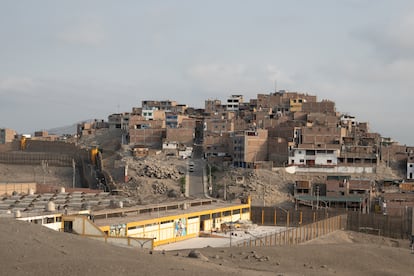
It took some time for José Luis Pérez Guadalupe — an academic who has dedicated his life to studying God and crime — to understand this ruling. It was mid-2022, Peruvian prisons were allowing visits after two years of the COVID-19 pandemic, and he sensed a climate of high tension in Lurigancho, the overcrowded fortress located east of Lima, where he has been visiting for 40 years, Bible in hand. The Venezuelan inmates, who back in 2018 numbered no more than 50 in all of Peru, had multiplied, and every corner of the prison was on edge.
As a pastoral agent — and former head of the National Penitentiary Institute (INPE) — he located the leaders and sat down with them to unravel the origins of the conflict, but also to prevent riots and massacres that seemed imminent. He discovered that Venezuelan inmates adhered to an underworld code, known as rutina (routine), that was so strict that breaking it was essentially a death sentence. These rules forbade sweeping and doing housework. Cleaning meant getting dirty. It meant becoming a “witch” and falling to the bottom rung of the criminal hierarchy.
The issue caused friction: the Peruvian prisoners didn’t want to be anyone’s servants. They also complained about the noise the Venezuelan inmates made. Coexistence was exacerbated by overcrowding: Lurigancho was built for 2,500 inmates in the early 1960s, but it overflowed to over 10,000. Surprisingly, sharing a cell with more than 20 inmates wasn’t what irritated the Venezuelans the most; rather, it was spending their confinement alongside gay men. “How can there be male couples holding hands? That can’t be allowed,” they complained.
The approach to this cultural clash behind bars took almost three years and is captured in El Tren de Aragua y el crimen organizado en América Latina (Tren de Aragua and Organized Crime in Latin America), authored by three researchers and professors from the Universidad del Pacífico in Peru: José Luis Pérez Guadalupe, Lucía Nuñovero Cisneros, and Guillermo Coronado Sialer. Through fieldwork — which included 36 in-depth interviews with inmates and prison authorities — it was possible to establish the root of these behaviors: the Tocorón prison, in the south of the state of Aragua. A model of “open prison” where the Venezuelan government handed control to the inmates — under the pretext of reducing fights — who then instituted and exported an archetype of criminal organization that has spread its tentacles throughout the continent.
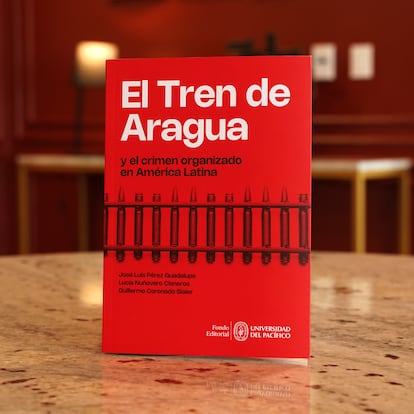
The book argues that the Tren de Aragua, led by Héctor “El Niño” Guerrero, inspired other Tren-model gangs in Venezuelan prisons such as Tocuyito, Puente Ayala, and El Rodeo. From there, they professionalized their primary criminal method: extortion. In Peru, the country that hosts the largest number of Venezuelan migrants after Colombia, the number of extortion complaints multiplied almost sevenfold: from 3,220 in 2018 to 21,831 in 2024, according to figures from the Ministry of the Interior. This is the same period in which the Venezuelan inmate population in Peru soared from 48 prisoners to more than 4,000.
There are four factors that explain the expansion of the Tren de Aragua: the migration process, in which high-ranking criminals camouflaged themselves; the role of the Venezuelan state, which, starting in 2011, “left the door open” for gangs to expand their networks and connections; the fact that criminals fled their country — because there was a price on their heads — and didn’t have much to lose, which would explain the level of violence; and the fact that countries like Chile and Peru did not have such highly organized and lethal criminal structures, which were ultimately displaced through bloodshed and fire, as in the business of prostitution and human trafficking. In other words: there are no more Peruvian pimps because Tren de Aragua killed them all.
“An inmate told me: ‘I know I’m going to wake up alive here. You go in here alive and you come out alive.’ That was something new for them,” recalls Pérez Guadalupe, the former interior minister of Peru. Because of the obedience Peruvian inmates display toward penitentiary officials, they used to say that in the Andean country, “there are no prisons, just kindergartens.” “Beyond the blunders of the government or the current president of the INPE, what prevails is a co-management between the authorities and the inmates who comply with these regulations. But the authority has never ceased to be the INPE. There are no liberated zones in Peru,” says Pérez Guadalupe.
The Tocorón prison in Venezuela, where inmates had to pay a weekly fee of $20 to avoid being killed, was transformed into a crime laboratory and, at the same time, into clubs whose luxuries were reserved only for the bosses, known as pranes. Before 2023, the year Venezuelan President Nicolás Maduro dismantled the prison, there were houses with swimming pools and barbecue grills, an exotic animal zoo modeled after Pablo Escobar’s Hacienda Nápoles, a baseball stadium, a bank, and a nightclub.
There, the “routine” was established, characterized by heightened machismo, resulting in homophobia and transphobia. Shaving one’s legs or shaking hands after using the bathroom was prohibited. Talking in double entendres or using an effeminate voice was prohibited. Asking too many questions was prohibited. As one of the testimonies recounts: if, for some reason, another inmate’s urine touched you because he was trying to mess with you, you had to kill him immediately. The body was then thrown to the pigs.
After a long time in Lurigancho, one of the most overcrowded prisons in Latin America, Venezuelans finally picked up brooms. The cellblock leaders set an example. A process of integration followed the initial conflict. However, Pérez Guadalupe warns, at the same time a process of blending in has also taken place, the consequences of which remain to be seen. For now, there are signs of the binational gangs are forming.
“It is necessary to understand that the fight is not against groups of migrants seeking to survive the living conditions of their country, nor against first-time or occasional criminals, but against veritable armies of mercenaries who have extensive criminal experience despite their youth,” the publication states.
But it’s not just about the effectiveness of combating crime; it’s also about the minimum conditions for reintegrating a convict into society. The Peruvian prison system houses over 100,000 inmates, compared to its current capacity of 41,000. The latest move by the Dina Boluarte government to try to address this problem has been to announce the possibility of reopening El Frontón, a prison closed in the mid-1980s, located on an island of the same name off the coast of Callao.
The truth is that in 2023, an INPE report determined the project was not feasible: it’s expensive and could at most house 108 inmates. “It’s all smoke and mirrors,” criminologists have said. This lack of direction can be seen in recent statements by Interior Minister Carlos Malaver, who, in a moment of candor, said in allusion to Tren de Aragua: “Now they shoot you first or kill you. Maybe now we miss our criminals.”
Sign up for our weekly newsletter to get more English-language news coverage from EL PAÍS USA Edition









































