
Trump seeks a way out to avoid a new energy crisis
The president is using his most powerful weapon, his rhetoric, to try to contain surging oil prices as a consequence of the Iran war
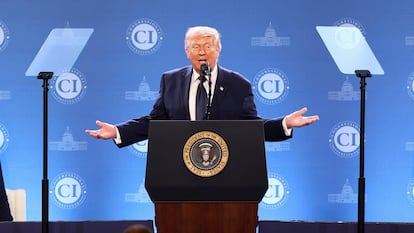

The surge in oil prices and the resulting increase in fuel costs has trapped U.S. President Donald Trump in a difficult situation. Gasoline prices have climbed 17% in the last week and diesel 22%, reaching levels not seen since 2014, at around $3.50 per gallon. The turmoil in the energy markets threatens to deliver another significant blow to his economic policy, following the Supreme Court’s setback to tariffs: Trump had made combating inflation and lowering fuel prices one of his top priorities.
The president is using his most powerful weapon: his rhetoric. During an interview on CBS, he asserted that the Iran war is virtually over, words that seem to have worked like a charm, because the markets immediately reacted with euphoria. The stock market, which had been trading in the red, has returned to positive territory. West Texas Intermediate (WTI) crude oil, which reached nearly $120 per barrel in the early hours of the morning, dropped below $90. The U.S. president’s words come despite his statement just three days earlier that there will be no agreement without the “unconditional surrender” of the Tehran regime, something that doesn’t seem easy to come by. So the effect of Trump’s spell may be ephemeral if it isn’t backed up by action. The formidable volatility in the energy market only confirms the hysteria of investors.
Just 15 days ago, Trump engaged in a typical self-promotional exercise during his State of the Union address. In Congress, before several hundred senators and representatives, he emphasized that in 12 months his administration had reduced inflation to its lowest level in more than five years. Gas, he said, “reached a peak of over $6 a gallon in some states under my predecessor” and added “it is now below $2.30 a gallon in most states. And in some places, $1.99 a gallon.”
During the campaign that took him back to the White House a little over a year ago, he repeatedly emphasized how expensive gasoline was under the administration of Joe Biden. He promised that when he returned to the Oval Office he would lower fuel prices and coined the slogan “Drill, baby, drill” as a metaphor for his energy policy, which would reduce prices by increasing crude oil production. One analyst underscores that in the United States, the price of inflation and the perception of losing purchasing power are strongly linked to the price of gasoline.
Just two weeks after the Union address and following the bombing of Tehran, the situation is not as rosy as Trump portrayed it. On Monday, oil prices reached $120 a barrel, almost double what they were a month ago, although they later moderated amid rumors that the G7 was considering releasing an unprecedented volume of emergency reserves and that the United States might intervene in the market.
The White House is concerned about soaring gasoline prices. Trump’s chief of staff, Susie Wiles, has warned in internal meetings of the “catastrophic” effect that rising fuel prices would have on the midterms in November. These elections are seen as crucial in determining Trump’s future, given his unfavorable poll numbers. Wiles has asked Energy Secretary Chris Wright to meet with executives from U.S. oil companies to discuss options in the event of a new energy crisis.
The surge in gasoline and diesel prices is occurring despite the fact that the United States is the world’s largest oil producer. It pumps 13.6 million barrels per day, nearly 20% of the global total. But crude oil is traded on global markets, and its price is determined by global supply and demand. The Persian Gulf countries have reduced their production because their storage facilities are full and they cannot sell their oil due to problems in the Strait of Hormuz. China has frozen exports, and other major economies are experiencing supply shortages, which is driving up prices. Therefore, Washington’s unilateral measures have little impact on the domestic market. Trump was confident that the war would be swift and have minimal effect on the energy market, but analysts remain unconvinced.
Rising gasoline prices are fueling inflation and posing a growing risk to the affordability crisis, one of the biggest challenges facing Republicans in the upcoming elections. “The most notable factor driving inflation upward in February will be gasoline prices. In January, they reached a low point [not seen] since the pandemic recovery and then began to rise. The increase accelerated as concerns grew about the war and its start at the end of the month,” says Dean Baker, an analyst at the Center for Economic and Political Research (CEPR).
All transportation will be affected, and farmers and ranchers in the Midwest, a major Republican voting bloc, will suffer the consequences in the middle of the harvest season after the end of winter. Food and many other products will become more expensive if the situation continues.
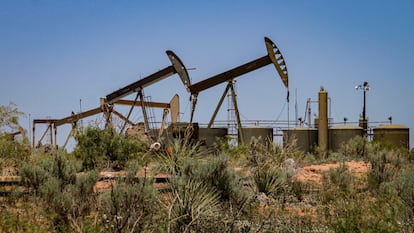
The White House’s reaction reflects concerns about the volatility of the energy market. Although he was reluctant last week to release the United States’ strategic reserves, as his predecessor Joe Biden did four years ago during the energy crisis following Russia’s invasion of Ukraine, the president is exploring options to mitigate the impact of rising fuel prices on household budgets and business finances.
“The United States is a net energy producer, but rising oil, gas, and electricity prices could amplify the effects of trade tariffs, resulting in reduced household purchasing power and lower corporate profits,” says James Knightley, chief economist at ING Research.
Analysts estimate that for every $10 the price of oil rises, two tenths are subtracted from economic growth and inflation rises by 0.2%.
White House officials have floated a range of options to try to ease pressure on oil prices, including restricting U.S. exports, intervening in crude futures markets, exempting some federal taxes, and lifting requirements that domestic fuel be transported only on U.S.-flagged vessels, among other measures, Reuters reported.
Sign up for our weekly newsletter to get more English-language news coverage from EL PAÍS USA Edition









































