
Trump loses the tariff hammer but grabs the flamethrower in the Middle East
The US Supreme Court lowers the risks of a trade war, but the strikes on Iran push geopolitical and geoeconomic uncertainty to new highs
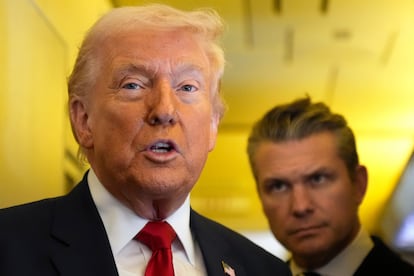

The Nazi regime’s chief political strategist whispered in Hitler’s ear that politics consists of identifying the enemy; the contribution of Trump’s ideologues to the reactionary spiral is to sow chaos. For more than a year, Donald Trump has pushed obsessively toward both goals, wielding tariffs like a hammer and threatening longtime allies, systemic rivals, and everyone in between. The checks and balances are beginning to push back.
“The Supreme Court has put an end to this divide-and-conquer tactic and thus manages to eliminate one of the main sources of uncertainty for Trumpism,” says Richard Baldwin, one of the leading experts in international trade. But Trump is a master of invention, and having lost his hammer, he has grabbed the flamethrower and, dragged along by Israel, has set the Middle East ablaze with the attack on Iran.
Trump’s 14 months in the White House are somewhat like the sequence between the titles of two Bergman films: Torment and Crisis. In that space of time he has undermined the international order, helped Israel turn Gaza into rubble, endangered Ukraine’s defense, intervened in Venezuela, and threatened Europe — and always with a supreme disregard for international law. And just when uncertainty seems to ease slightly after the Supreme Court ruling on tariffs, he drives it back up to Himalayan heights with the war in Iran, which is spreading across the Gulf and even reaching Cyprus, the easternmost island of Europe, just half an hour by plane from Damascus.
The future of this conflict is uncertain: starting a war is easy, but ending one is not. Other presidents had to learn that lesson in Afghanistan, in Iraq, and in earlier wars; now it is Trump’s turn to learn it with a vast country of nearly 100 million inhabitants. The war also has uncertain political consequences in Iran, in the region, in the United States, and across the world. And it has equally uncertain geoeconomic effects: a very 1970s economic illness given an impossible name —stagflation (economic stagnation plus inflation). Uncertainty is one of the best synonyms for chaos: once upon a time, there was chaos. Some of the most revolutionary ideas of our time often begin with the phrase “once upon a time.”
This “once upon a time” began to take shape in February after a meeting between Israeli Prime Minister Benjamin Netanyahu and Trump at the White House. A few days later, Israeli intelligence reportedly had information about a meeting of the entire Iranian regime leadership, according to diplomatic sources: Israel was going to strike. Netanyahu is uncannily effective at whispering in Trump’s ear, and Trump did not want to miss the opportunity to lead that attack — despite his campaign promises, and despite the fact that no U.S. president in decades had initiated a war with such overwhelming opposition from public opinion.
The declared objective is flexible: to destroy Iran’s arsenal, to halt its nuclear program, to eliminate terrorist proxies such as Hamas and, above all, to achieve “regime change,” says Richard Haass of the Council on Foreign Relations, an influential think tank. But regime change rarely comes from airstrikes alone. Russia has failed to defeat Ukraine in four years, and 45% of Gaza’s territory is still under Hamas control.
“History suggests that regime change requires troops on the ground and that it is not always possible to pursue ambitious foreign-policy goals — such as those achieved in Venezuela — with limited resources,” Haass concludes, hinting his criticism of the overconfidence of the U.S. commander in chief.
Charles Kupchan, a former adviser to Barack Obama, suggests that Trump may be shooting himself in the foot: “Tariffs, the Greenland fiasco, insults to long-standing allies, now Iran. Trump is becoming increasingly weak.”
Brookings, another prestigious think tank, explained in a recent analysis that Trump has achieved significant gains in Iran. It cites the effective control of Iranian airspace, the damage inflicted on the country’s inventory of ballistic missiles, its navy, and its nuclear program, and the elimination of much of its political, military, and religious leadership. But alongside these achievements, it also describes Iran’s success in blocking the Strait of Hormuz, a move which has disrupted the global economy. Iran has also inflicted damage on a dozen countries in the region. The regime remains in place, clinging to power through the networks it has woven over half a century. And in Washington doubts are emerging about the formidable costs of the operation — both material and human — and about its benefits, which are far clearer for Israel than for the United States, as both countries face elections at the end of the year.
Faced with an existential threat, the ayatollahs are trying to buy time by escalating the situation: transforming the war into a regional conflict and a global economic crisis. They have been remarkably successful in both cases. Oil surged past $100 a barrel. Natural gas prices have skyrocketed, leading to disastrous consequences for European and Asian industry. The global economy is less vulnerable than in the 1970s due to its reduced dependence on fossil fuels, but there are serious reasons for concern. There are three possible scenarios, each more uncertain than the last.
First: if the war is short, the shock to energy prices and stock markets will be temporary, with only a moderate impact on inflation and growth. That is the scenario preferred by the United States, but few now believe the war will last just a couple of weeks. If the conflict drags on for more than six months and Iran continues blocking Hormuz, the impact will be far greater and the parallels with the 1970s will become clearer. That is the second scenario: a longer war that would create “a real risk of stagflation that will put enormous pressure on economic authorities,” a European central banker tells EL PAÍS. And then there is a third nightmare scenario: that in the midst of such a prolonged war, there is a financial accident.
“Markets have been relatively insensitive to geopolitics over the past year, but that has changed radically. There has been a degree of exuberance in private credit, in public debt, and in sectors such as artificial intelligence. If that feared accident occurs, uncertainty will accelerate dramatically,” the same source says.
The time dimension of the conflict is essential for politics — with the U.S. midterm elections in November — and for the economy. “There are growing signs that the war will not be short,” says Josep Borrell, former EU foreign policy chief. “And it is increasingly clear that it is not in Trump’s interest for it to drag on, so at any moment he could declare it over, with a heavy dose of propaganda, even if he is nowhere near achieving his goals.”
Between the most ambitious goal — regime change — and the non-negotiable minimum of reducing Iran’s arsenal and definitively ending its nuclear program, Trump “will declare victory when he sees fit and withdraw,” according to European sources. The decision will depend on his domestic political needs, the level of military resistance, public support in Iran, and the war’s impact on markets and the broader economy. But selling that exit, when it comes, will not be easy. “Something like a turning point for Trumpism may be approaching,” Borrell concludes. “It has been dragged by Israel into a conflict that does not look likely to end with the unconditional surrender of the Iranians, but rather with erosion on the American side: public anger brought Trump to power, but public anger could also land him in serious trouble.”
The apocalypse almost always disappoints its prophets — but one must be careful with the almost in that sentence. Two BNP Paribas funds suspended redemptions at the beginning of the summer of 2007, and that was the first time we heard the word subprime; a year later came the crash of Lehman Brothers, and the geoeconomic system suffered a memorable blow.
History rhymes: last Friday the giant BlackRock limited redemptions in one of its private-debt funds. Doomsayers glimpse the outlines of a crisis combining war, shadow banking, and the AI bubble. Perhaps that won’t happen — but tensions are at a peak. The age of uncertainty threatens to give birth to a new “once upon a time: chaos.”
Sign up for our weekly newsletter to get more English-language news coverage from EL PAÍS USA Edition









































