
Trump lays bare Europe’s weakness in just six months
The US president has taken advantage of Europe’s geostrategic and economic vulnerability to strike a one-way trade deal and impose spending of 5% of GDP on defense
First, the image spoke volumes: the forced smile of the President of the European Commission, Ursula von der Leyen, giving a Trump-style thumbs up while the U.S. president grins gleefully at her side; the faces of contained resignation of the members of the European delegation versus the glowing faces of the Americans after signing a trade agreement that imposes a 15% tariff on European exports without having to give up anything in return. The scene took place last Sunday at the Turnberry golf club that Trump owns in Scotland. “The result is bad. That was clear from the duration of the meeting on Sunday: no great negotiations can be completed in an hour. You can see it in the body language of that final photo,” observed Josep Borrell, the former EU High Representative for Foreign Policy.
Putting the devastating scenario into words was Mark Rutte, Secretary General of NATO: “You are flying to another great success in The Hague. (...) Europe is going to pay BIG (sic), as it should, and it will be your victory,” he told Trump. Rutte — who never refrained from showing contempt for his partners in the EU when he disagreed with them while serving as prime minister of the Netherlands — was publicly shamed in June when his sycophantic messages were revealed on Trump’s Truth Social platform; messages telling Trump that his NATO allies were going to jump through hoops to reach 5% of GDP spending on defense. It happened a few days before the Atlantic Alliance summit in the Netherlands. “We are a bit like vassals. It has been like this since 1945. But it had never been quite this obvious,” says Ignacio Molina, a researcher at the Elcano Royal Institute think tank.
In just over half a year, the U.S. president has laid bare all of Europe’s weaknesses. With his intimidating and aggressive rhetoric, he has shown that no matter how much European leaders have talked about “strategic autonomy,” the continent is a long way from achieving it. Europe has not had the strength to make itself heard, or to influence the government of Benjamin Netanyahu into declaring a ceasefire to end the humanitarian tragedy in Gaza. And, regarding Ukraine, Washington has sidelined Europe in its attempts to negotiate a ceasefire, despite all the money spent by its European allies. Europe’s voice has not counted for much. In fact, it counted for nothing when Israel bombed Iran in a move that threatened to plunge the world into uncharted territory.
“Trump is not the cause of Europe’s weakness, he is simply taking advantage of it in a way that other [U.S.] presidents have not done,” says Hans Kribbe, founder and researcher at the Brussels Institute for Geopolitics (BIG). “In that sense, the NATO defense spending pact of 5% of GDP and the trade agreement are very similar.” This former adviser to the European Commission adds that “the trade agreement was not really a negotiation about trade, but about the protection that Europeans must pay for their security against Russia.”
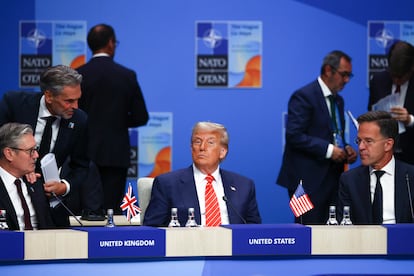
Brussels admits it has been hampered during its talks with Washington by the fear felt by the Baltics and former Soviet satellites towards Moscow. And Borrell ratifies this in a telephone conversation with EL PAÍS: “Of course, the dependence we have on the United States in security has been significant in recent months. Trump knows it and he has used it. But it’s not only been him, [Barack] Obama also told us. He told us in a friendly way and we didn’t listen to him.” Kribbe, who penned The strongmen: European Encounters with Soverign Power, sums it up starkly: “It was not a negotiation between two sovereign states, but between a sovereign power and a weak state or a union of weak states that depend on the United States for their security. That’s all there is to it.”
Charles A. Kupchan, a professor at Georgetown and a member of the Council on Foreign Relations (CFR), believes that the EU “could have done more to defend itself” regarding tariff negotiations with the United States, but at the same time he understands that Brussels calculated that any trade war with Washington could spill over into “the realm of security, and suddenly, Europe could be forced to manage Ukraine and Russia on its own… It seems to me that the EU preferred not to risk escalation.”
Trump has never concealed his animosity towards Europe and, in particular, towards the EU, a political organization that, in his mind, was created with the sole purpose of “screwing the United States,” as he was wont to remark during his election campaign. The idea that Brussels and London, like the rest of Washington’s trading partners, have been taking advantage of the United States’ supposed good faith for decades, was wholeheartedly embraced by MAGA supporters in the first few months of Trump 2.0.
The attacks on the EU came from the mouths of prominent members of his Cabinet. The vice-president, J. D. Vance, caused a huge commotion when he took advantage of his first trip abroad to berate foreign EU ministers for their European values at the Munich Security Conference. Then it was Pete Hegseth, Secretary of Defense, whose ideas about Europeans were exposed by Signalgate: Europeans, he said on the leaked chat, were nothing but “freeloaders” and “pathetic.” And now the U.S. administration has sent a bill to the “freeloaders.”
The Europeans were aware of their geopolitical and economic weaknesses. Reports drawn up by former president of the European Central Bank Mario Draghi and former prime minister of Italy Enrico Letta pointed them out last year, although they were not the first. Draghi flagged up the lack of investment in the EU and the technological gap between the two world powers, which makes the EU dependent on the United States in the digital universe. For example, electronic payments with credit cards (Visa, Mastercard, American Express) and digital services (PayPal, Apple Pay, Google Pay), are all in American hands.
The EU has begun to address some of its shortfalls, such as defense investment, but results won’t be seen overnight. Even when things appear to be moving fast for Brussels, they move slowly. For example, in February the Commission launched a fund of €150 billion for joint arms purchases between two or more EU countries. This week it has become known that 18 member states have asked for a total of €127 billion. They still have until November to finalize the details of their request. More than 10 months will have passed.
“The EU is not irrelevant,” explains Daniel S. Hamilton, from the U.S. think tank Brookings. “But it is not currently prepared to act as a geopolitical or geoeconomic force. Trump is simply exposing that weakness, he has not created it. Russia, China and other actors also pit EU countries against each other, because it is very easy to do so. It’s not their problem, it’s Europe’s problem.”
There are also questions of mentality and decisiveness. “The EU needs to change its way of approaching things,” says Georgina Wright, a senior researcher at the German Marshall Fund institute. “When you become a geopolitical power, you have to be united and you have to have economic power. The EU is more or less united, it has more or less economic power, but we have to be prepared to be much more aggressive. The EU has a lot to learn. China and the United States use market access as a way to exercise their power, and I think the EU needs to do more of that.”
This was evident in the clash between Washington and Beijing at the beginning of Trump’s 2025 trade war. Both escalated the situation by increasing tariffs to a prohibitive level. Then, at the beginning of April, China imposed controls on the export of seven rare earths that are key in the manufacture of high-tech products. Shortly afterwards, the two sides signed a truce. This approach is within the reach of Europeans, but they have yet to decide to use it. During trade negotiations with the United States, the Commission considered activating the anti-coercion instrument, a legal tool that would have allowed it to impose taxes on trade in services or veto access to public procurement by American companies in the EU. But there was a lack of unanimity: several members led by Berlin and Rome refused to get on board.
This timidity and lack of unity when it comes to exploiting the coercive arsenal available to the EU has been experienced first-hand by Borrell. The predecessor to Kaja Kallas repeatedly called for more action to rein in Israel in Gaza, but did not succeed. “It shows that we have little influence regarding Israel, among other things because we do not use the instruments we have at our disposal [in reference to the suspension of the collaboration agreement],” says Borrell. “We keep saying just ‘behave yourself’... We do not dare to upset Netanyahu or sanction at least two far-right Orthodox ministers for what they say and what they do in the West Bank. The Knesset [Israeli parliament] has voted to annex the West Bank, something they have openly called for.”
Borrell’s view was confirmed in July. After the Commission found that Israel was violating human rights in the Strip, it initiated the suspension of the association agreement, at least partially. Brussels’ proposal for a sanction was nothing more than symbolic, amounting as it did to vetoing Israeli participation in a scientific program. Not even that has been possible in the face of opposition from several partners, with Germany the first to block the initiative.
Everything that has happened in this first half of this year, with the culmination of Von der Leyen closing a damaging trade agreement at Trump’s Turnberry golf club in Scotland – “the other way around would be unimaginable” as Kribbe points out – greatly damages Europe’s position on the world stage. “It leads to international isolation,” Borrell says. “We have seen it clearly in Africa, where our only presence is in Somalia financing the peace mission there. One might assume that having been colonial powers we would maintain an influence, but no. We must remain more united and willing not to follow Washington at every turn.”
Sign up for our weekly newsletter to get more English-language news coverage from EL PAÍS USA Edition









































