
Trump’s unintentional gift: how the Fed’s erosion opens Latin America’s doors to the euro
Euro-denominated debt issuance climbed to 12% in the first quarter of the year, its highest level in a decade
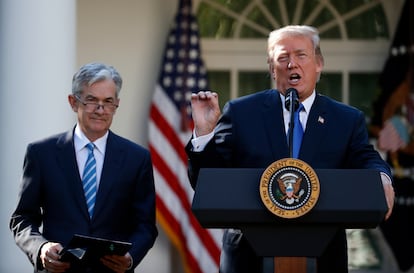

Latin America is reducing its dependence on the dollar, and it is doing so (at least in part) as a reaction to the policies of Donald Trump’s second administration. The increasing politicization of the U.S. currency—from the use of tariffs and sanctions to tensions with the Federal Reserve—has led various governments in the region to seek more predictable alternatives for financing themselves in international markets. And the euro has emerged as the main option for dealing with institutional uncertainty in the United States.
The most recent data from the Bank of Spain clearly illustrates this trend. In 2025, Latin American economies issued $182.5 billion worth of debt on international markets, of which 9.7% was denominated in euros, the highest proportion since 2016. This surge contrasts sharply with the low of 1% recorded in 2023, when Joe Biden was still in the White House. Notable transactions included those of Mexico (with a $2.5 billion bond in January and another one worth $5.5 billion in September), Colombia ($4.8 billion in September and $2 billion in November), and Chile ($1.7 billion in January and $1.5 billion in July), while the private sector had a marginal presence, represented only by América Móvil, which placed $764 million in euros in September.
The trend intensified in the first quarter of this year, coinciding with Washington’s military intervention in Venezuela and its subsequent attack on Iran. Amid this geopolitical chaos, the euro’s share in Latin America reached 12%, while the dollar fell to 81%. Total issuance reached $56 billion, with Mexico and Chile leading the way, according to figures from the Bank of Spain.
However, this advance of the euro is encountering limitations that the eurozone’s own architecture has yet to resolve. David A. Meier, an economist at Julius Baer, points out that, despite having credible institutions, the single currency lacks some of the foundations that underpin the dollar’s primacy: deep financial markets and a clear capacity to absorb shocks during times of stress.
The bloc’s economic fragmentation and the absence of a common fiscal authority continue to weigh heavily. Added to this is an equally important factor: the geopolitical support enjoyed by the U.S. which, according to the analyst, is something the Old Continent lacks. This includes America’s capacity to project military strength and an institutional order that benefits its currency. Therefore, according to Meier, the euro may consolidate its position as the second reserve currency, but it will hardly displace the dollar until Europe completes the integration of its capital markets and develops comparable geopolitical influence.
Derek Halpenny, head of European global market research at MUFG Bank, offers a different perspective. In his view, each crisis that’s been overcome in recent years—the health crisis, the inflationary shock, and the war in Ukraine—has strengthened the euro’s credibility, reducing doubts about its continued use among reserve managers. Therefore, he anticipates that debt issuance at the European level and increased fiscal stimulus in Germany will help create the stock of high-quality liquid assets that many investors need to diversify against a dollar increasingly manipulated by Washington. He cautions that the adjustment will be gradual, but the deteriorating fiscal outlook under the Trump administration is clearing some of the obstacles that have historically hindered the internationalization of the single currency.
This shift occurs within a familiar context: the increasing politicization of the dollar in Washington through the use of tariffs, threats of economic sanctions against other countries, and direct challenges to the independence of the Federal Reserve. Investigations into Jerome Powell’s management and pressures on monetary policy have eroded the perception of the dollar as a technical and predictable asset. For investors and public debt managers, the U.S. currency is beginning to incorporate a political risk component. In this context, it is logical that Latin American countries (a natural sphere of influence for the U.S.) are turning to the European market, both to diversify their investment base and to establish new price benchmarks.
Latin American diversification is being reinforced by geopolitical dynamics. The renewed interest of the United States in the region, partly to counter China’s influence, is forcing countries to reassess their financial dependence. Recent episodes in Bolivia and Argentina, where Javier Milei’s government has turned to the U.S. to meet a debt payment due to the International Monetary Fund, highlight the role of the U.S. Treasury as lender of last resort. But this dependence is precisely what is beginning to be questioned. Monetary fragmentation is occurring de facto, and in this process, the euro is gaining traction not only as a hedge against U.S. political risk, but also because it offers a more developed infrastructure of sustainable finance than Washington’s.
Although green and social bond issuance is projected to slow globally by 2025, European secondary markets maintain a penetration rate unmatched in the U.S. According to the International Capital Market Association, approximately 15% of the volume traded in corporate debt in the European Union incorporates sustainable criteria, providing Latin American issuers with access to an investor base more aligned with their energy transition agendas. As a result, the euro is gaining ground not only due to the erosion of the dollar but also because of regulatory and standards convergence, which strengthens its role as an alternative.
Dedollarization is, in any case, a gradual process rather than a sudden upheaval. The dollar remains the centerpiece of the system; it participates in nearly 90% of foreign exchange transactions, and U.S. payment infrastructure continues to move volumes that no other currency can currently match. However, the drift toward a more multipolar order is difficult to deny. Several countries are laying new financial pipelines—from clearing platforms driven by China to agreements to trade energy in local currencies—which, over time, are eroding the dollar’s primacy.
Sign up for our weekly newsletter to get more English-language news coverage from EL PAÍS USA Edition









































