
Judge blocks controversial SB 4 law that would let Texas detain and deport immigrants
A federal court halts key provisions of this state law, which human rights groups have labeled as one of the ‘most extreme’ anti-migrant measures in the country and was set to go into effect Friday
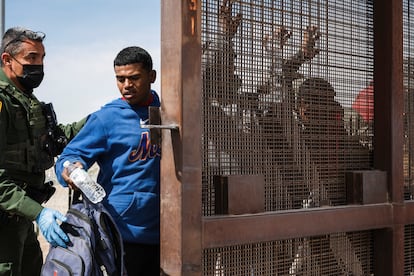

Police officers and judges in Texas will not be able to arrest, detain and deport immigrants who have crossed the southern border into Texas without authorization. A district judge has blocked key provisions of SB 4, the law that granted them these powers and which will not take effect this Friday as planned. It is expected that the decision will be appealed to a higher court.
“SB 4 conflicts with key provisions of federal immigration law, to the detriment of the United States’ foreign relations and treaty obligations,” wrote Judge David Alan Ezra of the U.S. District Court for the Western District of Texas in his 78-page opinion. Ezra’s decision to grant a motion for preliminary injunction was not unexpected. At a hearing on Wednesday, he had already asserted that four provisions of the law were “unconstitutional” and “problematic.”
On Thursday, he insisted that allowing SB 4 to advance could open the door for each state to pass its own version of immigration laws. “S.B. 4 could open the door to each state passing its own version of immigration laws. The effect would moot the uniform regulation of immigration throughout the country and force the federal government to navigate a patchwork of inconsistent regulations,” the justice argued. “SB 4 threatens the fundamental notion that the United States must regulate immigration with one voice.”
Along with Florida, Texas is one of the states most committed to President Donald Trump’s policy of mass detentions and deportations. According to records from Immigration and Customs Enforcement (ICE), nearly 400 state police officers have cooperation agreements with the federal agency to hand over custody of individuals without legal immigration status. The law’s implementation would represent a further step in that cooperation.
That’s why organizations like the American Civil Liberties Union (ACLU) believed that SB 4—which has been under legal challenge since its passage in 2023—would lead to more racial profiling, the criminalization of immigrants who have lived in Texas for years, and the separation of families. They labeled it “one of the most extreme anti-immigrant laws ever passed by any state legislature in the country.”
The basis of the discussion
Judge Ezra’s analysis stems from a class-action lawsuit—the second—filed in early May in his court by two of the largest civil rights organizations with a presence in the state (the ACLU and the Texas Civil Rights Project), representing two Honduran immigrants who could have been at risk of detention and deportation with the implementation of the state law. It challenged four provisions of the law.
One of these provisions criminalizes the entry of immigrants into Texas from Mexico without authorization and allows local police to detain people based on their immigration status. This could affect almost any immigrant in Texas who meets these criteria, even if they have pending immigration cases in federal court. The law also grants local judges the authority to order the deportation of individuals, a power never before granted to state governments.
“If SB 4 takes effect, the law would immediately impose criminal liability on thousands of non-citizens who have re-entered the state” and expose them to deportation, a process that “cannot be reversed,” the judge argued. “Thousands of people should not be arrested, jailed, or deported before the case on the constitutionality of SB 4 is resolved.”
The lawsuit targeted a single defendant: the director of the Texas Department of Public Safety, Freeman F. Martin, who would implement the law in the state.
SB 4 was passed by the Texas legislature and signed into law by Governor Greg Abbott in late 2023, a year in which migrant crossings at the southern border reached record highs. Republicans justified the law at the time by arguing that the state was experiencing an “invasion” of immigrants. According to figures from Customs and Border Protection (CBP), nearly 2.5 million arrests were reported along the entire southern border during that fiscal year (October 2022 to September 2023), more than 1.5 million of them in Texas. However, with asylum restrictions—which began under the Biden administration and have since intensified—arrests have dropped exponentially along the southern border over the past three years. By 2025, they totaled 443,671 (nearly 300,000 in Texas). and so far in fiscal year 2026 they total 63,732 (more than 50,000 in Texas).
Judge Ezra questioned Texas lawyers at Wednesday’s hearing about whether they still maintained that the state was facing an “invasion,” given the changed circumstances. David Bryant, the Texas Attorney General’s lawyer representing Martin, acknowledged the reduction in border arrests but asked the judge to dismiss the class-action lawsuit because the law’s implementation process was unclear.
This Thursday, the judge noted that the arrival of immigrants across the state’s southern border “is not new” and that for decades Texas has left the regulation of immigration to federal authorities, as established by the Constitution.
Sign up for our weekly newsletter to get more English-language news coverage from EL PAÍS USA Edition









































