
Efforts to control hantavirus outbreak reach global scale while cases in Spain and France fuel uncertainty
The WHO has downplayed the risk of a larger outbreak: ‘All cases have been isolated and are being managed under strict medical supervision’
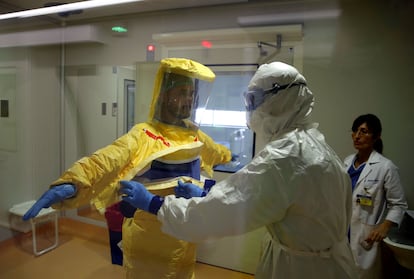
With the disembarkation of the Antarctic cruise ship MV Hondius progressing and with reports that there were no people with symptoms on board, experts and health authorities were confident during the early hours of Monday that the health crisis created by the hantavirus outbreak was entering a final phase that could be long —quarantines last up to 42 days— but without cause for major concern.
Everything changed, however, within hours, after new diagnoses. The first, although ultimately ruled out — the confirmatory test came back negative — was that of a U.S. citizen about whom the country’s authorities initially reported a “weak positive” result. There was less doubt — although confirmation of the case came in two stages — over the Spanish traveler who is isolated at the Gómez Ulla Military Hospital in Madrid. The Ministry of Health reported on Monday night that the first PCR test performed on him yielded a “provisional positive” result, but this became definitive on Tuesday. And there was no hesitation regarding the case of the French citizen admitted to the ICU, whose health deteriorated rapidly while she was being evacuated from Tenerife.
This succession of news reports and new cases has fueled uncertainty about whether the world has reached a point where bad news will begin to pile up. The World Health Organization (WHO) sought to dispel this concern on Tuesday with statements from its Director-General, Tedros Adhanom Ghebreyesus, following his meeting at the Moncloa Palace with Spanish Prime Minister Pedro Sánchez.
“All suspected and confirmed cases have been isolated and managed under strict medical supervision, minimizing the risk of further transmission. At the moment, there is no sign that we are seeing the start of a larger outbreak,” said the WHO chief, who, nevertheless, did not rule out that “the situation could change” and new cases could be detected.
In this context, the Public Health Commission, made up of experts from Spain’s Ministry of Health and the country’s regional governments, has changed the contact tracing protocol. It has established May 10 as “day zero,” from which the 42-day isolation period for passengers at the Gómez Ulla Military Hospital will begin, lasting until June 21.
They will be the only ones required to quarantine at this center. Should new contacts be identified, health authorities will conduct an individualized assessment of their situation, allowing them to quarantine in other facilities designated for isolation and health monitoring.
“All identified contacts, regardless of where they quarantine, will be subject to enhanced health surveillance for the first 28 days, the period considered to be most likely for the appearance of symptoms consistent with the disease. During this interval, a PCR test will be performed every seven days,” the Ministry of Health reported in a statement, explaining that isolation will be eased with visits permitted under safety measures after one week if the test is negative and no new symptoms appear.
The coordinated, global effort being made by governments, health authorities, and international organizations to contain the outbreak is immense. As an example, Tedros reported on Tuesday that all passengers on the cruise ship, “even those who disembarked in the most remote locations,” have been identified and are under observation to complete their quarantines.
One of the first hospitalized cases was that of a British citizen who was traveling on the MV Hondius and was evacuated to South Africa. He is currently recovering in the intensive care unit of the private Sandton Mediclinic medical center in Johannesburg, the city to which he was evacuated by helicopter from Ascension Island on April 27. He had developed symptoms such as fever and difficulty breathing on board the cruise ship. Subsequent blood tests confirmed the presence of hantavirus.
“He continues to improve and is much better than yesterday,” explained Foster Mohale, spokesperson for the South African Ministry of Health, who praised the speed of the country’s infectious disease experts, who were able to identify the virus on May 2. A spokesperson for the UK High Commission in South Africa stated that “the Foreign Office is providing consular assistance” to the patient and his family, but offered no further comment. According to other sources, the infected individual was traveling with an American companion who is also being closely monitored.
The most worrying case at the moment is that of the French citizen in “critical condition” at Bichat Hospital in Paris. The other four cruise ship passengers, who are currently asymptomatic and have tested negative in PCR tests, are in the same hospital. French Prime Minister Sébastien Lecornu announced on Monday that all of them — as well as the other 22 French citizens considered contacts of a confirmed case — will have to quarantine in a hospital, reports Raquel Villaécija from Paris.
The Spanish man who tested positive, according to sources at the Ministry of Health, is “apparently stable” and has not suffered any “clinical deterioration.” The patient, who is in the Gómez Ulla Military Hospital in Madrid, experienced a slight fever overnight and respiratory difficulties that lowered his blood oxygen levels. Tests performed on the other 13 people who were traveling on board the cruise ship have come back negative.
The same situation applies to the two Spanish contacts under surveillance because they shared a plane with one of the deceased in South Africa. One of them remains hospitalized at Sant Joan Hospital in Alicante and is considered a suspected case because she has symptoms (although tests have come back negative). The other remains asymptomatic and is in quarantine at the Hospital Clínic in Barcelona.
Two other passengers from the cruise ship, both Belgian nationals, have received inconclusive test results, according to initial tests conducted in the country, reports Silvia Ayuso. Both will undergo further testing. For now, they are doing well and are asymptomatic, according to health authorities. Until the definitive results are obtained, the two passengers will remain hospitalized in a special unit at the University Hospital of Antwerp, where they were transferred after being repatriated on Sunday on a plane that landed in the Netherlands.
In that country, under whose flag the MV Hondius sailed, a dozen members of the medical staff at Radboud University Hospital in Nijmegen will be quarantined as a precaution, since strict procedures were not followed when they treated one of the passengers admitted with hantavirus. According to the medical center, only “standard protective measures” were observed during the collection of blood samples and the processing of urine, reports Isabel Ferrer.
Unlike Spain, France, and the United Kingdom, where quarantines will be carried out under supervision in health centers, in the Netherlands they can be done in the private homes of those affected and the government “assumes that people will comply with the regulations”.
The prevention measures, however, extend to dozens of countries, since people of 23 nationalities traveled on the Antarctic cruise, in addition to those from other origins considered contacts for having been with one of the deceased on a plane in South Africa.
The European Medicines Agency (EMA), for its part, announced on Tuesday that it has activated its Emergency Working Group to investigate and “map [companies and institutions] developing medicines, especially antivirals, monoclonal antibodies and vaccines against hantaviruses” as part of its preparedness activities against the outbreak.
“Identifying immunomodulators for treatment and antivirals for post-exposure prophylaxis is a priority to reduce morbidity and mortality among those affected,” the agency stated in a press release. It also affirmed that it is “prepared to support the development and regulatory evaluation of vaccines and therapies against hantaviruses.”
Sign up for our weekly newsletter to get more English-language news coverage from EL PAÍS USA Edition









































