
Close to the stadium, but a long way from the World Cup due to ICE and sky-high prices
Eight games will be played in Inglewood, California where Hispanics make up a large portion of the population but where few can afford tickets to the premier soccer event
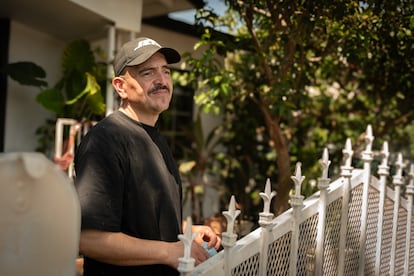

From Francisco Sosa’s front yard, you can see the imposing metal structure of the SoFi stadium in Los Angeles, California. Eight FIFA World Cup matches will be played on that pitch, but its proximity is irrelevant as far as Sosa is concerned; he is already resigned to watching the games of the most expensive tournament in history on TV. “There’s no money right now,” says the 41-year-old U.S. citizen who is a fervent supporter of the Mexican national team. When he learned that a luxury box for the match between the United States and Paraguay was selling for $112,500, his reaction was immediate: “Fuck! It’s too much.”
The absence of SoFi’s neighbors in the stands reflects the social inequality suffered by this mainly Hispanic working-class community in a location increasingly coveted by developers and investors who regard the stadium as a gold mine for business opportunities. The community lives in the shadow of gentrification, and activists allege that unjustified evictions have become more frequent. These families, however, are the ones who will have to put up with the chaos and traffic generated by the World Cup that will spill over into the surrounding blocks. The stadium is in Inglewood, a city in the Greater Los Angeles metropolitan area located just three kilometers from the L.A. airport.
Some residents say they did not even try to get tickets for matches that are going to be played a stone’s throw from their homes. Their bank accounts are already reeling from California’s soaring cost of living. The strain has been aggravated by relentless inflation and the recent rise in gas prices driven up by the war in Iran (whose team, by the way, will play at the SoFi.)
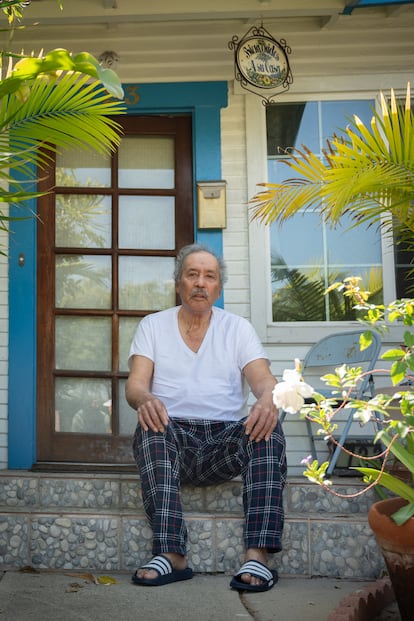
“There’s no money,” says Francisco Rosales, a 75-year-old from Zacatecas, Mexico who lives right across from the stadium’s main entrance, on the other side of Prairie Avenue. To join the well-to-do fans who have rented boxes from $23,000, Rosales says he would have to sell his modest home, which he paid for out of his gardener’s salary over 30 long years.
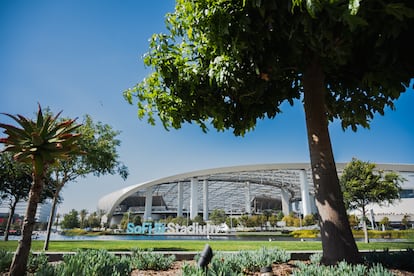
When it was announced that L.A. would be one of the locations for the World Cup, there were celebrations. This enthusiasm has, however, been tempered by the price of the tickets. The U.S. team’s opening game, which will be played on Friday, June 12, will cost fans between $1,000 and $3,600 per seat. FIFA President Gianni Infantino argued at an event in Beverly Hills that these are “market rates” adding that, if tickets had gone for cheaper prices, ticket touts would have bought them in bulk and resold them for far more. The explanation has yet to convince.
In Inglewood, even the cheapest $1,000 ticket is an unthinkable expense for families who live paycheck to paycheck. Hispanics make up 49% of Inglewood’s 102,000 residents. Only 32% of Hispanics own a home in an area where the average cost of a house is $800,000. These prices keep the majority out of the property market as the average income per household is about $72,000 per year. Fourteen percent of the population is considered poor, according to the Census Bureau. The vast majority rent a small apartment for about $1,800 a month. To the south, in neighborhoods like Lennox, the economic situation is even worse.
The ICE threat
On a hot Saturday, activists Quetzal Ceja and Jesse Rey toured the neighborhood next to the trendy SoFi Stadium and shared information on two key issues: the gentrification already underway in the area and the fear of Department of Homeland Security (DHS) agents during the FIFA tournament.
“I know that people love the World Cup and soccer, I like it too, but this year the balls are covered in the blood of all the people who have been arrested, of all the people who have been displaced from their homes,” says Ceja, a resident of Inglewood and a member of the community group HILL. “Someone has yet to tell me, ‘we’re going to a World Cup game.’ They are planning to watch it on TV. They’re worried about ICE coming for them,” he says.
Officials at ICE have indicated that the agency will play a key role in the World Cup security apparatus, a statement that has triggered alarm bells. Todd Lyons, acting director of ICE who will leave office on May 31, said in February that the agency’s work will focus on conducting national security investigations, a common task at major sporting events. Meanwhile, Kathryn Schloessman, executive director of the Los Angeles 2026 World Cup Host Committee, said in an interview with ABC7’s Eyewitness News that “ICE is going to be here, like they are for regular events, making sure that everybody is safe and secure and that there’s nothing that goes wrong. We haven’t heard anything other than that.”
Schloessman later rowed back on that statement, telling Eyewitness News that she misspoke, and saying that ICE agents are not part of the security plans at SoFi Stadium. “We are fortunate to have local, state and federal agencies working on planning for the various Los Angeles World Cup events. There will be assets deployed from multiple state and local agencies, and there is no indication that ICE will be deployed at our major events at SoFi Stadium and the L.A. Memorial Coliseum,” she clarified.
However, several videos have documented ICE operations in Inglewood starting last summer, when the agency’s deportation machinery turned its attention to the Los Angeles area. One of the most recent raids occurred on January 13. “In less than three hours, from 7 to 10 in the morning, 25 people were taken,” says Ceja.
Ceja’s organization has noted dozens of immigrant arrests since July 2025 at the Home Depot chain store located next to SoFi. For activists, the fact that the Home Depot chain store is also one of the official sponsors of the World Cup is disturbing. “They’ve taken more than 65 people from that Home Depot alone,” Ceja says.
The UNITE HERE Local 11 union, which represents stadium workers, including cooks, servers and sales staff, has expressed concern that SoFi management and FIFA have avoided responding to its repeated request to limit ICE agents’ access to the venue, leaving the issue up in the air. In March, the union sent a letter to its members reminding them that if ICE shows up at their workplace, they have the right to stop work and go home.
Although the union has stopped threatening a strike, tension persists. It now alleges that, during the accreditation process, FIFA will be sharing sensitive information regarding SoFi workers, such as Social Security numbers, addresses, nationality and country of birth, with the Department of Homeland Security. The union and the American Civil Liberties Union (ACLU) have asked the California attorney general to investigate.
Mohammad Tajsar, an attorney with the ACLU of Southern California, said in a statement that needlessly collecting people’s private data is wrong, especially when the federal government continues to use sensitive information to persecute immigrants.
The advance of gentrification
SoFi was inaugurated in 2020 and is one of the most modern stadiums in the world. It has the capacity to accommodate 70,000 fans and stands at the heart of a nearly 300-acre complex, considered the largest mixed-use urban development under construction on the west coast. The ambitious project is being driven by E. Stanley Kroenke, owner of the NFL’s Los Angeles Rams and English Premier League’s Arsenal team. The Inglewood authorities were able to attract this investment because it had the land available (the former Hollywood Park racetrack) and offered favorable tax and land use conditions. It now considers it its great achievement in terms of economic rehabilitation.
SoFi Stadium is to Inglewood what Disneyland is to Anaheim: an urban landmark and a magnet for major events. The venue already hosted Super Bowl LVI in 2022 and, after the FIFA World Cup, it is shaping up to be one of the venues for the Los Angeles 2028 Olympic Games. It has also hosted some of the biggest names in music, including Taylor Swift, Beyoncé, BTS, and Coldplay. The venue has been undergoing renovations for the past few weeks in preparation for the World Cup, for which it will be renamed Los Angeles Stadium.
Within the development, there is also the Intuit Dome, the new home of the Los Angeles Clippers basketball team; the Kia Forum and YouTube Theater venues; an NFL building and exclusive condominiums. Another project underway is the Hollywood Park film studio.
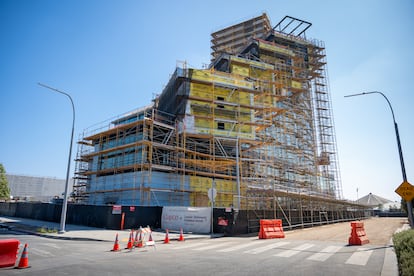
But activist Quetzal Ceja maintains that the profits from this multimillion-dollar investment stay on the other side of Prairie Avenue. Inside the complex promoted by Kroenke, he says a mall has been built with restaurants, shops and other amenities designed so that visitors do not have to leave the premises. “The promises have been hollow: it hasn’t benefited Inglewood at all,” he says.
Activists have recorded what they describe as “evictions with no excuse” in the area. “They are moving people out to build luxury apartments,” says Ceja. There are claims that landlords have resorted to illegal tactics, including abusively raising rents, neglecting basic repairs, inventing a so-called “sports tax” and even threatening to call ICE.
“Even if they agree to pay a higher rent, the owners still want to get rid of them, because they are trying to get people with more money to come to those apartments,” says Ceja. “Many people told us that their landlord warned them they had to pay $200 to cover the sports tax for the property. But that tax does not exist, it is not true.”
Kroenke Sports & Entertainment (KSE) declined to comment on either ICE’s possible presence in its stadium, gentrification or overpriced World Cup tickets. For their part, Inglewood officials did not respond to EL PAÍS.
Gabriel Barajas, a native of Michoacan, Mexico who has lived in an apartment located one block from the stadium for more than 20 years, has seen his neighbors leave because of the increase in rents. He fears that his family will be next. With his $3,000 salary a month as a laborer, he barely manages to keep up with rent rises to date – a leap from $1,200 to $1,700 in a short space of time. “It’s to drive people out, because where I live everything is emptying out. It all started when they built that stadium,” he says.
Barajas, 57, had never heard the word gentrification until his youngest daughter returned from school one day and repeated what her teacher had warned of prior to the construction of SoFi: they are going to build and they are going to displace people. “That’s what we’re seeing now,” he says.
Barajas has only entered SoFi once, for a free Los Bukis concert. He has no plan to cross Prairie Avenue for the World Cup games. “One hundred percent I’m going to watch them on TV,” he says. “Otherwise, I would have to pawn everything I have.”
Sign up for our weekly newsletter to get more English-language news coverage from EL PAÍS USA Edition









































