
From purple robes to MAGA caps: Is clothing the most despised yet most powerful political language?
In her new essay, ‘Fashion and Politics: The Appearances of Power’, university professor Ana Velasco Molpeceres traces the relationship between dress codes and political practice
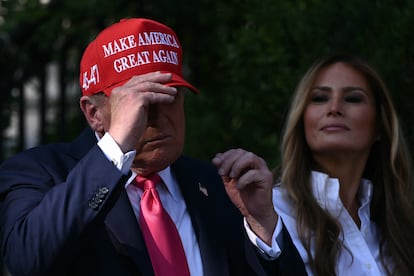
In 2018, Melania Trump traveled to several African countries — including Kenya and Egypt — to smooth things over after her husband’s remarks the previous year. It was rumored that Donald Trump considered them to be in a “shithole” region. During her visit, the First Lady faced heavy criticism while on safari for wearing a pith helmet, an item inextricably linked to the stereotypical image of an African traveler, but also reminiscent of the clothing worn by European explorers and colonial soldiers of the late 19th and early 20th centuries. In Egypt, while admiring the pyramids, she opted for a Panama hat. This didn’t fare any better. She was accused of implying white supremacy with her attire. Melania Trump told the media that they should focus more on what she did — visiting schools, engaging with the local culture — and not on what she wore.
The anecdote, though recent, serves to encapsulate the theme of the new essay by Spanish professor and journalist Ana Velasco Molpeceres. Moda y política. Las apariencias del poder (Fashion and Politics: The Appearances of Power), published at the end of March, is a further step in her research into the world of fashion and its historical and social implications.
“Fashion has been the most despised and persecuted political language […] Also the most explicit and admired. […] Legitimacy needs staging. Power, before dictating laws, constructs images. And the first of these is the clothed body,” she states on the first page. The essay embarks on a detailed recapitulation spanning millennia, from the Persian Empire (550-330 BC) to the attitudes found in the current U.S. administration. Wherever a civilization established its ranks of authority and dominion, fashion was part of them. Special attention was paid to its observance and to the punishment for disobedience. The purple color of togas and ornaments, extracted from the mollusk Murex brandaris, was chosen as the color of those who governed, whether Hebrews, Romans, or medieval cardinals; some as a distinctive mark to honor those fallen in battle, and others in their religious services. In ancient times, every garment and its color were meant to convey veneration, if not submission.
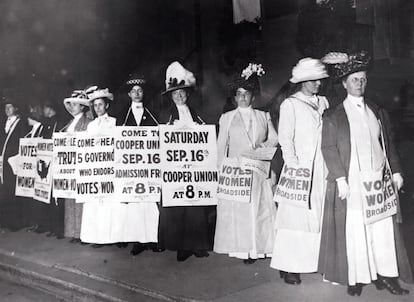
It is interesting to observe the transition and application of various garments and their representative colors throughout the centuries. White and mauve in the jewelry and textiles of the suffragettes at the end of the 19th century. Purple in the Spanish republican flag (1931-1939) and its legacy in today’s Podemos party (since 2014). All of these are examples of colors that had been emblems of privilege and hierarchies, from Roman times to the Renaissance, later appropriated for democratic purposes. Long women’s hair and the veils that covered it, a threat to Christianity between the 2nd and 4th centuries, evolved into the garçon cut at the beginning of the 20th century and the disappearance of hats due to references in cinematic imagery, especially Louise Brooks.
In revolutionary Russia, the adherence of artists and designers — Aleksandra Ekster, Nadezhda Lamanova, and Alla Levashova — some of whom had previously been vetted for their Tsarist connections, helped shape the ideal of proletarian fashion “with abstract designs, geometric patterns, […] natural drape, and wide sleeves,” aligned with the productivist vision of art. There was also the inevitable shift towards Western fashions during the Cold War, with the importation of patterns from Yves Saint Laurent and Christian Dior, with mixed results despite the efforts of Levashova, who directed the SKhKB (Special Bureau of Artistic and Industrial Design) of the Ministry of Light Industry. A degree of openness was finally seen under Slava Zaitsev, head of the Soviet Union’s Fashion House, from 1965 to 1978, nicknamed the “Red Dior” in the 1980s.
The details made all the difference. Accessories placed rulers and their acolytes before the gaze of their subjects. The coin-covered cape of the Count of Villamediana and the motto “They are my loves,” a reference to the luxury and gambling prevalent at the 17th-century Spanish court. The jeweled pendant of the privateer Francis Drake, presented by Queen Elizabeth I in recognition of his services to the English crown. The Phrygian caps and tricolor cockades of the Members of the French Commune (1793-1794). The red, blue, black, and brown shirts of the militias of the liberator Garibaldi, the Spanish Falange, and the youth wings of the Italian Fascist and German Nazi parties, respectively. The Trumpian cap with the slogan “Make America Great Again,” recycled from Ronald Reagan’s presidency...
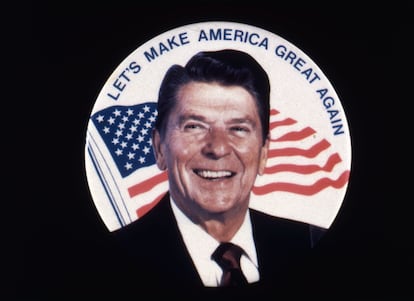
The vast array of elements, from election pins and Chanel dresses—a staple for Jacqueline Kennedy, designed by the New York fashion house Chez Ninon—to the sunglasses worn by presidents—Pedro Sánchez’s Ray-Ban Caravans inside the Falcon—parade through the pages of the essay, highlighting the delicate line between classism and integration, between elegance and mere ambition. Fashion shapes the sense of what one intends to direct or transgress, in addition to its inexhaustible capacity for emancipation and change. That’s no small thing. It’s best to be presentable for every occasion.
Sign up for our weekly newsletter to get more English-language news coverage from EL PAÍS USA Edition









































