
Frustration in Los Angeles over Olympic Games tickets: Soaring prices, steep fees and instant sellouts
Five million residents registered for an initial sale, but few had access to reasonably priced tickets: they were either unavailable or cost thousands of dollars
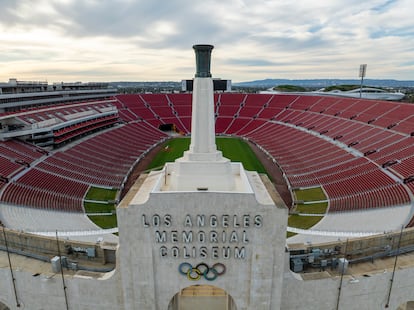

No matter how athletic you are — active or just a couch potato — the Olympic Games are one of those once-in-a-lifetime events. So, the residents of Los Angeles were thrilled when, in late 2025, they learned they would have priority access to a ticket sale for their third Games, the 2028 Summer Olympics. Registration began in early January, after zip code verification. They had to wait until the end of March, when the purchase period would open. Well, the wait is over. And so is the hope.
Buying tickets for the Gameshas turned into a collective frustration in Los Angeles. And this in a city used to both long lines and paying exorbitant amounts of money for everything, from matcha tea to a Taylor Swift concert. The problems began even before people could start buying. Some residents received confirmation emails, others didn’t; the reason was unclear. Later, it emerged that there was a delay of several days, with appointments to buy tickets on different days. Those who didn’t receive that email were able to access a later purchase (spoiler alert: there were no tickets left). According to the LA28 office — as it calls itself — more than five million people registered to buy tickets.
The emails assigned a 48‑hour window to buy up to 12 tickets in total, with a limit of four per event. Once in their session, users could choose their favorite sports, add them to their cart, and — in just 30 minutes — pick a zone (there are no assigned seats yet), select a price, and pay. Sales opened on the afternoon of April 2, with seats starting at $28. But only a few people — essentially those lucky enough to be slotted into the earliest purchase windows, apparently at random — ever saw those. By Friday afternoon, everything had become complicated.
Angelenos found that the normally priced tickets had vanished and weren’t being restocked. The rest were either exorbitantly priced or simply didn’t exist. For the closing ceremony, only $5,000 tickets remained. For the opening ceremony, everything disappeared in minutes. The cheapest tickets — a mirage — started at $328, rising in categories to $5,500 (and including $500, $700, $1,000, $1,600, $2,600, and $3,900). No Angeleno managed to catch a glimpse of them.
And it wasn’t just tickets to the ceremonies that caused despair. Tickets for the finals — gymnastics, soccer, track and field, tennis, men’s, women’s, mixed — vanished with the first buyers. There were no more available after the initial sales. Prices were still visible online; if anything remained, it was for the highest categories: over $600 for the women’s artistic swimming final, an hour south of the city; more than $1,300 for the women’s or men’s soccer final, an hour north. Many preliminary rounds were sold out or exorbitantly priced. Social media was flooded with critical comments, complaining that access seemed to be reserved for the wealthy.
And then there’s the issue of taxes. Each ticket carries a 24% tax, which local residents and press are calling exorbitant. EL PAÍS contacted the organizers to ask about the reason for — and destination of — this charge. Their only response is that these “service fees,” as they call them, “align with standard industry practices for ticketing live events in the U.S.,” and that they cover “the costs of securely processing and delivering tickets, such as ticketing platform development, customer service, payment processing, fulfillment and distribution.” They also argue that the ticket holder knows the total price, including taxes, from the outset. But that doesn’t explain why a quarter of the cost — already high — goes to fees. In any case, customers who want a paper ticket still have to pay for it: almost $20 per person per event.
Comparisons don’t paint Los Angeles in a good light either: for Paris 2024, it was easy to get tickets for less than $120 (including for finals), and for the closing ceremony, they cost just $260 and could be bought a few days in advance; 5% of the current price.
The story is repeating itself with ticket prices for this summer’s World Cup. In Los Angeles, the cheapest category for the semifinals costs around $1,000 (though the price varied depending on the fan’s country of origin); for the final, $5,000. And that’s for the cheapest tickets: the most expensive are approaching $11,000, and rising month by month. On resale platforms, they are even more expensive. A European football consumer association has even filed a formal complaint against FIFA over the prices.
All of this — coupled with the fact that the city is far from prepared for an influx like the Olympic Games will bring — makes chaos seem inevitable. A Deloitte report estimates around 15 million visitors over the 19 days of competition, with some days seeing up to half a million. With impossibly long distances, extremely limited public transport (not even the airport is well-connected to the city), a restricted hotel supply (around 100,000 rooms in total), and elections in six months that will turn everything upside down, bedlam is already looming two years from now.
Ticket prices and the lack of availability are infuriating Angelenos. The Games organizers claim they will sell up to one million tickets for under $30, and that two-thirds will cost less than $200. But if this was the best chance locals had, what will the next ones look like? And what will residents or visitors be able to get that’s affordable? They’ll have to wait a couple more years and, in the meantime, settle for watching a golf qualifier on a Thursday at 9:00 a.m. for $28.
Sign up for our weekly newsletter to get more English-language news coverage from EL PAÍS USA Edition









































