
US opens door to the 2026 World Cup, the biggest event in soccer
Along with Mexico and Canada, the United States is co-hosting a tournament it hopes will become a highly lucrative business. The goal is for soccer to definitively seduce the country with the world’s largest advertising market
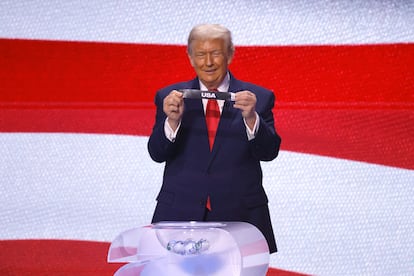

The United States aims to make the finals of the 2026 World Cup, which it is co-hosting with Canada and Mexico, the biggest sporting spectacle on the planet. The draw to determine the 12 groups for the 48 national teams—the largest number of participants in history—was worthy of Hollywood. “Nessun Dorma,” the famous aria from the opera Turandot, performed by Andrea Bocelli, opened a gala that also featured performances by Robbie Williams, Nicole Scherzinger, and Lauryn Hill, one of the greatest rappers of all time. The Village People, with their popular hit “YMCA,” closed the show.
The United States may not know much about soccer [its national team isn’t among the favorites], but it certainly knows about show business, a medium in which Donald Trump thrives. The goal is for soccer to definitively seduce the country with the world’s largest advertising market, where the most tickets and licensed merchandise are sold. With 104 matches scheduled, more than ever before, FIFA expects it to be a highly lucrative tournament with an audience of 2 billion people.
The final phase begins on June 11 when Mexico and South Africa will face off at the Azteca Stadium, the venue with the most opening matches. The draw has been seemingly favorable for Spain, one of the favorites, which was placed in Group H alongside Cape Verde, Saudi Arabia and Uruguay. Luis de La Fuente’s team enters the competition as clear favorites, along with Argentina, England, and Germany. FIFA will hold the draw for the venues and schedule this Saturday to accommodate television broadcasts.
It will be the last World Cup for Lionel Messi and Cristiano Ronaldo; it will also be the championship where Kylian Mbappé, Erling Haaland, Vinicius Jr., and Vitinha are expected to shine; it must also be the tournament that definitively establishes players like Lamine Yamal and Doué. However, they will be competing for attention with a figure who threatens to overshadow them all: the president of the United States, Donald Trump.
The group draw has had some peculiarities: each of the host nations will head one of the 12 groups, for which they have been given a more accessible group, at least initially. Furthermore, the top four teams in the FIFA rankings—Spain, Argentina, France, and England—cannot face each other until at least the semifinals. The two favorites, for example, Spain and Argentina, cannot meet until the final. Additionally, there cannot be more than one country from the same continent in each group, except for European teams, of which a maximum of two could be in the same group.
One of the highlights of the gala was a video message in which actor Matthew McConaughey, a huge soccer fan and owner of an MLS team, and actress Salma Hayek encouraged former soccer player Rio Ferdinand to co-host the draw with presenter Samantha Johnson. Model Heidi Klum attended the gala accompanied by American comedian Kevin Hart.
FIFA and Trump
The U.S. president’s thirst for the spotlight, indulged by FIFA leader Gianni Infantino as master of ceremonies, marked the gala, held at the Kennedy Center in the U.S. capital, and also attended by the Prime Minister of Canada, Mark Carney, and the President of Mexico, Claudia Sheinbaum, co-hosts of the World Cup.
An elated Trump received the new FIFA Peace Prize from his close friend Infantino, an award expressly designed to please the U.S. president, who had expressed his desire to win the Nobel Peace Prize, which instead went this year to Venezuelan opposition leader Maria Corina Machado. Before the winner was announced, everyone at the gala knew Trump would accept the prize, given his close friendship with the FIFA president and the latter’s determination to please his host above all else.
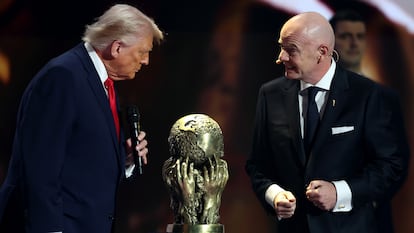
Relations between the three host countries have been tense since Trump took office. The three leaders sat in the same box, but separated from one another, highlighting the distance between them following the U.S. president’s threats to annex Canada and the tightening of immigration policies with raids and deportations. But soccer can thaw tempers, at least for a while. “It’s a great honor,” said Trump, before moving on to say that ticket sales have been phenomenal.
The 2026 World Cup will be held jointly in 11 U.S. cities, three Canadian cities, and two Mexican cities. While there are doubts about the United States’ ability to organize the championship due to its obsession with security and disregard for other issues affecting athletes, there are no doubts about its fantastic sense of spectacle. The organizers chose four of the brightest stars in the world of sports to draw the balls: Tom Brady, one of the greatest American football players; former NBA player Shaquille O’Neal; NHL legend Wayne Gretzky and Major League Baseball legend Aaron Judge.
Around seven million visitors are expected to travel to the United States for the games. FIFA anticipates record advertising revenue from the most expensive World Cup in history. Ticket prices for matches have doubled and, in some cases, increased eightfold. Tickets for the final, for example, can cost more than $6,700.
List of groups
Group A: Mexico, South Africa, South Korea, Playoff D
Group B: Canada, Qatar, Switzerland, Playoff A
Group C: Brazil, Morocco, Scotland, Haiti
Group D: USA, Paraguay, Australia, Playoff C
Group E: Germany, Côte d’Ivoire, Ecuador, Curaçao
Group F: Netherlands, Japan, Tunisia, Playoff B
Group G: Belgium, Iran, Egypt
Group H: Spain, Uruguay, Saudi Arabia, Cape Verde
Group I: France, Senegal, Norway, Playoff 2
Group J: Argentina, Austria, Algeria, Jordan
Group K: Portugal, Colombia, Uzbekistan, Playoff 1
Group L: England, Croatia, Panama
Sign up for our weekly newsletter to get more English-language news coverage from EL PAÍS USA Edition









































