
Soccer offers Mexico and Canada a respite from Trump’s attacks
Sheinbaum visited Washington for the first time for the World Cup draw gala. The US president is being friendly with his North American partners after months of threats and insults
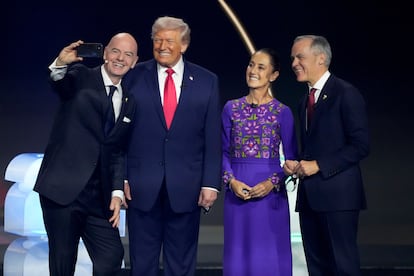

Had Washington not awakened to the first snowfall of winter, it might have been an opportunity to invoke the familiar image of a thaw in relations between U.S. President Donald Trump, his Mexican counterpart Claudia Sheinbaum, who was visiting the U.S. capital for the first time, and Canadian Prime Minister Mark Carney. The three North American partners are about to close out the most tense year in their relationship since the signing of the free trade agreement in the 1990s, but this Friday those squabbles—and Trump’s threats and insults—were momentarily set aside in the name of soccer.
The reason for the unofficial trilateral summit (a group that, in a past that now seems distant, used to present itself as “The Three Amigos”) was the draw for the FIFA World Cup, which will be held next year in stadiums spread across 16 cities in the three countries.
FIFA, its organizer, usually argues that politics has no place in the tournament, but at Friday’s event, held at the Kennedy Center in Washington DC, the city’s great temple of music and performing arts now at the service of MAGA ideals, politics were more present than ever.
That pledge of neutrality of football’s governing body didn’t stop Gianni Infantino, its president, from honoring Trump by giving him the FIFA Peace Prize, invented on the spot as a consolation prize for the U.S. president and delivered one week before the one the president truly craves, the Nobel Peace Prize, which will be presented in Oslo to Venezuelan dissident María Corina Machado.
In his acceptance speech, the U.S. president claimed with characteristic exaggeration to have ended eight wars, and praised the “working relationship” of the U.S., Mexico and Canada: “I want to say that our coordination and friendship and relationship has been outstanding.” Earlier, he had told reporters who follow him daily that he would discuss trade with his partners after the draw, although he didn’t give any further details about when or how.
The three leaders then took to the stage of the Kennedy Center Opera House and stood behind music stands bearing the number 26. Sheinbaum, speaking in Spanish, presented an “extraordinary, beautiful, magical” Mexico. “We have played the ball game since ancient times,” she added.
Trump, for his part, recalled that this would not be the first time that soccer has tried to take root in the United States: he went back to the days of Pelé at the Cosmos, the defunct New York team. Infantino took a selfie with the three of them and they returned to the presidential box of the opera house in the cultural complex.
Threats of tariffs and security demands
The event was surrounded by uncertainty about the match-ups that the draw would give the 48 qualified countries (not the groups in which the host teams would fall; that was decided beforehand), but also by how Trump would behave in the presence of allies whom he has been threatening for months with tariffs and reprimanding for not doing enough to stop the trafficking of fentanyl, a powerful opiate that has caused a sensational crisis of tens of thousands of overdose deaths.
In the case of Mexico, these threats have been escalating in recent weeks, when the U.S. president has flirted with the idea of launching a military offensive to decapitate the drug cartels, as he has been doing with the extrajudicial killings of the crew members of the alleged drug boats in international waters of the Caribbean and the Pacific.
Trump’s personal relationship with Sheinbaum has been cordial in recent months. After nearly two dozen calls, letters, and a string of direct and indirect allusions, this Friday brought the crucial test of face-to-face contact, something the Mexican president had clearly avoided. A bilateral meeting in the Oval Office did not take place, a meeting that would have exposed Sheinbaum to another kind of gamble, where she could have drawn one of two balls from the White House’s lottery drum: a cordial encounter despite previous attacks, such as those from New York’s mayor-elect, Zohran Mamdani, or an ambush in the style of the one orchestrated against Ukrainian President Volodymyr Zelensky, which made headlines worldwide last February.
A brief meeting was planned, in which both leaders expected to discuss security and trade issues. Trump has imposed 25% tariffs on all products not included in the USMCA, as well as 25% tariffs on automobiles and 50% tariffs on steel, aluminum, and copper. It was also hoped that Sheinbaum, who has already extradited more than 50 organized crime leaders to Washington in two separate transfers, would offer a third round of drug traffickers from Mexican prisons to those in the United States.
Carney has faced the Oval Office ordeal twice. The first time, he reminded Trump that “Canada is not for sale,” and emerged unscathed from a hostile climate, fostered by the U.S. president even before taking office, and by his alleged aspirations to make the northern neighbor the 51st state of the Union.
The shift in relations between the two longtime allies has awakened dormant nationalism in Canada, fueled boycotts of American products, and disrupted the plans of many Canadians to cross the border for vacations or business. Hence the surprise at the selection of hockey legend Wayne Gretzky, a friend of Trump and recently criticized by his compatriots for his affinity with the MAGA movement after decades of living in the United States, to represent the country in the lottery draw.
Sign up for our weekly newsletter to get more English-language news coverage from EL PAÍS USA Edition









































