
Defying fear in California’s fields, ground zero of Trump’s immigration paradox
In the agricultural heart of the country’s most productive state, more than half of farmworkers are estimated to be undocumented, yet farmers decisively voted last year for the Republican candidate who promised to deport them. The tension between political promises and economic needs has created a contradiction with no immediate solution

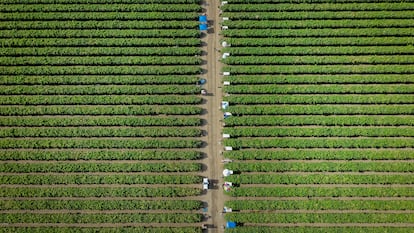
María moves busily among the vines under the August morning sun, as if nothing existed beyond the dust and the grapes. After 23 years working the fields of California, this 45-year-old woman, born in Michoacán in western Mexico but raised just south of the U.S. border, is a one-woman production line. She gathers two large crates of green grapes and carries them to the small station where she sorts and packs them. Around her, 60 others do the same, each assigned to a row beneath the trellis. By the end of the day, those migrant hands will have produced countless kilos. In this way, day after day, decade after decade, they have made this land their own.
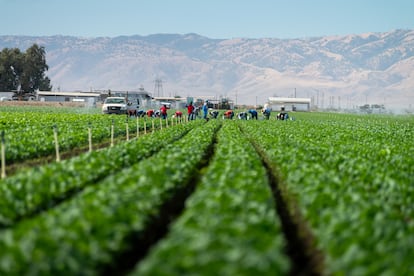
“I’m from here, from Mexico,” María says firmly, without hesitation and without seeing any contradiction. Spanish — colored by a variety of Mexican accents — is the lingua franca of the fields, but the reality is that this vineyard on the outskirts of Bakersfield, in the fertile heart of California’s Central Valley, is the United States. In the era of Donald Trump, whose declared mission is to deport every undocumented foreigner, this region embodies the central paradox of his immigration policy. If he were to follow through on his promise and, overnight, the millions of undocumented migrants working in the country were gone, sectors such as construction or caregiving would be hit hard nationwide — but agriculture, especially in California, would collapse entirely. And yet, in the state’s farming counties, where the voters are mostly native ranchers, Trump won overwhelmingly. Now, however, his immigration agenda is threatening their businesses, since nowhere in the country is as dependent on migrant labor.
This is no ordinary place. From California’s agricultural counties comes a third of all the vegetables produced in the United States, and two-thirds of the fruits and nuts. It is a territory the size of Portugal — 40% of California’s land — dedicated to farming: a vast grid of almond orchards, tomato fields, peach trees, and countless other crops that demand thousands of hands to tend them. Because farm work is seasonal, only about half of the nearly 900,000 agricultural workers are employed in any given season. Of these, studies estimate that between 45% and 70% are undocumented immigrants. In the midst of an immigration crackdown that has put them in the crosshairs of the federal government, this living engine that makes California the nation’s leading agricultural state is living and working each day under this threat.
In addition to reports indicating that the government has a daily quota of 3,000 arrests, California ranks as the third state with the highest number of immigration detentions since Trump returned to the White House, behind only Texas and Florida. And it has likely been the most high-profile. In early July, a massive raid on an industrial cannabis farm led to a clash with Immigration and Customs Enforcement (ICE) agents that ended with 200 arrests and one death.
A month earlier, a series of raids sparked protests in Los Angeles that dominated the national conversation, set off a direct confrontation between Governor Gavin Newsom and President Trump, and led to the federal deployment of 4,000 National Guard troops and 700 Marines to the city. Over the past three months alone, 5,000 people have been arrested in Los Angeles for deportation, according to a recent announcement by Homeland Security Secretary Kristi Noem.
The fear that lingers
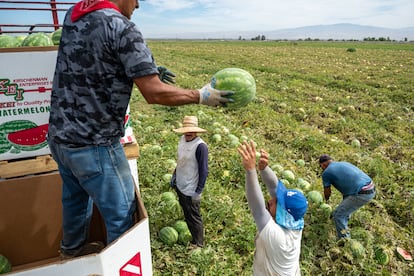
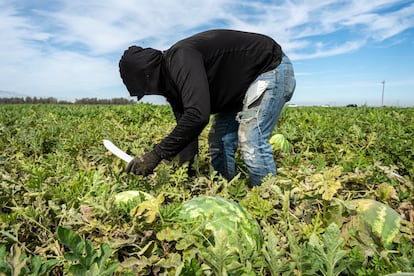
The calm and apparent normalcy in California’s fields can make one forget that the shadow of ICE permanently hangs over undocumented farmworkers. But in the chest of Sergio, a 40-year-old worker from Veracruz who crossed the border without a visa 20 years ago, it’s a constant knot. As he tosses freshly harvested watermelons to his partner, who catches them and packs them onto a truck moving relentlessly forward, he runs the numbers that force him to swallow his fear: “I can make $600 a week. But rent is $1,200, I spend $20 a day on gas, $20 on lunch, and then there are the kids’ expenses. There’s nothing left. I have to take the risk, even with the police around.”
For María, whose nine-hour shifts among the green grapevines have become routine over the years, time has brought lessons that ease the fear of ending up in a detention center. “Here I’m calm,” she says, her smile hinted at beneath the scarf covering her face to shield her from the chemicals sprayed on the vines. “Immigration officers can’t come into the fields while we’re working,” she explains, her hands never stopping as she packs bunch after bunch of fruit. Since the land is private property, without a court order the employer’s rights also protect the worker during the workday.
It is on the way to the fields — where rows of parked cars give away the presence of laborers — or on the long drives home, which can last up to two hours, that migrant workers are most vulnerable. Just before Trump’s second presidency began, as a warning of what was to come, Border Patrol carried out a multi-day operation in Kern County, the southern gateway to California’s vast agricultural territory. It was an unprecedented raid: people were detained — even U.S. citizens — on their way to work or simply on the street because of how they looked or the jobs they held. Dozens were deported within hours. In the days and weeks that followed, panic spread unchecked, and many people stayed home, leaving fields and schools empty, taking shelter from agents who boasted about their cruelty on social media.
Sooner rather than later, however, the need to work prevailed. A small legal victory also brought some relief. In April, the American Civil Liberties Union (ACLU) and the United Farm Workers (UFW) won a lawsuit barring Border Patrol from operating so far from the border. In July, another court order prohibited racial profiling in immigration raids in Southern California. Still, nearly every worker knows someone who has been detained, often when showing up for routine immigration check-ins. And reports of recent raids suggest that ICE never truly abided by the last order, which is no longer in effect after the Supreme Court accepted the government’s appeal.
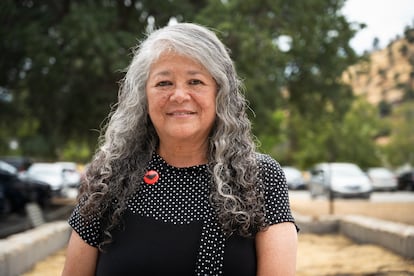
Teresa Romero, the current president of the United Farm Workers (UFW) — founded in the 1960s by the iconic labor organizer César Chávez — says the current climate only strengthens their mission. “We continue to organize workers, and we are going to keep doing everything possible to protect them,” she explains from her office at the union’s headquarters, located at the southern edge of California’s Sierra, home to giant sequoias and the granite towers of Yosemite.
But beyond its natural wonders, Hollywood glamour, and Silicon Valley innovation, California is farm country. And the current context finds the UFW in a period of growth, boosted by political measures that came to its aid. After years of dwindling membership, in 2022 Governor Gavin Newsom signed a law making it easier to vote for union representation by allowing secret ballots through cards rather than in-person elections under the watchful eye of employers.
The union has secured a handful of victories over the past year. UFW’s top priorities include winning better conditions for workers: fairer pay by the hour rather than tied to production speed, basic health insurance, dignified treatment, essential tools — and now also a clear protocol for what to do in the event of an immigration raid.
Alejandro, a farmworker at an Asian vegetable plantation in southern Bakersfield who formalized his union contract late last year, recalls how he worked during the eight years before that. “We made $70 in 12 hours. We’d start at 6 a.m. and sometimes wouldn’t leave until 7 p.m. On a good day, we might reach $120, but normally it was about $8 an hour,” he says. In California, the current minimum wage is $16.50 an hour — more than double what this farmworker used to make on average.
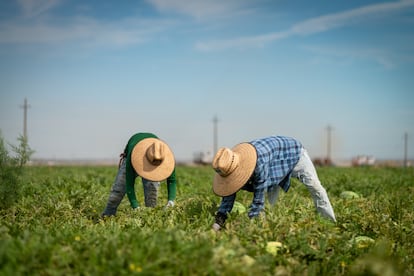
Less than 1% of farmworkers are unionized, which means that abuses and irregular practices — enforced through constant threats of dismissal and difficult to report due to language barriers or fear of exposing oneself to immigration authorities — are common, according to the workers’ own accounts. This is the case despite the fact that California is one of only two states, along with New York, that provide labor protections for farmworkers. Now, though the evidence is anecdotal, there are fears that conditions could worsen if employers exploit the heightened risk of deportation to further intimidate workers.
Embracing fear
For Francisco, the constant threats and abuses pushed him to his limit in early July, when he quit his job at a Central California dairy where he had worked for eight years. “There were about 450 cows for one person to milk on a ten-and-a-half-hour shift, with no break, no lunch, no drinking water, no bathroom, and on top of that you had to clean the pens and the machines for the next shift,” explains the man, originally from the Mexican state of Jalisco, who crossed the border without papers two decades ago.
“The worst part was the way they treated us,” says Francisco, who recalls specific episodes: being forced to clean the inside of a chemical tank, holding his breath and sticking his head out every so often just to breathe; or the time he was electrocuted and lay unconscious for hours until the coworker on the next shift found him in a puddle of mud. Because he had no health insurance, when he finally woke up, he couldn’t even go to the hospital. He now says he feels “something” in his chest but adds, “there’s no way to get it checked.”
Even so, Francisco insists he no longer feels afraid. The most immediate fear — how to make a living — doesn’t trouble him much; he knows he’ll find another job quickly. And as for the fear of deportation, he embraces it as a possible fate that one can run from until his day comes. Two months ago, it was his brother’s turn; he is now back in Mexico for the first time in 23 years.
When stories of entire lives unraveled by deportation become routine, the only thing to do is prepare for the moment. Nearly seven months into the current administration, every worker knows the rules — like the fact that ICE agents cannot enter workplaces. Some have left clear instructions about what to do with their belongings if they are deported, and many carry their “red card,” a small document listing migrants’ rights, in case they are detained. Much of this civic education has come from community organizations that in recent months have devoted considerable effort to empowering migrants.
The situation has laid bare the full picture of California’s agriculture. It is a vast and essential industry, as shown by the fact that during the pandemic farmworkers were among the few who kept working in the state. The system is built on migrants, many undocumented, earning meager wages and enduring conditions that can border on exploitation. “I’ve never seen an American in the fields,” farmworkers repeat from one farm to another.
So far, raids in the fields have been limited — whether because of court rulings or because growers themselves have asked the government to stay away from their workers. Still, the impact is already visible in labor statistics. According to a recent study by the University of California, Merced, private-sector employment in the state has fallen by 4.9% in recent months. While most of those affected are citizens and other economic factors, like tariffs, also play a role, the economic footprint of the crackdown on migrants — evident as well in reduced spending by this community in local commerce — is comparable, the report notes, to the toll of the financial crisis or the pandemic.
Deep-rooted fear
The situation is unsustainable on all three fronts, each under tension. On one side are the farmers, seeking favorable conditions for their businesses, tax breaks, trade advantages, and a large pool of employees willing to work for low wages under harsh conditions.
Then there is the federal government, indebted to these farmers who contributed so much to its electoral victory — both in votes and in donations — yet championing deportations as one of its main ideological banners. Finally, there are the workers and their families, who feed the country in exchange for the hope of living in peace and perhaps sending their children to college.
Reconciling the conflicting economic interests of farmers and workers, alongside the anti-immigrant stance of the Trump administration, has become one of the greatest paradoxes of Trumpism. Bryan Little, senior director of public policy at the California Farm Bureau, the statewide farmers’ guild, acknowledges the concern. “We have been very clear that [raids and mass deportations] could have a destructive effect on food production. And that could generate inflation, not to mention that it would devastate local communities.”
The contradiction extends even to the president’s own statements. In June, he admitted he would ease immigration enforcement in the agricultural sector to avoid disrupting operations, but a few days later he backtracked, suggesting a program where farmers could “sponsor” their migrant workers to prevent deportation.
In a recent interview with The Daily Caller, the president was even more explicit: “I have two groups [..] people that don’t want to allow people to come into the country illegally, and the farmers. [...] And it’s a little at odds, because some of the people coming in for many years have worked on farms, and they’ve been good, and in many cases, they pay taxes. [...] And some of my best people don’t want anybody in for any reason, no matter what. [...] So we’re working on legislation now that I think it going to make everybody happy.”
But the various bills introduced in Congress to find a lasting solution to this structural problem show that it is not so simple. One example is the Farm Workforce Modernization Act, a bipartisan effort specifically aimed at reconciling the differences between farmers and workers, that offers a path to legalize migrant farmworkers. Yet this legislation has been stalled for years due to opposition from the radical wing of the Republicans, who reject labor protections for farmworkers.
On the other hand, the proposal known as Braceros 2.0, introduced two months ago by a Republican congresswoman from Texas, simply seeks to expand the temporary visa system for farmworkers, the H-2A program. On paper, this would allow thousands of undocumented workers to be deported and replaced legally without causing an unsustainable wage increase for farmers, which could result from a sudden and massive surge in demand for labor. However, the measure faces significant skepticism, as it is unclear whether the U.S. can attract millions of temporary workers for the grueling tasks of agricultural labor.
While these debates advance — or stall — in the offices of Sacramento and Washington, under the almond trees that stretch uniformly across California’s Central Valley, Lidia smiles as if the world beyond does not exist. This Oaxacan woman has been harvesting tomatoes for one of the country’s largest producers for 23 years — ten more than her age when she first arrived in the U.S. — and explains that the key is to fill the bucket to the brim, not a drop more. A few extra dollars at the end of the month depend on it.
Credits
Sign up for our weekly newsletter to get more English-language news coverage from EL PAÍS USA Edition