
Farmworker activist Alfredo Juárez Zeferino’s ICE ordeal: An express arrest and three months in limbo
The case of a founding member of a small independent union representing Indigenous farmworkers in Washington raises concerns about potential persecution of migrant labor activists
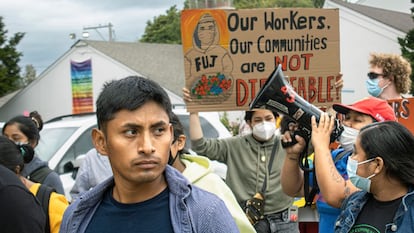

When he was 13, Alfredo Lelo Juárez Zeferino was already working picking strawberries on a farm in Washington state, some 2,500 miles north of his small hometown in the mountains of Guerrero, Mexico. In 2013, he and 200 other workers, almost all Indigenous like him, walked off the fields to demand better working conditions and wages.
That was the beginning of his struggle. He naturally became a spokesperson and interlocutor, as he is trilingual: he speaks Spanish, Mixtec, and English. In 2017, he and his colleagues succeeded in forming Families United for Justice, an independent union representing about 400 Indigenous farmworkers in the two northernmost counties of the state. In March of this year, he was arrested by agents of the Immigration and Customs Enforcement (ICE) and has been detained ever since. For his colleagues, his arrest is no coincidence.
On the morning of March 25, according to the account of one of his union colleagues, Juárez was giving his girlfriend a ride to her job at a tulip plantation when he noticed a car without special identification following him. The car turned on its lights and made him pull over and stop. An ICE agent dressed in civilian clothes emerged and asked Juárez for his papers; Juárez had lowered the window to communicate and request a warrant.
When he turned to get his papers, they broke the window without warning. Juárez then got out of his car, but was immediately handcuffed and put into another vehicle, which took him to an industrial warehouse that he and other activists had identified years before as a clandestine ICE investigative center. That night, protests were organized outside demanding his release. But Juárez was transferred to the ICE processing center in Tacoma, nearly 120 miles to the south. He has been there ever since.
According to the official version, Juárez’s detention is due to a deportation order dating back to 2018 and originating in 2015, when Juárez — still a minor protected under the Deferred Action for Childhood Arrivals (DACA) program — was briefly arrested by local authorities and handed over to ICE. Juárez sued the local police for racial profiling and received a $100,000 settlement a few years later.
Now the Department of Homeland Security (DHS) accuses Juárez of not complying with the orders of the agent who arrested him, forcing them to use force to subdue him, and of being a flight risk for failing to appear at his deportation hearing seven years ago.
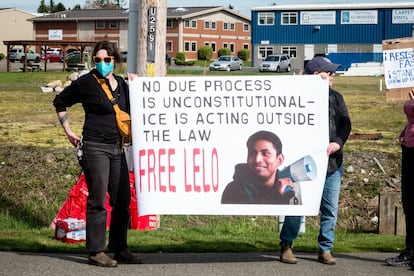
His lawyer vehemently refutes these claims and adds that the fact that multiple federal agencies collaborated in Juárez’s arrest shows it was targeted and premeditated. The lawyer also argues that Juárez failed to appear at his deportation hearing because he never received the notice— it was sent to a bounced email address. On that basis, the lawyer succeeded in reopening the case in April, just one day before he was scheduled to be deported. However, he has not yet succeeded in getting the case dismissed or obtaining parole, despite having no criminal record. The next step, the lawyer says, is to apply for asylum.
Juárez’s attorney refrains from outright saying that the arrest was politically motivated due to his client’s activism. But the question hangs in the air, especially as the Trump administration has launched aggressive crackdowns on activists and public figures who have spoken out against immigration or labor abuses and voiced support for Palestine.
And Juárez is a recognizable face. He has played a key role in winning protections for farmworkers in Washington state, including a rule requiring water breaks when temperatures exceed 80°F (26°C) and overtime pay. Additionally, in 2019, his advocacy over abuses in the H-2A visa program for temporary agricultural workers pushed the state to create the first foreign worker oversight committee in the country.
The fear that his case could set a federal precedent has alarmed labor organizers concerned about farmworkers’ ability to organize and defend their rights. There is concern that immigration enforcement could intimidate people into silence. Since Juárez’s arrest, several other reports have emerged of union activists being detained by immigration agents. The fact that he was denied bond, despite his clean record, has been interpreted as a tactic to repress social movements through the immigration system.
Juárez’s case has caught the attention of the district’s representative in Congress, Democrat Rick Larsen, who visited him in late June at the ICE detention center, where he has now been held for more than three months. Larsen highlighted the poor conditions in which the roughly 1,500 detainees are being held.
“They aren’t staffed up fully to be able to serve these people every day with even basic services. They say they’re trying to do their best but still falling short,” Larsen said in a video outside the facility after his visit. The legislator has vowed to fight for detainees to have a decent place to sleep, three meals a day, the ability to communicate with loved ones, and access to legal representation — adding that only 10% of those detained have lawyers.
Representative Larsen’s support is just the tip of the iceberg. Juárez has requested a visit from Washington’s two U.S. senators, Patty Murray and Maria Cantwell, Democrats who have each served in Congress for two decades. But the most meaningful support is the one he hasn’t had to ask for: dozens of letters from his community, and the unrelenting advocacy of his fellow union members. On July 14, the date of his next hearing, a solidarity vigil is planned outside the detention center.
Sign up for our weekly newsletter to get more English-language news coverage from EL PAÍS USA Edition









































