
One in three soldiers who died in the Afghanistan war were non-US military
Data refutes Donald Trump’s statements in which he downplayed NATO’s support in the conflict, which lasted from 2001 to 2021
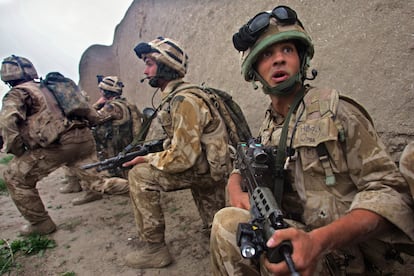
In another instance of backtracking, U.S. President Donald Trump on Saturday retracted his statements attacking and belittling the work of NATO troops in the war in Afghanistan (2001-2021): “They stayed a little back, a little off the front lines,” the U.S. president had stated last Thursday at the World Economic Forum in Davos. His words even angered British Prime Minister Keir Starmer, who is generally more measured in his responses to the Republican. Two days later, Trump changed his tune: “The great and very brave soldiers of the United Kingdom [...] were among the greatest of all warriors,” he posted on his social media account, Truth.
The data shows that 3,609 military personnel died in combat actions during the intervention in Afghanistan, of which 1,144 were non-U.S. troops, almost one in three, according to iCasualties, a database that collates all military deaths in Afghanistan from information from various media outlets and government statements.

Following the September 11, 2001 attacks perpetrated by the terrorist group Al Qaeda against New York and the Pentagon, the United States launched a massive military intervention in Afghanistan, then governed by the Taliban, who harbored Osama bin Laden, the main architect of the 9/11 plot, and hosted numerous training camps for the organization. A total of 42 NATO countries participated in the conflict, 31 of which suffered military casualties in combat. This compilation only includes deaths in combat on the ground and excludes other casualties, such as the Spanish soldiers who died in the Yak-42 plane crash. Sixty-two military personnel were on board, returning from their mission in Afghanistan, when the aircraft crashed into a mountain near the Turkish city of Trabzon.
Aside from the U.S., the country that had to bury the highest number of combatants was the UK, with 457, followed by Canada (159), France (90), and Germany (62). In the case of Spain, there were 35.
Most of these casualties — 90% — occurred between 2001 and 2014 when the mission was under the umbrella of the International Security Assistance Force (ISAF), led by NATO and under a UN mandate to fight in the Central Asian country.

In 2015, the allies abandoned the goal of implementing a new regime and opted instead to train Afghan troops capable of assuming the country’s security under the Resolute Support Mission, notes Pol Bargués, a researcher at the Barcelona Centre for International Affairs (CIDOB). “The most conflictive years were 2008, 2009, and 2010 because [the allies] ultimately wanted to achieve stability throughout the country and couldn’t quite manage it. And so they decided to plan a withdrawal,” Bargués explains.
After more than two decades of war, the allied forces, unable to defeat the Taliban regime, finally withdrew between May and August 2021.
Félix Arteaga, senior researcher for Security and Defense at the Elcano Royal Institute, asserts that, from the outset, the intervention in Afghanistan “was neither a mission to rebuild the country nor a humanitarian one, but a military one in which the majority of soldiers died in the first few years.” “It was a failed intervention that lasted 20 years,” Bargués agrees.
Regarding Trump’s statements, both insist that the U.S. president is wrong. Arteaga asserts that “it says very little about the prudence of a leader who aspires to be a world leader. They are appalling, cruel words, an insult.” He adds: “[The British troops] were as close to the front lines as the American soldiers themselves.”
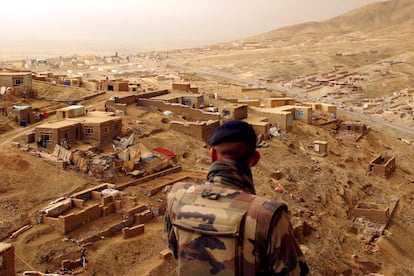
“It’s a complete lie,” Bargués asserts. The researcher interprets Trump’s behavior as reflecting his increasingly evident intention to defame his European allies, blaming them for the mission’s failure. “NATO never managed to penetrate the most remote areas of the country, that’s true. But the claim that the United States did well and NATO didn’t, and that this is why the mission failed, is essentially a lie. Trump invented it to place blame on the allies and for the U.S. to emerge victorious,” he emphasizes.
The mission’s failure, according to the CIDOB researcher, was due to several factors, but it also allowed NATO to learn for future interventions. He highlights, in particular, the need for the support of local governments — which in the case of Afghanistan was never achieved beyond the Kabul area, the capital — and for clearer and more achievable objectives. He emphasizes: “More resources do not necessarily mean better results.”
“[Former president Joe] Biden said that one of the problems was that there were too many goals, too ambitious, and that from that moment on they will no longer carry out nation building, which is understood as building a nation, a state, from the outside,” explains Bargués.
Arteaga points out that the “failure” of the war in Afghanistan and the attitude shown by Trump generate “a feeling of distrust regarding the United States,” and as such, he concludes, “the distancing of the allies is inevitable.”
Sign up for our weekly newsletter to get more English-language news coverage from EL PAÍS USA Edition









































