
Davos highlights the deterioration of America’s international standing
The World Economic Forum shows how Trump’s policies are alienating traditional allies, giving more space to China and garnering marginal support

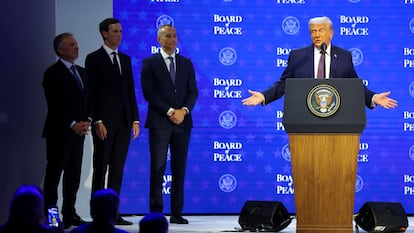
The image on the Davos stage was crystal clear. The United States, the world’s leading power, the country that forged the most formidable network of alliances in history and, thanks to it, was able to wield an astonishing level of hegemony, presented a new international diplomatic project to the world’s rich and powerful gathered in the Swiss town. Flanked by some twenty leaders, none of them were among its major allies, none of the advanced democracies, none of the world’s largest economies. It was an emblem of what Davos has made evident: the deterioration of America’s international standing, the rapid march toward geopolitical suicide that consists of undermining the network of alliances and fomenting resentment through unrestrained abuse and humiliations.
On the Davos stage, Donald Trump’s performance—his now-traditional litany of self-praising arguments—was backed up by leaders such as Javier Milei of Argentina, Viktor Orbán of Hungary, and the presidents of Indonesia, Pakistan, Mongolia, Qatar, Kazakhstan, Azerbaijan, Armenia and Paraguay, as well as foreign ministers from Morocco and Turkey, among others. “This group, I like every single one of them, can you believe it? Usually I have about two or three that I can’t stand. But I like every single one of them. They’re great people. Great leaders. The Board of Peace is made up of leaders, the greatest leaders in the world,” Trump said.
But the anecdotes from Davos go beyond this scene. Traditional allies like Canada and France clearly demonstrated, through their leaders, a firm rejection of U.S. policies. Mark Carney issued a resounding call to establish resistance networks among countries that do not share the approach of brute force. Emmanuel Macron said he prefers “respect to bullies, science to conspiracy theories.” Both drew criticism from a clearly annoyed Trump. The Élysée Palace responded with a “fake news” troll to false allegations made by the U.S. leader on the Davos stage.
Although EU countries have not yet formed a truly united front against Trumpism, the threats against Greenland provoked a tangible backlash which, along with the market reaction and the reluctance of sectors within the Republican Party itself, led Trump to abandon the option of violent conquest and to withdraw the tariff threat. It is impossible to know what he will do in the future, but the shift in Davos is significant.
The level of animosity is such that, according to reports in the Financial Times and Reuters, one of usual working dinners held at the complex hosting the World Economic Forum ended with booing at the verbal attack by U.S. Commerce Secretary Howard Lutnick against the Europeans, and the subsequent departure from the room of the president of the European Central Bank (ECB), Christine Lagarde.
Meanwhile, there is no doubt that China is gaining ground in its efforts to position itself as a responsible player at the negotiating table. Its leaders have been trying for years to emphasize that they are a reliable partner in defending rules-based multilateral frameworks and free trade. Chinese Vice Premier He Lifeng reiterated this point in his letter. And while it is clear to everyone that China disregards international law when it doesn’t suit its interests—as in the case of the unfavorable ruling on a maritime dispute with the Philippines—and that there is growing concern about the surplus of production capacity developed with large subsidies and which is trying to flood other markets following Trump’s trade war, the reality is that many countries are looking at China with new eyes. The unpredictability and arrogance of the Trump administration are prompting a search for stable relations with the other global superpower.
On the other hand, China can also take advantage of the vacuum that the United States is rapidly leaving in various international institutions, opening up the opportunity for the latter’s adversaries to increase their influence there.
The U.S. still retains extraordinary levers of power, from the sheer might of its armed forces to the robustness and innovation abilities of its large corporations. These assets and persistent dependencies lead many world leaders to maintain appearances. German Chancellor Friedrich Merz, for example, encouraged attendees at Davos not to turn their backs on NATO, but to try to keep it strong and functional. However, the rest of his speech was a very clear call to build up European independence. Merz also declared his determination to pursue the military strengthening of his country. Aware of the historical lessons of German militarism, he urged that this drive for defense be reined in within shared frameworks.
This decline could also have repercussions in the technology sphere. While several American companies are at the forefront of crucial developments of our time, distrust of Trump and the close ties of several corporate leaders to the MAGA movement could result in a comparative advantage for Chinese products in the future, especially in the AI language modeling segment.
The open platforms that China has embraced represent a competitive offer compared to the closed ones in the U.S. While it’s clear that these platforms don’t inspire confidence, given the characteristics of the regime under whose tutelage they are based, it’s also clear that the political trajectory of Elon Musk—present in Davos—and the ideas of Peter Thiel, president of Palantir, influence their prospects. Palantir has a $10 billion contract with the Pentagon to develop AI systems and software that are causing considerable concern. Its stand on the Davos Promenade is conveniently located directly across from the USA House, which is itself adorned with a logo of the American eagle that conveys a strong sense of predatory aggression.
At its core, as Canadian Prime Minister Mark Carney pointed out, lies the perspective that any hegemonic power seeking to exploit its position in a brutally abusive manner risks a progressive decline in its extractive capacity. And for a very simple reason: others, if they manage to avoid complete subjugation, can reorganize, becoming less dependent, stronger, and more resilient. Cooperation is often the most effective path, the Canadian prime minister noted in a speech that was met with a standing ovation. Trump’s speech ended with a modest, perfunctory applause.
Sign up for our weekly newsletter to get more English-language news coverage from EL PAÍS USA Edition









































