
The Trump administration is selling a ‘new Gaza’ in the style of Dubai
Jared Kushner announced a project to rebuild the Strip with tourist skyscrapers by the sea, even as Israeli strikes continue and Palestinian children die from hypothermia
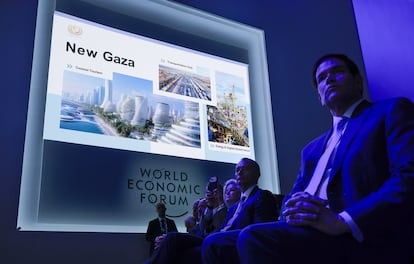
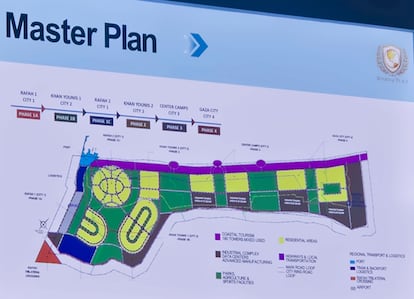
Amidst the erratic shifts in policy regarding Greenland and the self-congratulatory pronouncements of U.S. President Donald Trump in Davos, one of his top advisors for the Middle East (his own son-in-law Jared Kushner) on Thursday presented—with an enthusiastic tone suggesting an investment opportunity—the “new Gaza” he aspires to build upon the ruins of the current one. It is envisioned as a kind of Dubai or Singapore, boasting numerous tourist skyscrapers along the waterfront, a “transportation hub” with a port and airport, and “a free-market economy” with the “same approach” that Trump applies in his own country. “There is no plan B,” he declared, displaying the slides of the “master plan.”
The presentation, overshadowed by all the other issues occupying this year’s World Forum, paints a picture of the future of a Gaza Strip where life has barely changed for its more than two million inhabitants since the signing of the ceasefire last October: the Israeli army conducts daily strikes and has killed 16 Palestinians in the last 48 hours, three of them journalists. Rescue services also announced on Thursday the death from hypothermia of a three-month-old baby, while Israeli military authorities are preventing the entry of the agreed-upon amounts of aid.
Kushner —who at the beginning of the Israeli invasion mentioned in an interview the future real estate value of the devastated Gaza coast— explained that the plan would begin with the construction of more than 100,000 residential units in the “new Rafah” (the devastated southern city) and would end with the capital, Gaza City.
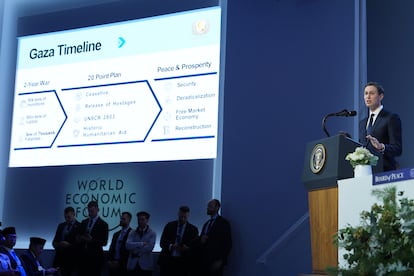
The next phase, Kushner explained, is the demilitarization of Hamas, which is included in the ceasefire. This wasn’t part of the initial plan, but the U.S. and Israel ultimately made it a prerequisite for progress on the other phases. “We are committed to ensuring that Gaza is demilitarized, properly governed, and beautifully rebuilt,” said Trump, who promised to work in coordination with the UN. “It will be a great plan.”
The U.S. advisor has limited reconstruction to areas where disarmament is complete, which will mean starting in areas controlled by Israeli troops and inhabited by only a few thousand of Gaza’s more than two million residents. Kushner indicated that they intend to encourage the surrender of weapons with offers of amnesty or guarantees of safe passage out of Gaza.
On the eve of the meeting, the U.S. president threatened Hamas with getting “blown away” if it refuses to fully disarm. The Islamist movement has agreed to cede power to the newly appointed technocratic committee and is open to surrendering offensive weapons, but it is conditioning this on a complete withdrawal of Israeli troops and refuses to disband as long as the Israeli occupation continues.
The second phase includes the deployment of a multinational military force, but this element has been disappearing from public statements due to a lack of candidates. Israeli President Yitzhak Herzog stated this Wednesday in Davos (he attended because he is not wanted by international justice): “It is clear that no one wants to enter Gaza and fight, except our army, our sons and daughters.”
For now, the Rafah crossing, which connects Gaza and Egypt, will reopen next week in both directions, a commitment that has been postponed by Israel. This was announced on Thursday by the head of the Palestinian technocratic committee, Ali Shaath, in a recorded video message, and by Nikolay Mladenov, the so-called Board of Peace’s envoy to Gaza. Mladenov mentioned “an agreement on preparations for the reopening of the crossing” while “logistics for implementation are being coordinated.” Although Israeli military authorities (who control the crossing) have not confirmed it, the context and the forum suggest that this differs from previous similar agreements that ultimately failed. In fact, this Sunday, at the Cabinet meeting, Netanyahu is scheduled to discuss the search for the last hostage’s body in Gaza and the reopening of the crossing.
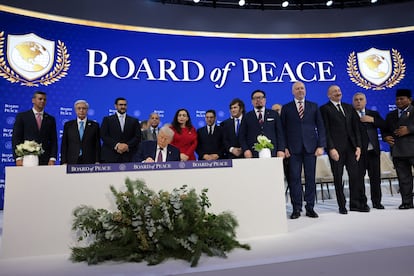
These interventions followed Trump’s presentation of his Board of Peace, an initiative he claims can contribute to resolving conflicts worldwide. The U.S. leader launched the project surrounded by some 20 leaders, among whom there were no representatives from the most advanced democracies. These democracies view with suspicion an initiative that appears to undermine the prerogatives of the United Nations and are uneasy with U.S. foreign policy. Hungary and Bulgaria, both members of the EU, participated. Other attendees included the president of Argentina, Javier Milei, and the leaders of countries such as Azerbaijan, Armenia, Kazakhstan, Pakistan, Indonesia, and Paraguay. “I like all these people,” said the US leader. “They are great leaders.”
Benjamin Netanyahu, the prime minister of Israel, was absent. He will be a member of the Board, but an arrest warrant issued by the International Criminal Court has been pending against him since 2024 as the alleged perpetrator of war crimes and crimes against humanity in Gaza during the invasion that began in October 2023 following the Hamas attack, and which has left more than 71,500 dead and reduced the Strip to rubble. His empty chair at the front center served as a reminder.
Last month, the Integrated Phase Classification, the main food security analysis tool involving UN organizations, withdrew the famine designation it had made in August for half a million Gazans, because the increase in food supplies has improved nutritional levels, but warned that the situation remains “critical,” with 1.6 million people (77% of the population) still in acute food insecurity.
Gaza is currently divided, with 42% of the territory controlled by the Islamist movement, where virtually the entire population lives, and the remaining 58% almost deserted and in the hands of the Israeli army, which continues to demolish buildings despite the ceasefire and prevents anyone from approaching. “At first, we considered the idea of building a free zone and then a Hamas zone,” Kushner admitted, before explaining that the U.S. master plan ultimately encompasses the entire Gaza Strip.
These two parts are separated by the Yellow Line. It is theoretically a temporary dividing line, until the first phase is completed, but Trump announced this month the transition to the second phase without demanding a further Israeli withdrawal. Netanyahu has asserted that his troops will remain permanently in a “large area” of the Gaza Strip.
Sign up for our weekly newsletter to get more English-language news coverage from EL PAÍS USA Edition









































