
Raúl Incertis, a doctor in Gaza: ‘I lost count of the number of dead children’
The Spaniard, who spent four months as a volunteer in two hospitals in the Strip, recounts his experience amid the chaos and his sole certainty of caring for wounded minors
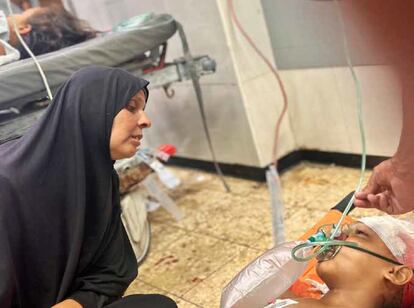
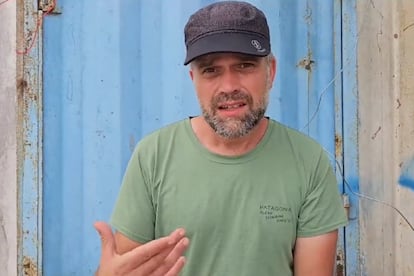
My name is Raúl Incertis, I’m an emergency room doctor and anesthesiologist, and from April to June of this year I volunteered in two hospitals in Gaza. It’s not for me to say whether or not there’s a genocide in Gaza, but during my time there, I lost count of the number of wounded children who arrived alone at the hospital because their family had been killed in a bombing. I remember a six-year-old girl: I had to pick up her amputated and charred arm because it was getting in the way of us trying to help her hold on to the thread of life she was hanging to. I also remember that she was wearing a tank top with little sheep on it, which we had to cut off to examine her. She died, and I don’t remember her name. Because, by then — three weeks after my arrival in Gaza — I had already lost count of the mutilated, amputated, crushed, or burned children I and my colleagues had had to treat. And the dead.
There’s a black cloud in my head, made of abject images, that prevents me from remembering. Many were dying in front of us, despite our efforts to treat them. I’ve also lost count of those who died during the course of medical care. Just like the trucks or carts pulled by starving donkeys that entered the hospital with corpses piled up, on their way to the morgue. They came and went, like workers entering and leaving a factory, but dead. Most of them wore a grimace of terror that reflected their last emotion before being murdered.
I can’t say what constitutes genocide and what doesn’t, but from a certain date on, we received civilians who had been shot in the head and chest every day, even several times a day. They were people, like you and me, who were queuing for humanitarian aid, where the Israelis shot them to death with rifles, tank artillery, and grenades launched from mortars or drones. Forty, sixty, ninety wounded at once. One morning we received over two hundred. You stumbled upon wounded lying on the ground, tripped, and fell over them. Many were children and women. There were so many that you couldn’t treat them all, and many died waiting for help that never arrived.
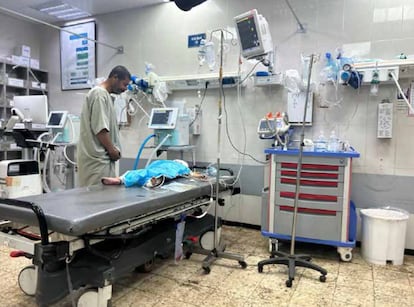
Amid that chaos of dead and mutilated bodies, and hysterical relatives, at least I knew who I should care for first: the children. One of the youngest we treated, 18 months old, was shot in the chest while her mother was holding her. Like almost everyone else, she came from one of the food distribution points operated by the Gaza Humanitarian Foundation, the aid organization set up by the United States and Israel. They should change the name of that foundation. It’s in bad taste to call it that.
Someone else will have to say whether this is genocide or not, but Dr. Alaa, a pediatrician at the hospital, had almost her entire soul amputated, leaving her with less than a tenth of it. An Israeli strike killed nine of her 10 children and her husband while she was on duty at the hospital. I don’t know where she found the strength, three days later, dressed in mourning clothes, to approach the doctors who had treated her only surviving son, Adam, to thank us. I’ve also lost count of those parents who had lost their children, of the women and men I saw lying catatonic on the floor or screaming in pain at the sight of their recently dead son on a stretcher. All of my colleagues, without exception, have had first- or second-degree relatives murdered.
They have been murdered too. I have to suppress their memory because sometimes the image of Ahmed, a scrub nurse with whom I spent countless hours in the operating room, comes back to me. He was killed with his three young children when a bomb hit the shack they were living in. No one brought a smile to my face like he did. Despite suffering like everyone else, and living in poverty like everyone else, crammed into shacks like battery farms, every time he saw me, his face lit up with joy and he would enthusiastically shake my hand, then offer me a compliment that made me feel like a better person. His wife, pregnant and a nurse like him, was on duty at the hospital when the Israelis deliberately bombed their canvas tent.
Every day, especially at night, we received entire families who had been bombed in their shacks in the displaced persons camps, in the Al-Mawasi “humanitarian zone,” which is where the army had told the population to go to avoid being attacked, and where it has now told them to go again. They should change the name of that area. Many of my friends there think sarcasm isn’t necessary. They know that their future will never be as beautiful, not even remotely, as the past they can’t recall, because it’s filled with pain and absence. And their present is hellish. At least they shouldn’t be mocked.
It is down to others to decide whether this is genocide or not, but I’ve traveled all over Gaza and there’s one thing I do know: it’s impossible to live there.
Sign up for our weekly newsletter to get more English-language news coverage from EL PAÍS USA Edition









































