
In Gaza, even the dead are being displaced
Israeli bombing and the military occupation of the Strip prevent the burial of the deceased in traditional cemeteries, despite the trauma this causes for their families
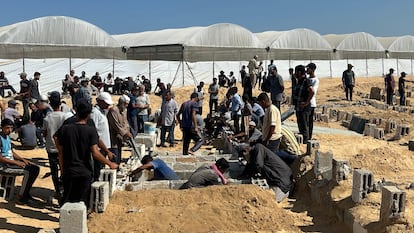
With his hands dirty with dust and cement, Nazmi Abu Lehia finishes sealing his father Mohammad’s grave in a makeshift cemetery in Al Mawasi, in the southern Gaza Strip. The 15-year-old decided to postpone the burial for a day, hoping to be able to take the body to the family plot. “I wanted him to rest next to my grandfather and uncles,” he says. “We used to visit them, read the Quran, and bring flowers. That gave us some peace,” he adds.
But today, that area is within what the Israeli army designates as a “red zone” or combat zone, meaning it’s too dangerous to enter; civilians have been ordered to leave. “Now, even our dead are displaced,” Abu Lehia laments.
His father, Mohammad, 42, was shot by the Israeli army near a humanitarian aid distribution point in Rafah, in the southern Gaza Strip. When he received the news, the best thing the boy could do was find a place for him in one of Gaza’s new public cemeteries, recently created to provide a decent place for the thousands of dead from this war.
According to figures from the Gaza Health Ministry, controlled by the Islamist Hamas movement, Israel has killed at least 57,000 Palestinians in the Strip since October 7, 2023, and the number of injured exceeds 134,000.
This war has not only killed people, but it has also separated us from our sense of belonging. It’s a pain that only the people of Gaza understandAbu Mohammad, resident of Gaza
In recent months, images recorded by citizens have shown the world bodies abandoned in the streets or chewed by dogs, and, according to humanitarian organizations, hundreds of bodies have yet to be recovered from the rubble. When there is an opportunity to say goodbye to a loved one, it is done hastily, as is the case with Abu Lehia and his family, who pray with the drones buzzing overhead. “We can’t say all the prayers; we just want to finish quickly,” the young man admits.
Typically, Gaza families bury their relatives in plots where other deceased members of the clan already have burials. It’s a form of spiritual and emotional continuity. Furthermore, many people leave very specific instructions about how and where they wish to be buried, and their wishes are considered sacred. But all that has been shattered. Abu Mohammad, Abu Lehia’s uncle, addresses those present: “This will be our cemetery now. It’s not what we want, but it’s what war allows.”
“Since the beginning of this war, we’ve buried more than 40 relatives outside the family cemetery,” says Abu Mohammad. “It’s unthinkable. Some of them had left instructions about where they wanted to be laid to rest, but now none of that matters.”
There have been cases of families trying to access their cemeteries to bury a person and being attacked, or of others escaping at the last second with the body and resigning themselves to finding another place.
Donating land to bury the dead
According to the UN, in the last three months alone, more than 714,000 Gazans, or a third of its population, have been displaced. Most had returned to their homes, or what remained of them, following the ceasefire declared in January, which Israel decided to end in mid-March. Many did not take advantage of the truce to return, fearing the risks or knowing they would only find ruins. The UN estimates that 90% of Gaza’s population has been displaced at least once since October 2023.
I’m trying to get more land. People keep dying and have nowhere to rest.Imran Al Astal, resident of Gaza
“This war has not only killed people, but it has also separated us from our sense of belonging,” Abu Mohammad adds. “It’s a pain that only the people of Gaza understand.”
The cemetery where this family member is being buried didn’t exist until March 2024, when Imran al-Astal, an 80-year-old Palestinian living in Al Mawasi, donated a one-dunam (1,000 square meter) plot of land after witnessing families forced to bury their loved ones in the streets. He called his sons, who work in construction, to help him dig and build graves. “I saw people carrying corpses and nowhere to bury them. They were ready to dig in the alleys. I did what I could,” he explains.
Today, the site is one of Gaza’s emergency cemeteries, many of them in agricultural areas or vacant lots. But the land is becoming too small. “It’s almost full. I’m trying to get more land. People keep dying and have nowhere to rest,” says Al Astal.
Al Mawasi is also becoming increasingly populated by the living. Currently, some 425,000 people live in this area of approximately nine square kilometers, compared to 115,000 three months ago, due to displacement orders issued by Israel and military operations in the two major southern cities, Rafah and Khan Younis. The UN estimates that more than 80% of the Strip’s 365 square kilometers are now unlivable, either because they are military zones or because the Israeli army has ordered the displacement of civilians.
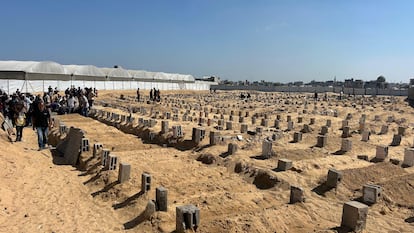
Near Nasser Hospital in Khan Younis, there is another newly created cemetery. It is known as the “Algerian Cemetery” because a local charity funded the construction of more than 1,200 graves. Most of those buried there came from the city of Rafah, now fully under Israeli military control, or from devastated or forcibly depopulated areas of Khan Younis.
Lying among strangers
For families, the trauma of burying a loved one in an unfamiliar place deepens the sense of displacement. “My son Abdulrahman now lies among strangers,” says Mohammad al-Faqaawi, whose 15-year-old son also died while waiting to receive humanitarian aid near Rafah. “Our family cemetery is only two kilometers away, but it’s a red zone. I couldn’t take the risk,” explains the father.
His voice breaks as he finishes covering the grave with sand. “His sister, Hanan, was killed last year. She was buried in our old cemetery. But when the Israelis entered Rafah, her body disappeared. I never found her,” he sobs.
The Gazan psychologist Said al-Kahlout explains that choosing and caring for the burial site of a loved one helps with grieving and preserves memories. “In Gaza, we don’t just bury our dead, we anchor them. But now, people are burying their children in unmarked plots, in places they may never be able to return to,” he explains.
In Gaza, we don’t just bury our dead, we anchor them. But now, people are burying their children in unmarked plots, in places they may never return to.Said Al Kahlout, Palestinian psychologist
Al Kahlout recently lost his mother, whose last wish was to be buried next to his father, who died two decades ago. Despite the danger, he and his siblings fulfilled her wish. “We took a chance because we knew how important it was to her and to us,” he explains.
But many, most, have no choice, because family graves are too far away. “I’ve spoken to men who grieve not only for the loss of a child, but because they couldn’t bury them properly,” he recalls. “There are also families who have paid a lot of money just to retrieve bodies from collapsed buildings and give them a proper burial,” he adds. “Even in the midst of war, this matters.”
In the Algerian Cemetery, where rows of newly created graves stretch across the sandy soil, families wander from plot to plot, trying to remember where their son or mother was buried, because many graves lack names or headstones. “I don’t know if I’ll be able to find this place again,” Al Faqaawi admits.
In Al Mawasi, Abu Lehia places a small flower on his father’s grave and brushes the dust and sand from his hands. Around him, others do the same. “If we ever go home, I’ll take my father with me,” he promises.
Sign up for our weekly newsletter to get more English-language news coverage from EL PAÍS USA Edition









































