
Netanyahu, back in the White House, calls Trump’s ceasefire plan ‘a good proposal’
The Israeli prime minister visited the US president for the second time in less than 24 hours. Washington sees the signing of a truce as feasible by ‘the end of this week’
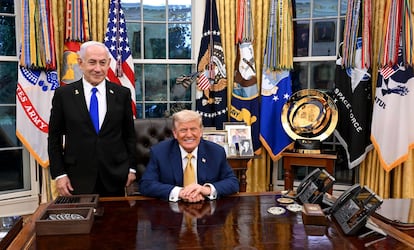

Israeli Prime Minister Benjamin Netanyahu returned to the White House less than 24 hours after attending a dinner hosted by President Donald Trump on Monday. On Tuesday, the two leaders met again for a conversation that, unlike the previous day’s, did not, according to U.S. administration sources, cover several topics, but rather focused on a single one: the ceasefire agreement in Gaza that Trump put on the table last week and which he is urging both parties, the Israeli government and Hamas, to sign.
On Monday, Netanyahu showed up for his appointment with a letter under his arm, which he said he had sent to the Norwegian Nobel Peace Prize Academy to nominate Trump for the prestigious award. This isn’t the only such proposal received in Oslo in recent weeks: both the Pakistani government, in gratitude for Trump’s role in de-escalating the latest military tension between that country and India, and several members of the Republican Party on Capitol Hill have also promoted the nomination for an award the U.S. president has spent years saying that he deserves.
The second meeting between Trump and Netanyahu was held behind closed doors for an hour, and few details have emerged, although it has been confirmed that Vice President J.D. Vance was present. The Israeli prime minister arrived at the White House shortly after 4:40 p.m. local time after spending the morning on Capitol Hill, where he met with Republican House Speaker Mike Johnson.
While Netanyahu was on Capitol Hill, Trump’s Middle East envoy, Steve Witkoff, explained during a Cabinet meeting at the White House the terms of the agreement that Trump proposed last week for a 60-day ceasefire to halt the Israeli military’s brutal offensive in Gaza, where it has killed at least 57,500 people in 21 months, according to estimates by health officials there. Witkoff said he expected the truce to take effect by the end of the week.
He also offered some details that had been leaked unofficially in recent days. Ten live hostages will be released, along with nine deceased hostages, Witkoff said. “We will meet, at the president’s direction, with all the hostages’ families to inform them, and we believe this will lead to a lasting peace.” Currently, 50 hostages remain in Hamas’ hands, out of the 250 that the Palestinian group kidnapped during its surprise attack on October 7, 2023, in which 1,200 people died. About 20 of those hostages are believed to be still alive.
Netanyahu declared Tuesday on Capitol Hill that Israel accepts the proposal put forward by the mediators, which includes Egypt and Qatar, the emirate that sent a delegation to the White House. “It’s a good proposal. It matches Steve Witkoff’s original idea, and we think we’ve gotten closer to it. And I hope we can cross the line, that is our purpose,” he explained. But he added that Israel “still has to finish the job in Gaza, release all our hostages, eliminate and destroy Hamas’s military and governance capabilities, because Gaza must have a different future, for our sake, for everyone’s sake,” said Netanyahu.
Social media campaign
During his visit to Congress, he also promised to combat what he called an orchestrated social media campaign of “vilification and demonization” that is, he said, undermining American support for Israel, especially among Democrats. “We intend to fight it, because nothing defeats lies like the truth, and we shall spread the truth for everyone to see once people are exposed to the facts, we win hands down. That’s what we intend to do in the coming months and years,” he warned.
It’s unusual for a foreign leader to visit the president of the United States, as Netanyahu has done, three times in just over five months. Even less so for him to be received at the White House twice in a single trip. The Israeli prime minister’s exceptional welcome speaks eloquently to the rapport he has with Trump, whom he recently convinced to join his military offensive against Iran. Washington attacked three uranium storage and enrichment facilities on June 21, two days before forcing an end to the “12-day war” between the two old rivals.
Never in Israel’s 77-year history has there been such a level of coordination, cooperation, and trust between the United States and Israel as there is today, Netanyahu said Tuesday, adding that this unprecedented rapport was due to “President Trump.”
Sign up for our weekly newsletter to get more English-language news coverage from EL PAÍS USA Edition









































