
Voices from Gaza City in the face of Israel’s offensive: ‘We will stay until the end, we have no plan B’
Residents describe the anguish of choosing between yet another forced displacement or witnessing the arrival of Israeli tanks
As is customary in remote conversations with Gazans (Israel has barred free entry to the foreign press since the start of its invasion), the exchange of messages with Rami Abu Jamous, a journalist in the Strip’s capital, begins with a question and an answer:
― How are you?
― Still alive
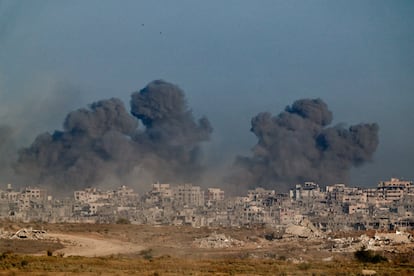
He had just witnessed the beginning of Israel’s total conquest of Gaza City, launched on Tuesday, as part of an announced ground offensive that Defense Minister Israel Katz promised last month would see the capital end up “like Beit Hanoun,” the town in the north of the Palestinian enclave that the Israel Defense Forces (IDF) have wiped off the face of the earth, as Katz himself boasted when he released a photo of the devastation.
This is how Abu Jamous recounts the brutality of the bombing that preceded the offensive: “The Israeli defense minister said [in a tweet on Tuesday] that Gaza was burning. And Gaza was really burning.”
He then explains that he has decided to stay in the capital, like hundreds of thousands of other people, exhausted, hungry (the UN declared a famine in the city last month), and, in many cases, without the money to pay the exorbitant price of fleeing south. The IDF estimates that 60% of the population remains in the capital, which was estimated at around one million before the first orders to leave the city were issued last month. The Hamas government in Gaza says that 914,000 people remain in the governorate, which in addition to the city includes surrounding villages and refugee camps.
“This isn’t the first time I’ve done this,” Abu Jamous explains. One of the first decisions taken by Benjamin Netanyahu’s government upon launching its invasion following the Hamas attacks of October 7, 2023 was to order the evacuation of the entire northern half of the Strip (encompassing over a million people), including the capital. He urged them to flee to the south, where they met the same fate. “Then, too, we stayed in Gaza City until the last minute. Then tanks surrounded us, and we eventually left. Now we will do the same: hold out until the end, hoping that not moving will slow the ground offensive. And hoping that, one day, all this will stop,” he notes in an audio message.
“Hamas strongholds”
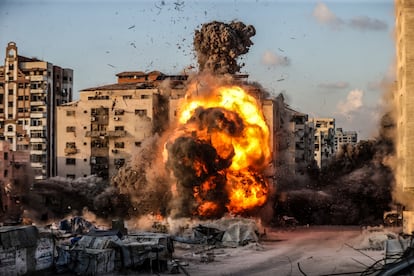
Since that “until the end” can arrive at any moment (sometimes the IDF bombs without warning; on other occasions, it gives just 15 minutes to flee the targeted building), and Israel has its sights set on skyscrapers like the one he lives in (“Hamas strongholds,” Netanyahu called them on Monday, justifying the destruction of around 50 in recent weeks according to rescue services), Abu Jamous has three suitcases packed. Two, in a friend’s apartment on the ground floor of his building. The third, in front of his door, on the ninth floor. “When there’s a bombing, the first reaction is to go straight to the door. So my wife and I would just have to grab the children. One is four years old; the other is seven months. A purse, a backpack, and we run. Then we wouldn’t know what to do. We don’t have a plan B. I always have a plan B, but this time I don’t want one.”
The brutality of the shelling has brought back to Gaza an exodus that has been all too familiar over the past two years. Thousands of civilians are fleeing — at the mercy of military orders or the intensification of the bombing — with their possessions. Few and humble, but now precious after so much forced displacement: mattresses, fabric for setting up tents, and plastic jerry cans for collecting water. The images show those fleeing with blank stares, riding in trucks, cars, or on donkey-drawn vehicles. Those who cannot afford to pay walk for miles.
Hussan Lubbad, who is around 60 years old, is one of them. He posted a desperate text on social media about the constant Sisyphean flight that has taken him from his home in the now devastated Beit Lahia, in the north, to the house of one of his nieces in Shati, a refugee camp from the time of the Nakba (disaster, in Arabic), the flight or expulsion from their homes of 750,000 Palestinians between 1947 and 1949, in the face of the advance of Jewish militias and, later, the newly created Israeli army, in order to create the State of Israel in 1948. The majority of the inhabitants of Gaza today are descendants of refugees from the Nakba.
“My home is in Beit Lahia, and Gaza City is the soul and center of my life,” he wrote. “I wanted to spend my life there and be buried next to my children, my father, and my grandparents. I was displaced twice from my home to my wife’s house and then to my daughter’s. Now I face the difficult decision of moving into the unknown in southern Gaza, to the harsh life in tents. I prayed to God that I would die rather than live this life. May God make things easier for us and for the people of Gaza, who are being exterminated before the eyes and ears of the world!”
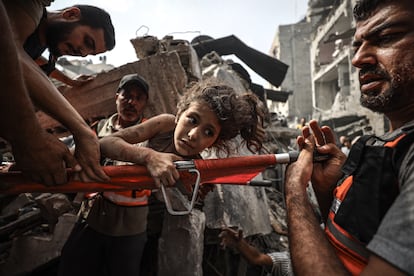
Doctor Mohammed Salha has taken the opposite route to what Israeli military authorities have ordered: instead of leaving the capital, he returned on Monday to accompany the rest of his team from Deir el-Balah, in the center of the Strip, where he had been caring for his hospitalized mother for two weeks. “My colleagues have to feel that I am with them; it’s a psychological thing. It’s not easy to face the challenges and dangers alone,” he said in a telephone conversation often interrupted by connection problems.
He chose to spend the night with his team at the headquarters of the Al Awda medical institution, in the center of the capital. He’s not alone. “There are more than 25 of us here. Everything around us is so dangerous, and it’s so difficult to move from Gaza City to the center of the enclave, that some of our members also chose to sleep in the office,” he says.
Although they try to remain where there are civilians to care for, their colleagues have already had to flee the offices in the east of the capital — where Israeli forces had been concentrating their advance — and take refuge in the western neighborhoods, one of the next announced targets of the offensive. “If at some point there were no more civilians in Gaza City, we would evacuate, but if there is even one person who needs medical attention, we will stay,” he says.
The aerial and artillery bombardments that launched the ground incursion on Tuesday were, he says, “horrible.” Among the targets were “three houses where people were sleeping,” which reminded him of the strategy he witnessed in northern Gaza. At the time, it was the area hardest hit by the bombing. It was then leveled with bulldozers and controlled explosions to flatten the section of the Strip that Israel plans to fully control and keep uninhabited. The advance of the invasion, however, has gradually homogenized Gaza around the gray color of destroyed buildings.
There, in the north, his home is just a pile of rubble. His family was in a rented apartment in Gaza City, but it was damaged in a strike on one of the skyscrapers. His family, he explains, is now with his brother-in-law in Deir el-Balah. “I don’t have a place for my family. There are more than eight families in four rooms. Each family is eight or 10 people. They’re crowded together. My son jokingly tells me they sleep standing up.”
Sign up for our weekly newsletter to get more English-language news coverage from EL PAÍS USA Edition









































