
Israel orders hospitals and NGOs to prepare to evacuate Gaza City
Netanyahu states that the offensive on the Strip’s capital is continuing while announcing talks to free all hostages held by Hamas

The Israeli army announced Thursday that it has informed Gazan medical authorities and humanitarian organizations that they should prepare to leave Gaza City and move south. The notice anticipates that an evacuation order will be issued later “for the entire municipality,” where the Strip’s health authorities and NGOs estimate there are currently one million people.
Israel issued the warning publicly the day after army spokesmen — with the approval of Benjamin Netanyahu’s government — stated that they were already engaged in the controversial seizure of the enclave’s largest municipality without waiting for authorization from the Security Cabinet, which is expected to greenlight the offensive on Thursday night.
Netanyahu also announced Thursday that he has ordered “immediate” negotiations to begin “to release all hostages” remaining in the Gaza Strip. The statement marks the first apparent reference to the ongoing ceasefire talks and the truce proposal that Hamas accepted on Monday, which the Israeli government has so far made no mention of.
Despite resuming diplomatic channels, the Israeli prime minister insisted that the offensive on Gaza City will continue: “We are at a decisive stage. I came to [visit] the Gaza Division today to approve the plans presented to me and the Defense Minister by the IDF for the takeover of Gaza City and the defeat of Hamas,” Netanyahu stated. Multiple analysts believe the prime minister is manipulating every step of the preparations for the offensive to gain advantages at the negotiating table.
According to a military statement, a representative of COGAT — the Israeli authority that manages humanitarian aid in Gaza and the rest of the occupied Palestinian territories — held a phone call with a member of the Strip’s health authorities: “I’m talking to you about the possibility of the army entering Gaza City,” he said in the call, the content of which is reflected in the note: “This requires you to prepare a plan to transfer medical teams from the north to the south so that you can treat all patients.”
For two weeks now, Israeli authorities have been planning an offensive that will see troops expel the starving crowds gathered in Gaza City. The dismantling of health services and their relocation southward, as Israel intends, would allow the Israeli army to launch an offensive against the surface and subsurface of the municipality, which it has touted to Israeli citizens as the culmination of its search for the captives.
Olga Cherevko, spokesperson for the United Nations Office for Humanitarian Affairs (OCHA), affirms that they will remain present in Gaza City as long as they can. “We will not be part of any forced displacement,” she told EL PAÍS. “Aid must be available wherever people choose to stay. If people decide to stay in the north [in Gaza City], they must also have services.”
The Hamas-controlled Gaza Ministry of Health also opposes the Israeli demand: “The ministry expresses its rejection of any measure that weakens what remains of the health system after the systematic destruction carried out by the occupation authorities.” This measure, it adds, would endanger the lives of residents, patients, and the wounded. The same ministry reported Thursday the death toll of 70 people from Israeli attacks, which also left more than 350 injured in the space of 24 hours. Gazan authorities also reported two new deaths from starvation, bringing the total number of fatalities from this cause to 271 in 22 months of conflict.
“Hamas’ governmental and military stronghold”
On Wednesday, Israeli military spokesperson Effie Defrin confirmed that the IDF had already launched the second phase of the Gideon’s Chariots offensive, which aims to invade Gaza City. The army claims the municipality is “the governmental and military stronghold of the terrorist organization Hamas” and warns that it is preparing to “deepen the damage to that infrastructure above and below ground, cutting the population’s dependence on Hamas.” The troops assert that the operation is in its preparatory phase, that they already “control” some parts of the city’s outskirts, and that they are present in the Zeitoun neighborhood, the largest in the city.
What the troops see as a preparatory phase has meant the violent expulsion of thousands of innocent civilians. This is reflected in OCHA data. Over the past eight days, 95% of the people displaced within the enclave have fled the Zeitoun neighborhood, where Israeli troops are already present and where testimonies report constant bombardment.
“My family decided to leave their home in Zeitoun last Saturday because they were attacked by a drone,” Ayman Lubbad, a Palestinian aid worker working in Deir el-Balah, in the center of the enclave, said via WhatsApp. “[The attack] killed my cousin and left the other one injured, with both legs amputated. My parents and siblings miraculously survived.”
Mohamed Salha, a doctor who ran the last available hospital north of Gaza City until the Israeli army expelled the workers in May, threatening them with death, said a few weeks ago that he wanted to stay in Gaza City no matter what. Now, he sees things differently. “I’m trying to find a place in Deir el-Balah,” he said via WhatsApp, referring to the area in the center of the enclave, where Israel permits the presence of civilians while it attacks the zone. “But it’s very difficult to find one.”
For humanitarian organizations, the mass displacement Israel is pursuing could constitute a crime under international law. “Forcing hundreds of thousands of people south is a recipe for even greater disaster,” OCHA denounced in a statement Thursday, referring to the act, which has been classified as a violation of the Geneva Convention.
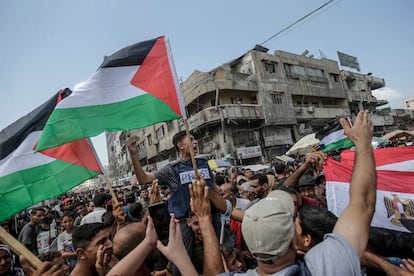
A group of a few hundred Palestinians demonstrated Thursday in Gaza City with banners and Palestinian flags to demand an end to the war and forced displacement. The signs read “Stop the war” and “Gaza is fighting alone.” The protest was attended by the journalists’ union, members of the local NGO network, the Chamber of Commerce, and leaders of some of Gaza’s main clans.
“History repeats itself,” Lishay Miran, the wife of a hostage believed to be still alive, said at a press conference from the other side of the wall. “There is an agreement on the table that can save the living captives and provide a proper burial for the dead. Hamas has accepted it, but the prime minister is trying to decree a death sentence for the living and the disappearance of the dead.”
Sign up for our weekly newsletter to get more English-language news coverage from EL PAÍS USA Edition









































