
Israeli security cabinet approves Netanyahu’s plan to occupy Gaza City
The decision could entail pushing out a million civilians and become a step towards a full military takeover of the entire Palestinian enclave
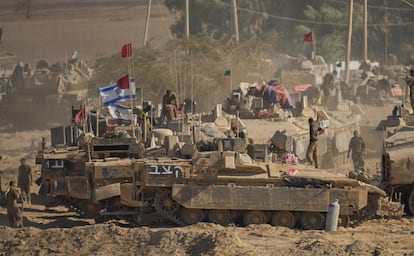

Israeli Prime Minister Benjamin Netanyahu has secured the approval of the security cabinet to launch the occupation of Gaza City. The decision was confirmed in a statement from the president’s office early Friday morning, more than 10 hours after the meeting began. The prime minister has thus overcome the pushback from the military leadership and from the streets, where protests have surged in response to an offensive perceived as potentially lethal for the remaining hostages.
The statement leaves more questions than answers. It does not address why it talks about occupying Gaza City when Netanyahu’s stated objective before entering the meeting was to secure approval to take over the entire enclave. The statement also doesn’t clarify whether occupying that city is just a preliminary step toward expanding into the remaining territories where the army has no presence.
The Security Cabinet has approved the Prime Minister's proposal for defeating Hamas.
— Prime Minister of Israel (@IsraeliPM) August 8, 2025
The IDF will prepare for taking control of Gaza City while distributing humanitarian assistance to the civilian population outside the combat zones.
In any case, the security cabinet’s decision could mark the imminent expulsion of around one million Gazan civilians crowded into Gaza City. Israeli media outlets such as Channel 12 reported on Thursday that this is Netanyahu’s plan for that territory. If implemented, it would represent another mass displacement in a Strip where 90% of the population has already been displaced, most of them on multiple occasions. The humanitarian sector anticipates catastrophic consequences, including an increase in civilian deaths.
The escalation aims to empty territories where Israel believes Hamas is hiding captives in order to shift the offensive there. The prime minister’s entourage defends the expansion and justifies it as necessary to rescue the 20 hostages believed to remain alive in the enclave. But both the army leader, Eyal Zamir, and the families of the hostages reject this idea and insist they prefer an agreement that would free the hostages.
Tension with the army and the families of the hostages
This friction is what led thousands of concerned Israelis to protest early Friday morning. The demonstrations resulted in the blockade of some of Tel Aviv’s main avenues, the use of water cannons by police, and arrests. Many gathered outside the prime minister’s office in Jerusalem.
The difference of opinion between the prime minister and the army leader is well known. Before the meeting, Netanyahu confirmed to the press his intention to occupy the entire Palestinian Strip. ”We intend to, in order to assure our security, remove Hamas there,” he declared on Fox News.
“We want to hand it over to Arab forces that will govern it properly without threatening us and giving Gazans a good life,” said Netanyahu without going into detail about who might be willing to take over from the Israeli occupation in the future.
Shortly afterward, a Jordanian official speaking on condition of anonymity told Reuters that Arab countries “will not accept Netanyahu’s policies or clean up his mess,” adding that they will only support “legitimate institutions” that “the Palestinians decide.”
Chief of the General Staff of the Israel Defense Forces Eyal Zamir expressed his disagreement with Netanyahu’s intentions. “We now have the ability to maintain a new security border while maintaining pressure on the enemy,” he said Thursday prior to the security cabinet meeting in an attempt to prevent further escalation. He was defiant: “The army will continue to express its position without fear; we are dealing with matters of life and death.” The army chief’s words came days after Netanyahu’s entourage leaked that Zamir should resign if he disagreed with the prime minister’s plans to occupy the entire Gaza Strip.
On Thursday night, before the approval of the expansion into Gaza City became known, Israeli troops issued multiple evacuation orders against different areas of the city, urging residents to move south “for their own safety.”
The Israeli army currently controls 75% of the Palestinian enclave and considers 88% of the Strip a military zone. The expansion approved Friday will bring troops into part of the remaining 12% of the territory, where the majority of Gaza’s two million people are crowded in a situation of extreme weakness and helplessness.
Sign up for our weekly newsletter to get more English-language news coverage from EL PAÍS USA Edition









































