
The story behind a photo that symbolizes hunger in Gaza: ‘I took it while I was starving myself’
Gazan photographer Ahmed al-Arini recounts the pain and exhaustion he deals with daily to document the humanitarian catastrophe ravaging the enclave
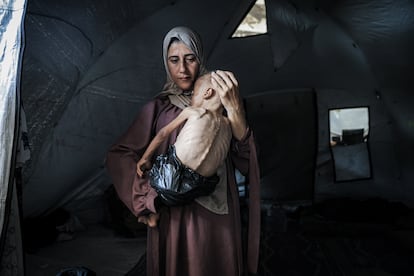

Ahmed al-Arini had to walk for a long time with his camera on his shoulder to reach the tent where little Mohamed and his family are eking out a living. It’s just another tent amid an ocean of tarps crowding the displaced persons camp located east of Gaza City. Mohamed Zakariya Ayyoub al-Matouq is 18 months old and weighs barely six kilos (13.2 pounds). The image of his skeletal body, in his mother’s arms, has gone around the world as a symbol of the humanitarian catastrophe ravaging the Strip after more than four months of the Israeli blockade on the entry of humanitarian aid, and more than 60,200 Palestinian deaths during the nearly two years of the Israeli military offensive.
He wears a black plastic bag instead of a diaper, a scarce item that has become an unattainable luxury for most Gazans, as a single one can cost 10 shekels (around $3). Families are forced to make do with old rags or plastic bags.
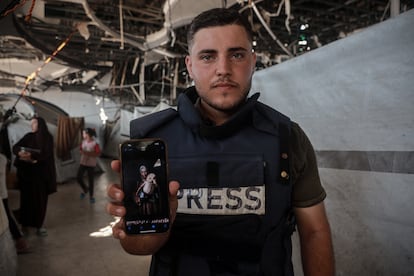
Al-Arini photographed little Mohamed to show the rest of the world the extreme hunger affecting Gazan children. Between shots, he had to stop and take deep breaths. “I photographed him inside a tent for displaced families, amid hunger, pain, and a severe shortage of formula and diapers,” recalls the 25-year-old photographer. “I decided to document his story — and those of other children — because the signs of hunger were clearly visible on him. I had seen previous photos of him, when he was healthy and full of life, and then I saw the heartbreaking state he is in now,” he adds, speaking to this newspaper via instant messaging. Mohamed had gone from nine kilos to six kilos, about half the average weight of a child his age. “I was overcome with grief at how emaciated he was. I took these photos while I was starving myself,” he explains.
Mohamed’s story is not an isolated case. The United Nations Children’s Fund (UNICEF) estimates that more than 320,000 children under the age of five in Gaza face the risk of acute malnutrition. Around 90 children have died from this cause since October 7, 2023, according to the Hamas-controlled Gaza Ministry of Health.
Gaza is currently experiencing the worst possible famine scenario. This was highlighted last Tuesday by the Integrated Food Security Phase Classification (IPC), the leading international system for monitoring hunger. The latest data, collected by the organization through telephone interviews in July, show that 81% of households were experiencing days without any food to eat. Furthermore, 96% of the households surveyed reported having gone hungry several times a day in the past month. Nine out of 10 households even took risks to obtain food or searched for it in garbage. “People’s access to food across Gaza is now alarmingly erratic and extremely perilous,” the IPC says in an alert document posted on its website. According to its figures, between April and mid-July, more than 20,000 children have been admitted for treatment for malnutrition. The only solution, warns the IPC, is a cessation of hostilities that allows for sustained and secure access to humanitarian aid.
The Israeli military announced some measures on Sunday to ensure a minimal easing of the blockade and allow more aid to enter through “safe routes.” The United Nations, however, continues to insist that this is insufficient to prevent famine and a catastrophic health crisis and denounces “bureaucratic and security” obstacles to the entry of supplies from Israel.
“People are living in desperate conditions, in makeshift tents set up on the streets and among the rubble of their destroyed homes. They are facing a dire crisis. Prices are skyrocketing, all basic food and supplies are in short supply, and there is no cooking gas,” the photographer explains.
Working as a photojournalist in this context fills me with pain and exhausts meAhmed al-Arini
Gazan journalists are the only reporters on the ground in the Strip, as Benjamin Netanyahu’s government has barred the international press from entering the enclave since the beginning of the offensive. Since then, more than 230 journalists have been killed by the Israeli army, according to the Palestinian Journalists Syndicate.
Al-Arini, who currently collaborates with several international news agencies, had to flee Jabalia, in the north of the enclave, after his family’s home was destroyed in an Israeli attack. Since then, he has lived in the capital, Gaza City. “Working as a photojournalist in this context fills me with pain and exhausts me. You cover the war and the blockade while you are hungry, exhausted, and unable to provide food for your own family and children. Perhaps the world has grown accustomed to these scenes. We have been living with death, destruction, and the blockade for almost two years. No one seems to care about what the civilians and innocent people of Gaza are enduring,” he laments. However, he continues to hope that these images “can help stop the genocide and end this painful war.”
Sign up for our weekly newsletter to get more English-language news coverage from EL PAÍS USA Edition









































