
Netanyahu confirms Israel intends to militarily occupy all of Gaza
The plan to take the entire Strip remains in place despite criticism from the army leadership, the families of the hostages, and the humanitarian sector
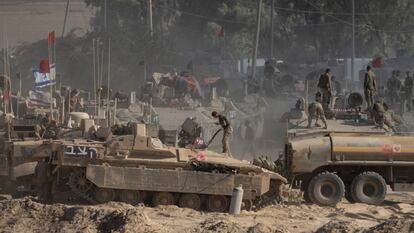

The Israeli army intends to invade the entire Gaza Strip. This was confirmed Thursday afternoon by Prime Minister Benjamin Netanyahu, a few hours ahead of the Security Cabinet meeting where the country’s top officials are expected to officially approve the full occupation of the enclave. Israel’s military leadership, the families of the hostages held in Gaza, and the humanitarian sector have rejected the expansion of troops in the Strip for various reasons, but the veteran Israeli leader has assured that it is necessary for Israel to “liberate ourselves and liberate the people of Gaza from the awful terror of Hamas.”
In an interview with U.S. television network Fox News, Netanyahu indicated that Israel does not intend to perpetuate its occupation of the Palestinian enclave or to annex the territory, but rather to control it temporarily until conditions allow for an Israeli withdrawal.
“We intend to, in order to assure our security, remove Hamas [from] there,” he replied in the interview when asked if Israel would occupy the entire enclave. “[We will] enable the population to be free [of Hamas] and to pass it to civilian governance that is not Hamas and not anyone advocating the destruction of Israel.” Netanyahu did not go into detail about who might be willing to take over from the Israeli occupation in the future, but he mentioned the possibility of “Arab forces” governing the territory “in an appropriate manner.”
The approval of the Israeli military expansion could now lead to the forced expulsion of one million Gazans in Gaza City, which represents half the population of the enclave. This is what Israeli media outlets, such as Channel 12 television, predict will happen during the first phase of the new Israeli military operation. That phase would last several weeks and involve pushing the entire population to the south of the enclave.
In a second phase, Israel would launch an offensive against the areas where it believes Hamas is holding the hostages, after ordering their evacuation. At the same time, the U.S. is expected to announce new efforts by the White House to increase the flow of humanitarian aid in coordination with Israel. These efforts will consist of expanding the self-styled Gaza Humanitarian Foundation (GHF) — whose facilities are the site of daily shootings of Palestinians — from four distribution areas to 16.
Chief of the General Staff of the Israel Defense Forces Eyal Zamir and the families of the captives have expressed their rejection of these plans because they believe they jeopardize the survival of the 20 hostages believed to still be alive. For its part, the humanitarian sector asserts that the expansion of the occupation will lead to an increase in civilian deaths and an unmanageable situation. If it goes ahead, the new Israeli offensive will involve the deployment of troops in the 12% of Gaza’s territory where most of the population is now concentrated, and where troops will encounter crowds of people living in the open, weak and starving.
“Abandoning the entire population”
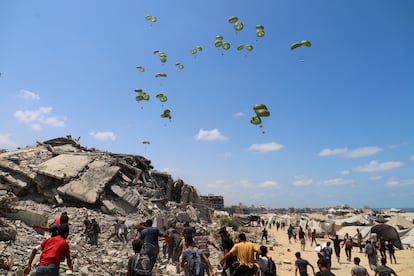
“If the world allows it, it will mean abandoning the entire population,” laments Ahmed Bayram, communications officer for the Norwegian Refugee Council (NRC). Israeli expansion, he says, “will mean death in every corner [of the Strip] and the spread of disease.” Bayram projects the situation from the present, which he already considers catastrophic. Israel, he asserts, is concentrating people in territories where there are enormous shortages, forcing them to fight over water, food, and space. “You can’t displace an entire population without guaranteeing their protection,” he asserts.
The NRC, one of the groups dedicated to collecting data on the state of shelters in Gaza, reports that 288,000 families in the enclave are spending their days and nights under inadequate shelter. “That means they are on the streets, in damaged buildings, or sleeping in dilapidated tents,” Bayram explains. Again, most of these families are located in the 12% of the territory that Israel could invade. At the same time, Israel is preventing the entry of new tents or other types of shelters, according to Bayram via voice messages sent from Amman, Jordan.
Deaths from Israeli bombing are another likely consequence of the expansion of the occupation. This is the opinion of José Mas, head of the Doctors Without Borders (MSF) Emergency Unit in Barcelona, where he is in direct contact with the teams in Gaza.
If the offensive moves into these crowded areas, he states via text messages, “the only possible outcome is greater suffering for a civilian population already experiencing a catastrophic humanitarian situation.” He goes further: “A military operation in an environment like this poses enormous risks to the civilian population and has enormous potential to exponentially increase the number of direct victims of violence.”
Mas sees this possible Israeli maneuver as a continuation of what came before. He points out that Gaza is being subjected to “a genocide that takes different forms” in which “everything necessary for life is being systematically destroyed.” He cites as an example access to food, where more than 800 people have been shot dead in the distribution areas of the GHF, the opaque entity that Israel launched in late May with U.S. support while marginalizing the traditional UN-led humanitarian system.
These deaths do not alter the position of the White House, which announced Wednesday night that it intends to increase the organization’s distribution centers in the enclave. To date, there have been four. Now, according to the U.S. ambassador to Israel, Mike Huckabee, there will be 16. Huckabee added in statements to Bloomberg that the intention is for the centers to remain open “as much as 24 hours a day.”
“As you walk, you start to cry”
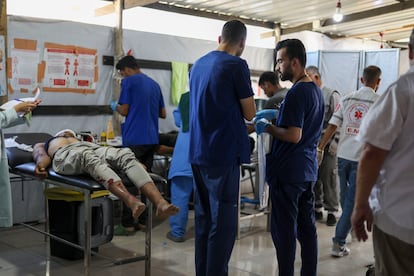
MSF published a report Thursday describing the GHF’s distribution areas as “death traps” and demanding that governments and donors withdraw all support for the project. The investigation compiles clinical data and testimonies collected at two MSF centers in the south of the enclave, located near GHF distribution centers. This proximity meant that some of the people shot at these distribution points were transported to MSF teams.
Between June 7 and July 24, these two clinics recorded 28 deaths and a total of 1,380 injuries. The influx of victims, mostly suffering from gunshot wounds, when GHF opened its facilities, guarded by Israeli troops and U.S. contractors, became a pattern. According to the report, MSF teams are put on alert when GHF announces activity.
The number of wounded includes 71 children who were hit by bullets. Among them, a 12-year-old boy and an eight-year-old girl. But the majority of the wounded are men aged under 30, reflecting what MSF considers a “survival strategy” among Palestinian families. This consists of sending to these centers men capable of walking long distances at night, advancing among soldiers and hostilities, and running and fighting with others to grab a bag of food.
“I’m an ordinary citizen,” says Mahmoud, 39, a patient quoted in the report. “I’m a university graduate. I’m married. I have children and I can’t even feed them.” He says walking to the GHF distribution points is humiliating. “As you walk, you automatically start crying. Not just for yourself. For the people. For all of us.” Suddenly, he was shot twice in the leg. But no one could help him, he explains, because everyone around him was “exhausted.” “It’s like a zombie movie. No matter how hard I try, I can’t explain it in words,” he concludes.
Sign up for our weekly newsletter to get more English-language news coverage from EL PAÍS USA Edition









































