
Israel prepares to launch its offensive at the gates of Gaza City
The government has called up 60,000 reservists while Netanyahu rejected the truce proposal accepted by Hamas and called for ‘seizing control of the last terrorist strongholds’
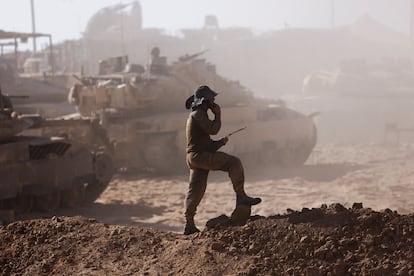

The plan for the Israeli occupation of Gaza City has begun. Israeli Defense Minister Israel Katz confirmed Wednesday morning the approval of the military project to occupy the largest municipality in the occupied Palestinian territories, where nearly one million people live in poverty. Hours later, military spokesman Effie Defrin confirmed that the first steps are already being taken. “We have begun preliminary operations and the first phases of the attack on Gaza City. The Israel Defense Forces (IDF) already control the outskirts of the city,” Defrin said.
A few minutes earlier Prime Minister Benjamin Netanyahu, to whom the army planned to present its plans for the takeover of Gaza City on Thursday, called in a statement for a shortening of the timetable “for seizing control of the last terrorist strongholds and the defeat of Hamas,” creating a greater sense of urgency.
Several political leaders have argued in recent days that this will be the definitive operation to bring about the collapse of the Palestinian militia, despite the fact that the IDF’s commander-in-chief opposed it days ago on the grounds that it puts the lives of Israeli hostages at risk.
Katz gave the green light to the plan proposed by the military leadership during a meeting on Tuesday attended by the head of the Israeli army, Eyal Zamir — who was tasked with designing the offensive — and other senior military and intelligence officials. During that meeting, the leaders also approved the call-up of 60,000 reservists who are to enlist on September 2 to carry out the invasion of Gaza City. It is estimated that the total number of reserve soldiers who will be mobilized in the coming months to reinforce the Israeli army — not only to be deployed in Gaza, but also to swell the ranks of the troops coinciding with that operation — will reach 130,000.
Israeli leaders hope to empty Gaza City and push its population southward before October 7, a symbolic date as it will mark two years since the Hamas-led massacre of 1,200 people in southern Israel. From that point on, the Israeli plan is to surround the municipality and launch an offensive against Hamas in the area.
Currently, around one million people are surviving amid the rubble in Gaza City, according to estimates by the United Nations and other international organizations. This population is hungry and weakened after 22 months in which the Israeli government has subjected the entire enclave to a military offensive and the blockade of basic supplies. Humanitarian organizations and the UN have warned that the new offensive will have “catastrophic consequences” for the civilian population: not only because it will lead to more deaths — in the last two years, Israel has killed more than 62,000 Palestinians in the Strip — but also because it will encourage the separation of families and vulnerable people amid a chaotic exodus, distancing them from the few public services that remain intact.
Israel is continuing with its plans to occupy Gaza City despite Hamas’ acceptance on Monday of a truce proposal. The government of Qatar — one of the mediating countries in this phase of the conflict, along with Egypt — noted that the proposal accepted by the Palestinian party-militia is “almost identical” to one that Israel had already approved weeks ago, but Netanyahu’s administration has not yet clarified whether it will sign it. Senior Israeli officials have assured the press that the government is studying the text. In any case, the fact that Israeli officials are devoting their time to working on plans that run counter to a ceasefire dampens the prospects for a positive response.
The invasion of Gaza City also worries the families of Israeli hostages who remain in the hands of Hamas. Almost simultaneously with Katz’s announcement, the Forum of Families of the Captives and Missing issued a statement of condemnation: “Approving plans to occupy Gaza [City] when there is a proposal [for a truce] on the table for Netanyahu to approve... is a stab in the heart of the families,” the text reads. “The plan that should have been approved yesterday [Tuesday night] is the return of every captive.”
The Forum is demanding a meeting with the defense minister and the army chief to give them assurances that their loved ones will not be in danger as Israeli troops advance. The chief of staff is in a complicated situation: according to various Israeli media outlets, he has opposed the launch of the invasion in several meetings because he believes it puts the lives of captives that Hamas may be hiding in the area at risk. But the war cabinet led by Netanyahu is moving forward with the operation.
Pressure in favor of war
The continuation of the war comes amid calls from various ministers in Netanyahu’s government for the offensive to continue in order to keep the executive afloat. The latest to express this view was Orit Strook, Minister of Settlements and National Missions, who warned on Wednesday that her political party, Religious Zionism, would “probably” leave the coalition if the government took measures it did not like. “A right-wing government that implements left-wing policies has no right to exist,” Strook said.
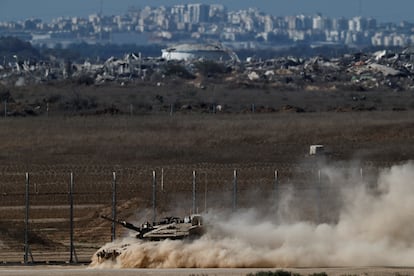
Although the plan to occupy Gaza City has not received final approval from the security cabinet, the Israeli press claims, citing anonymous sources, that the army is already beginning preparations for the offensive against the perimeter of Gaza City, especially in the Zeitoun neighborhood. This assessment fits with reports of the Gazan population fleeing the neighborhood for more than a week amid shelling. The Euro Med monitoring group recorded the start of these operations on August 11 and counted the exodus of tens of thousands of people and the demolition of 400 buildings, including private residences, during the first six days.
According to Israeli representatives, Tuesday’s meeting between defense leaders addressed how to prepare the southern Gaza Strip for the arrival of those who will be expelled from Gaza City. These efforts would allegedly include field hospitals.
The Israeli leaders present at that meeting named the operation to take Gaza “Gideon’s Chariots B.” In May, the same leaders approved an operation called “Gideon’s Chariots” with the aim of controlling 75% of Gaza’s territory, which they hoped would be decisive in subduing Hamas and securing the release of captives. That did not happen. Months later, Israeli analysts warn that applying the same strategy now will not yield different results.
The Israeli army believes that Hamas has two brigades remaining in Gaza City. Israel reiterates that it wants total victory over the Islamist militia, but has not defined what that victory would entail. Since the beginning of the conflict, multiple reports suggest that Hamas and other Palestinian militias have been able to recruit new fighters. In May 2025, the Israeli army estimated that Hamas had about 40,000 fighters, a figure similar to what it had before the conflict.
Gaza City, the main population center in the Strip, had 650,000 inhabitants in 2021, according to figures from the Palestinian authorities. However, the military offensive launched by Israel on Gaza in October 2023 has caused successive forced displacements of thousands of people throughout the enclave over the past two years, making it very difficult to know how many people remain in Gaza City at this time. Even so, estimates from various international organizations suggest that the current population is close to one million.
Sign up for our weekly newsletter to get more English-language news coverage from EL PAÍS USA Edition









































