
Journalists under fire in Gaza: ‘How many more have to be killed before the world reacts?’
Many reporters are estranged from their loved ones, and suffer from the constant fear they experience in the face of an Israeli offensive that has killed more than 200 of their colleagues
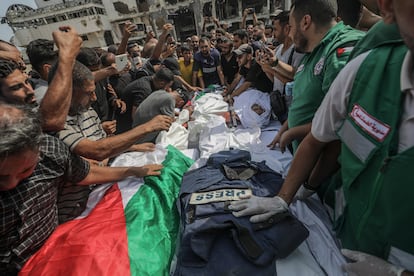

“I’ve been staying away from what we call ‘predictable targets’ here for a long time. That includes places and people. And Anas was one of them,” admits a cameraman from Gaza City. The reporter is referring to Al Jazeera journalist Anas al-Sharif, whom Israel killed on Sunday, along with four other employees of the Qatari media outlet.
“I’m very ashamed to say this today, because my heart is broken, but I avoided him, even though I loved him very much. I would have been very afraid to sleep in the same place as him,” adds this reporter, who asks to be identified as Hatem because he doesn’t want his name to appear in any media. “We’re already in enough danger,” he explains.
Anas al-Sharif had been directly threatened by Israeli military officials, and on Sunday, the army posted a message on X with the words “Hit,” a sort of claim of responsibility for the attack. The same bombing also killed reporter Mohammed Qreiqeh, cameramen Ibrahim Zaher and Moamen Aliva, and assistant Mohammed Noufal of Al Jazeera, as well as Mohamed al-Khalidi of the local outlet Sahat. They were all living and working in a tent outside Al-Shifa Hospital in Gaza City, seeking in vain the protection that hospitals usually offer in times of war.
But there’s no way to protect a Gazan journalist right now, agree Reporters Without Borders (RSF), Al Jazeera, NGOs, and media security coordinators. Some media workers choose to stay home, but many are distancing themselves from their loved ones due to the constant fear they feel and the lack of help for them to get food every day. Some live and work in groups, while others move around alone, blending in with the population and without a vest marked “press” because, instead of feeling protected, they feel singled out.
“I like to think I’m not a target. I’ve always been very neutral, I have no political affiliation, but Israel delves into your history, your messages, and the lives of your siblings, parents, and friends, and it transforms things,” Hatem believes. “So yes, there have been times when I’ve felt in danger and stayed home, not gone to work. My house is half-destroyed, but I still believe it’s the safest place for me right now,” he adds.
RSF estimates that some 220 Gazan journalists have been killed violently since October 2023, but the Gaza press office estimates the number to be 237. Furthermore, the Palestinian Journalists’ Syndicate estimates that 152 journalists’ homes have been bombed, resulting in the deaths of 665 people, including family members and neighbors.
Posthumous message
“We’re unable to protect them or their families. Many write a kind of will, aware that they could be targeted at any moment,” explains Adel (not his real name), a Palestinian journalist who left the Strip over a year ago and coordinates his media team who remain in the enclave from outside Gaza.
Al-Sharif wrote the posthumous message that many journalists have written. “I never hesitated to convey the truth as it is, without lies or distortions,” he said.
“Yesterday (Sunday), Anas asked me to be able to sleep for a few hours, turn off his phone, and disconnect because he hadn’t been able to for weeks. When he turned it on, he found dozens of missed calls and felt guilty for being gone for a few hours,” said Tamer Almishaal, a presenter for Al Jazeera’s Arabic service, recalling that both Al-Sharif and Mohammed Qreiqeh were targeted after “great coverage of hunger in the Strip.” “They are our eyes in Gaza, and there are fewer and fewer of them,” he added.
On several occasions in recent months, the journalist had been directly accused by Israeli officials of belonging to the armed wing of the Islamist movement Hamas, which rules Gaza. “In November 2023, Anas already suffered the first threats from Israeli intelligence to stop working. And he refused. He had a commitment to Gaza. Days later, his house was bombed and his father died,” Almishaal explained to this newspaper.
The fact that Israel does not allow any foreign journalists to enter Gaza increases the suffering of local reporters, who say their work is also compromised because they are Palestinians. “The presence of international journalists would undoubtedly protect them more,” admits Adel, who leads a team of several Palestinian reporters.
“I feel like my work is worth less because I’m Palestinian, but my job is to keep documenting: to find sources, get to the truth, and be strong. There should be some way to protect ourselves and hold those who attack us accountable. We’re real people,” Hatem says.
“Tied hand and foot”
Edith Rodríguez Cachera, vice president of RSF-Spain and of the International Council of the organization that defends journalists, admits that they have never faced a similar situation. “We are tied hand and foot. We can’t do anything RSF normally does in a conflict zone: we can’t evacuate them, we can’t get them materials, from phone cards to vests, and we can’t organize any kind of security or digital security training. Nothing,” she explains.
According to Adel, the Palestinian journalist who coordinates several reporters in Gaza, “the photographers’ and cameramen’s greatest concern is protecting the cameras, ensuring they don’t get dusty or damaged, because there’s no way to replace them.” “We also can’t get them gasoline so they can get around in vehicles. Sometimes they ride donkeys or walk long distances,” he adds.
“And we don’t know how to get it right. If we tell their stories so people are aware of how they survive, we expose them, but if we don’t, we also put them in danger,” Rodríguez Cachera emphasizes.
The RSF official also laments the international “abandonment” in firmly condemning these attacks against journalists in Gaza and taking appropriate action. “And the media must also take action, coordinate, go further, take a stand in some way, and loudly call attention to them,” she urged.
“How many more murdered journalists does it take for the world to react? Anas Al-Sharif and Mohammed Qreiqeh weren’t the first, and they won’t be the last,” Almishaal lamented.
In 2015, the UN Security Council passed Resolution 2222, which protects journalists in armed conflicts and aims to end impunity for attacks against them. “But Israel has been violating it for a long time, long before this war broke out, and especially with Al Jazeera,” the RSF official denounced. In May 2021, the Israeli army bombed a building in Gaza that housed Al Jazeera and other international media outlets, alleging it was being used by Hamas militants. In 2022, Palestinian-American Al Jazeera journalist Shireen Abu Akleh was killed in the northern West Bank by a bullet that the UN said came from Israeli troops. In July 2024, Israel killed the Qatari network’s journalists Ismail al-Ghoul and Rami al-Rifi in Gaza. “But nothing happened in any case,” Rodríguez Cachera laments.
Sign up for our weekly newsletter to get more English-language news coverage from EL PAÍS USA Edition









































