
The new China isn’t buying the American dream: Why Starbucks and Burger King are languishing
Both US corporations have handed over control of their business to local partners to keep up presence in a market that is becoming less friendly

During the 1980s and 1990s, when China was immersed in the process of economic reform, foreign restaurant chains became one of the most visible symbols for that process of opening up to the outside world. Eating a hamburger with fries, or a pizza, was synonymous with the modernity and access to other countries that was still a far-off prospect for the majority of the population. They were also experiences that were exclusive to the big cities, which were slowly incorporating such establishments as a way to showcase the new, urban China.
When the country’s first Starbucks opened in 1999, in the financial center of Beijing, the Seattle coffee titan didn’t only sell a beverage that was practically unknown to a society traditionally tied to tea. It also offered a space to socialize, work, and to see and be seen; an aspirational meeting point for an incipient middle class that was beginning to distinguish itself through global consumption habits. Today, this panorama is quite different. Starbucks has fallen behind strong local competitors, who have been able to adapt their offerings to consumers who are extremely dependent on home delivery, and increasingly sensitive to price and novelty.
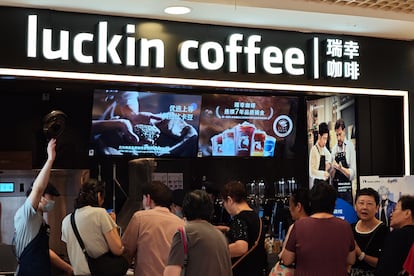
The clear winner of the coffee wars has been Luckin, the Chinese business that was founded in 2017 and since then has bet on a digital model oriented toward fast consumption, with small locations and a strong dependence on cell phone orders. It presents itself as a stark contrast to Starbucks, which is based on the in-store experience. The result has been a significant decline in the U.S. company’s position: Starbucks’ market share fell from 34% to 14% in just five years, according to Euromonitor International, and its earnings decreased by 19% between 2021 and 2024, according to Financial Times.
Amid those storm clouds, Starbucks has made a strategic shift: selling 60% of its business in China to Hong Kong’s Boyu Capital, in an operation valued at $4 billion. The decision is much more than a financial maneuver, and reflects a diagnostic evolution: the model that brought it practically unrivaled growth in China (its second-biggest market) for decades has ceased to be competitive. Handing over control has now become the price to pay in order to earn flexibility and the ability to react in a growingly hostile environment. This new association with Chinese partners appears to be a way to split the risks.
More competition
The pressure is not minor. Growing competition from Chinese firms has become the second-largest challenge for U.S. companies that operate in the Asian country, even ahead of economic deceleration, according to a fall report published by the U.S. Chamber of Commerce in Shanghai. The push from ever-more-solid local entities has come to occupy a central position among the concerns of U.S. businesses, surpassed only by the impact of geopolitical tension between Beijing and Washington.
In a move similar to that of Starbucks, Burger King has also handed over the reins. The hamburger giant has announced the transferral of 83% of its business in China to the Beijing firm CPE through a joint venture valued at some $354 million. With the operation, it seeks to relaunch its brand beyond large urban centers, where the market is less saturated, and has set a goal of doubling its number of restaurants in five years and getting to more than 4,000 locations by 2035, as compared its current total of 1,250.
“European and U.S. brands’ problem is structural,” conclude analysts at the WEGO Institute, a research group based in Beijing. “While local brands have grown at top speed over the last decade, the Western ones, which have heavier organizational structures and elevated cost models, react more slowly.” Faced with this scenario, the analysts say, options are limited: “Transform, divest assets, or even sell them to survive.”
Sign up for our weekly newsletter to get more English-language news coverage from EL PAÍS USA Edition









































