
The life of a delivery driver in China: ‘Many people don’t know how an order can arrive at their home in just one day’
The Asian giant is the world’s largest online marketplace. In a book that was recently translated into English, author Hu Anyan chronicles his precarious experience in the parcel delivery sector
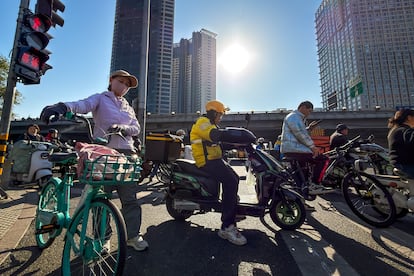

At the corner of his lips, there’s a grimace that betrays years of hardship. He’s wearing a sweatshirt and his head is shaved. He’s one of the thousands of package delivery drivers buzzing through Beijing.
Hu Anyan was one of these precarious workers until not too long ago. Today, he has a hamburger and a beer in front of him, which he sips while telling his story: “Many people don’t know how an order can arrive at their home in just one day.”
In China, home deliveries are a craze. Everyone orders things all the time. The Asian giant has the largest online commerce market on the planet, with an average of 125 packages per person, per year. That’s one order every three days.
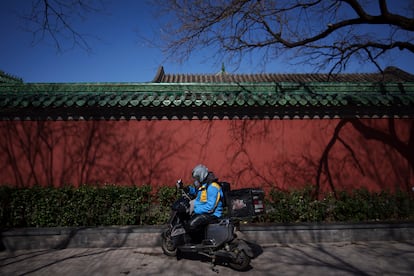
Companies compete fiercely. And the deliveries are handled by an army of motorcyclists on electric scooters, each with a metal box on the back. They’re the ones who park outside your building, carry your package to the door, knock, or call you on the phone call if necessary.
These individuals have low-paying jobs with extremely long hours. They’re often migrants from rural areas, who travel to the cities to earn a living, while residing in tiny apartments on the outskirts. These wage earners in what are called “new forms of employment” — which include delivery drivers and ride-hailing app drivers — number 84 million in China.
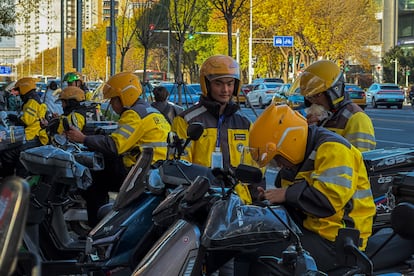
Hu Anyan, 46, was one of these people. He worked as a delivery driver and on the night shift for a logistics company. Based on his experiences, he published I Deliver Packages in Beijing (2023), an autobiographical account that achieved some success in China. It was translated into English this past October.
The book offers a glimpse into the conditions of a new lumpenproletariat. “I generally enjoyed the work: there was no need to talk, no need to use my brain. I just rolled up my sleeves and got on with it,” he writes, describing the night shift at the logistics company, where he was in charge of sorting packages. “I sweated so much that I never needed to go pee.” He worked 12 hours a day, with a half-hour break for dinner. He earned between 4,300 and 5,000 yuan (about $610 and $710), depending on penalties.
Then, he became a delivery driver. Every morning began with a speech from the area’s manager: “Don’t think we couldn’t do this without you. Anyone could do it!” he would bellow. Hu worked 11 hours a day, barely allowing himself a drink of water during a shift, in order to avoid going to the bathroom. Bathroom breaks are a nuisance on the road, as well as a waste of precious seconds.
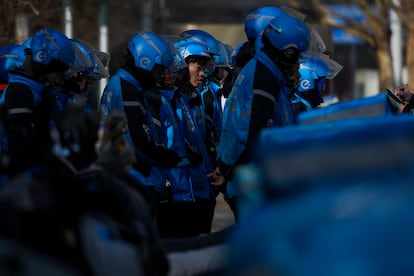
Hu obsessed over time and money. This led to a memorable passage in the book, in which he calculates the value of time if he intends to survive in the city: half-a-yuan per minute (about eight cents). If the company pays him two yuan (24 cents) per delivery, he estimates that he needs to deliver a package every four minutes in order to make it worthwhile to work. “Little by little, I got used to approaching everything from a purely financial point of view,” he writes. Urinating costs one yuan. Eating, 10 yuan (plus the cost of the meal). “I skipped a lot of meals,” he clarifies.
Facing the remains of the hamburger that he has devoured in just three bites during his interview with EL PAÍS, he lists his literary influences, ranging from Flaubert to Kafka to David Foster Wallace. He will soon publish a collection of short stories and is currently working on a novel. Nowadays, he lives off his writing: he has moved to Chengdu, a city known for its relaxed atmosphere. Hu doesn’t seem to be in any hurry: “I write slowly,” he reflects.
Hu believes that the success of his book may be due to the fact that it has revealed what often goes unseen, yet is enjoyed by everyone. “The first readers were shocked and moved,” he points out. Others see themselves reflected in the work, because they feel “confused or frustrated” with their surroundings. The author believes that the high level of development in modern societies has led to the emergence of all kinds of professions and a marked division between different social groups. “People don’t know what others do for a living.”
Sign up for our weekly newsletter to get more English-language news coverage from EL PAÍS USA Edition









































