
The rich marry the rich: How love perpetuates inequality
The wealthiest men and women in Spain are three times more likely to marry each other than if couples were formed randomly

Social class permeates all aspects of life, and love is no exception.
In Spain, for instance, couples don’t form randomly; rather, they’re typically determined by socioeconomic factors. This means that people tend to partner with those most similar to themselves in terms of income and wealth. And, at the top of the social ladder, this tendency intensifies. Those who earn and have the most assets find each other with a frequency three times greater than would occur in a society where relationships were completely random.
This finding goes beyond mere intuition or dinner-table conversation: it’s pure statistics. Silvia de Poli, a researcher affiliated with the Complutense University of Madrid, analyzed microdata from the Spanish Ministry of Finance and Spain’s National Institute of Statistics (INE), in order to answer a question as simple as it is powerful: what would happen to inequality if relationships were formed randomly, such as if people’s names were drawn from a lottery?
The answer is clear. If this were the case, the economic gap would narrow, both in terms of income and wealth.
De Poli’s simulation was conducted using three scenarios involving heterosexual couples. The model required systematically comparing samples, and, due to limited data availability, it couldn’t be applied to same-sex couples.
The first scenario is purely random, with people pairing up without regard to their salaries or inheritances. The second is one of perfect homogamy, where the richest marry the richest and the poorest marry the poorest. The third is complete heterogamy, in which someone from the top pairs with someone from the bottom, and so on. Spain is closer to the second scenario — a form of selective marriage is at play.
De Poli has created a chart illustrating this phenomenon. To do so, she ranked all individuals according to their economic status and divided them into 10 equally-sized groups, in order to observe how they interact with one another. The first group, or decile, represents the poorest 10%, and the last represents the richest 10%. When the value approaches balance (represented by 1), it means that pairings occur as if by chance; when it falls below 1, people from different groups rarely cross paths; and when it exceeds 1, individuals tend to marry within their own socioeconomic group.
In Spain, these values are extremely high in the wealthiest segment of the distribution. This is according to the study conducted by De Poli and other authors, which was published by the European Commission. Men and women in the top 10% of earners are 3.1 times more likely to marry each other than if everything were left to chance. The lower and middle-income brackets tend to remain within the equilibrium, reflecting a reality that looks very close to chance. Meanwhile, a very wealthy man is five times less likely (0.2) to marry a woman with lower-middle income than he would be in a purely random scenario.
This trend is more clearly observed when it comes to wealth, which is a more stable indicator. While income is more volatile and only captures a snapshot of a person’s financial situation — which can also change with retirement or reduced working hours — wealth tends to remain steady over time. And here, men and women from each group are clustered almost harmoniously across the entire scale: the wealthiest get together with the wealthiest and the poorest with the poorest.
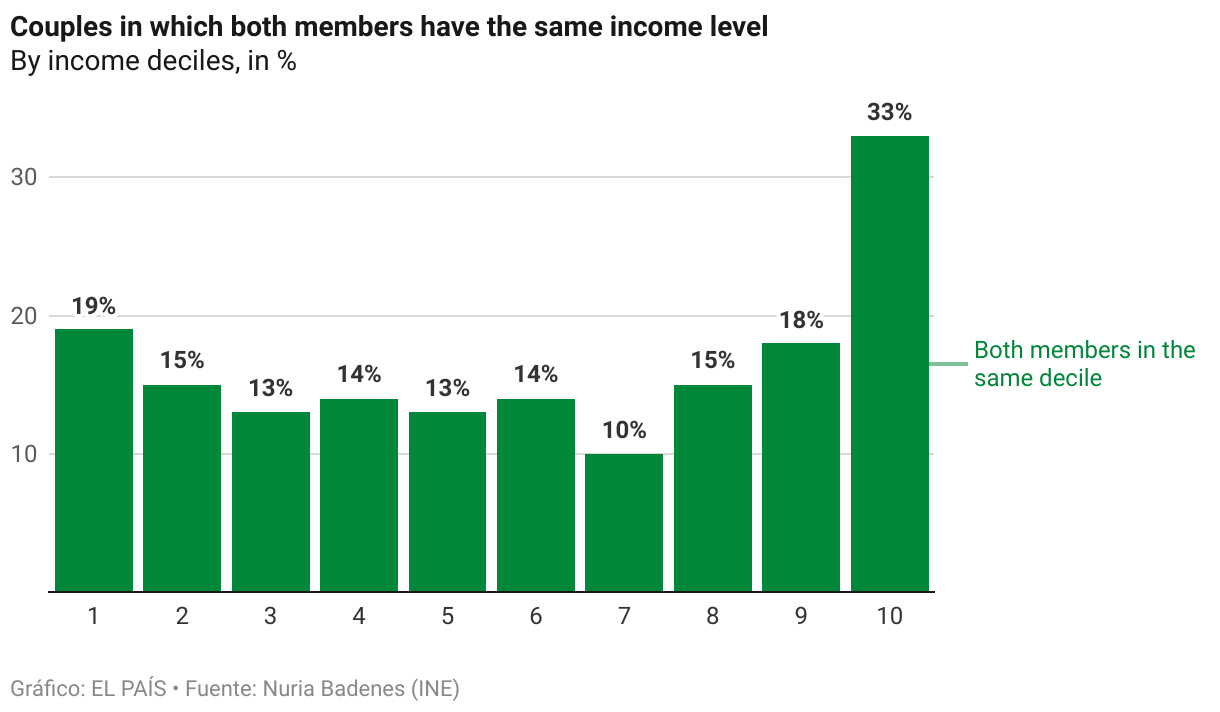
There are other ways to approach this phenomenon. Nuria Badenes, a researcher at the Institute for Fiscal Studies, has analyzed the INE’s Living Conditions Survey and corroborates this kind of economic endogamy. On average, the members of a couple belong to the same income group in 16% of cases, but in the top decile the rate doubles to 33%. “Choosing a partner is a decision that cannot be judged as being either fair or unfair. Yet the fact that people with higher incomes choose to partner up with each other contributes to perpetuating income inequality,” she points out.
From graduate school to the altar
So, where does this tendency come from? Diederik Boertien, a sociologist at the Center for Demographic Studies in Barcelona, explains that selective marriage stems from both individual preferences and social structures. People tend to seek partners with resources or characteristics associated with status, such as education, lifestyle and, of course, income. Thus, he notes, “a competition arises, where the most attractive people — that is, those with the most resources — end up together, while others pair up with each other or remain single.”
The very organization of society — with its rhythms and internal boundaries — fosters bonds within the same social class. “The people we interact with in daily life tend to be from a similar socioeconomic stratum. Family members, friends, classmates and colleagues, neighbors… they all tend to have relatively similar economic resources,” Boertien continues. And these, he adds, create entry barriers into groups where double-barrelled names are common. “It’s much harder to meet a wealthy person than a poor one,” he says, because “wealth allows for the creation of exclusive spaces where only the privileged have access and can meet each other.”
According to an adviser who works at a private banking firm, this is a trend that’s “clearly noticeable” among high-net-worth clients. “It’s common for members of a couple to have very similar levels of income, assets and investments.” They usually share not only a financial strategy, but also a similar economic background. “This makes it easier for them to structure their assets jointly,” says the adviser.
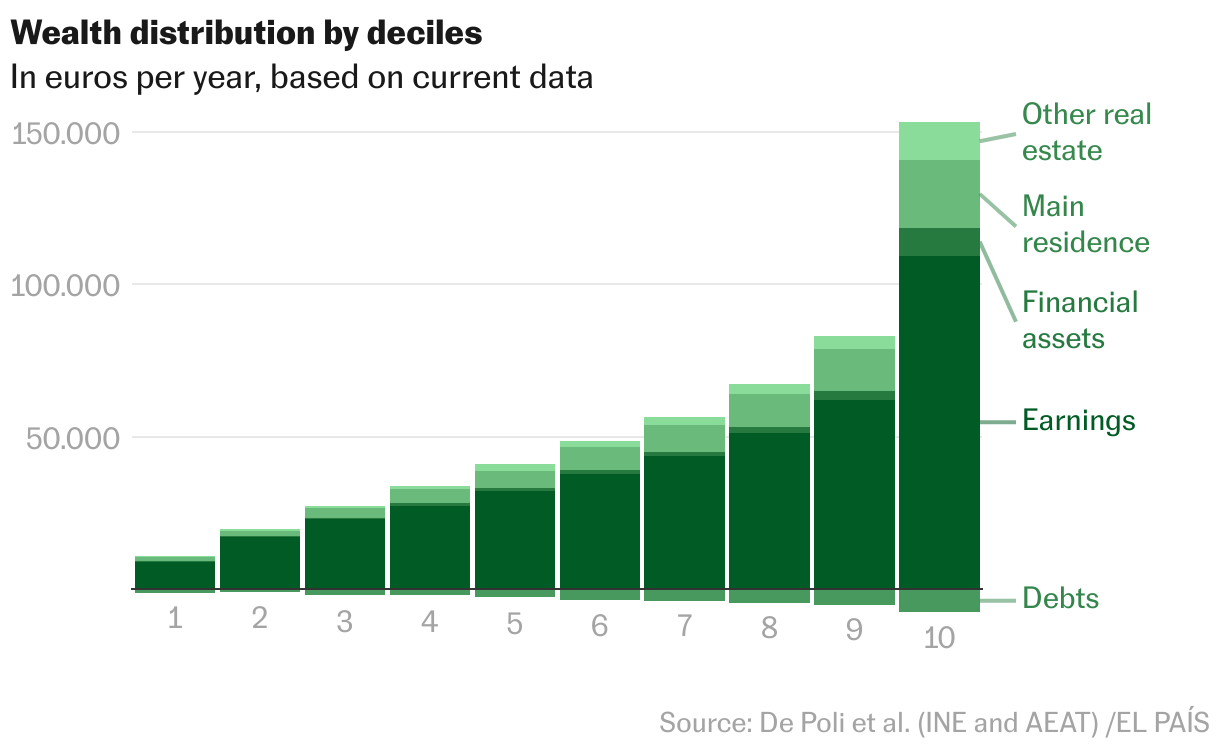
Homogamy — marriage between people from similar sociological or educational backgrounds — helps perpetuate economic inequalities in Spain. According to De Poli’s data, couples in the wealthiest 10% of the population have, on average, almost double the income and wealth of those in the next income bracket. And they hold 12 times the income and 42 times the net worth of those in the lowest decile.
De Poli reminds us that, in the formation of a couple, there are unobservable factors, such as personality, values and cultural affinities. But of the measurable factors, one of the best for exploring the origins of socioeconomic segregation is education. This is because, as Badenes points out, income tends to increase with the level of education. Data from the INE reflects that couples in the highest income brackets in Spain are, by far, are by far the ones with the least educational differences between partners.
To reach this conclusion, Badenes observed the educational gap within each union, ranging from a very large divide — such as a university graduate being in a relationship with someone who didn’t finish high school — to couples whose members have virtually identical educational backgrounds. She found that the higher the economic level, the more similar the couples’ educational paths are. At the lower end of the social spectrum, people with very different educational backgrounds mix, but at the top, partners almost always share a similar, generally higher, levels of educational attainment.
The romance elevator
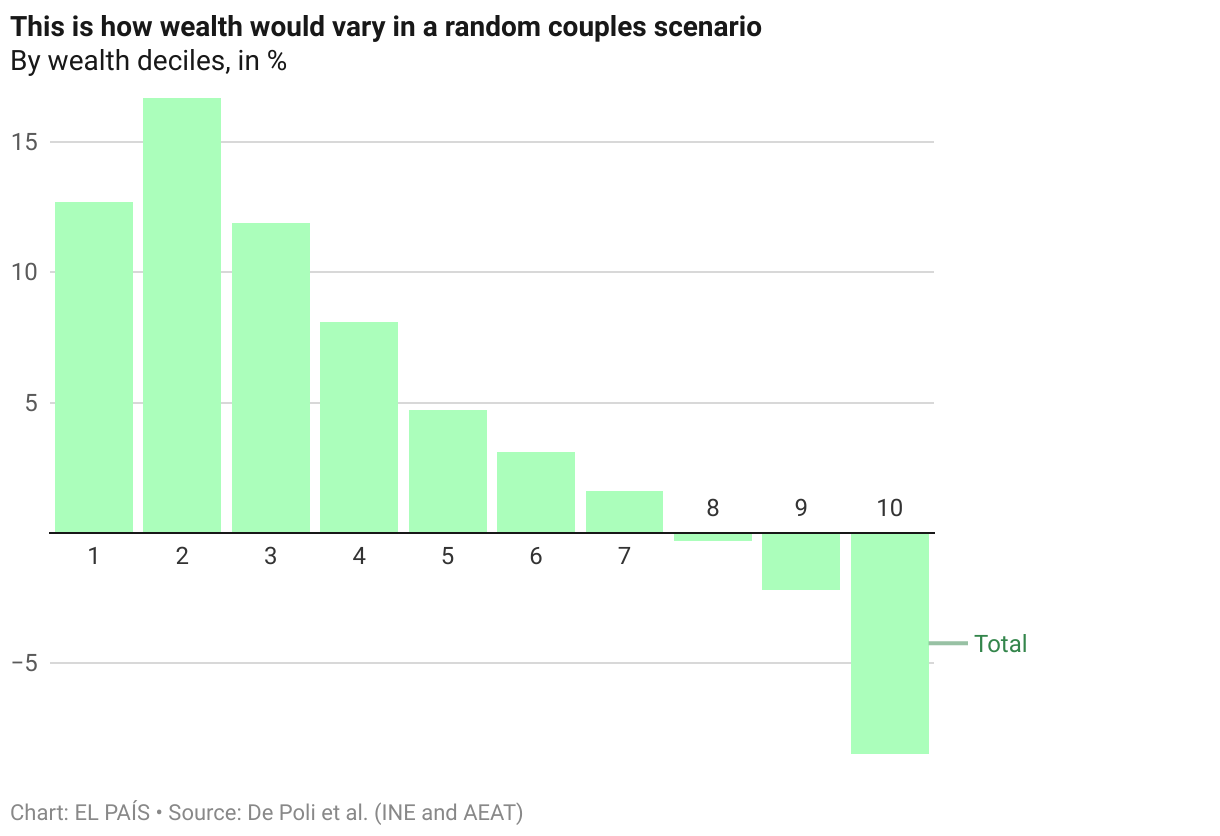
From this point, De Poli delves deeper into the effects of marrying within your social class and tries to determine what would happen to wealth distribution under a hypothetical framework of random marriages. In such a scenario, couples in the lowest 80% of income earners — especially those at the bottom of the scale — would be better positioned than in the current reality. Meanwhile, those in the remaining 20% would lose economic power. The difference is mainly explained by income, but wealth — especially when it’s held through primary residences — also plays an important role in this hypothetical redistribution.
When wealthier individuals concentrate resources and marry among themselves, they combine fortunes and advantages that not only multiply their purchasing power, but also ensure that their children are born with above-average wealth. At the top, these couples form veritable economic powerhouses, while those with fewer resources face greater obstacles when it comes to accessing equivalent opportunities.
The recent study suggests that taxation and other public policies partially mitigate the effect of homogamy on inequality. However, they are unable to halt the gradual accumulation of wealth resulting from selective marriages.
Sign up for our weekly newsletter to get more English-language news coverage from EL PAÍS USA Edition









































