
Young people versus boomers? Four charts to understand generational tension in Spain
The debate is warranted, as the data show genuine disparities. They also highlight a deeper reason: Spain’s growth is no longer what it used to be


Is our system too generous to older people? The generational debate in Spain has intensified, mixing reasonable arguments with false claims and misunderstandings. My position: the concern is valid, even though the problem has no simple solution.
First, let’s put one point aside: it doesn’t matter if young people have lived better than their parents. My generation (1981), lives better than the one before it (1950), and I hope my daughter, born in 2023, will have an even better life. Spain is a richer, healthier, freer, and more equal country. But that doesn’t stop the following from being true: an economic gap has opened between generations. The numbers make this clear.
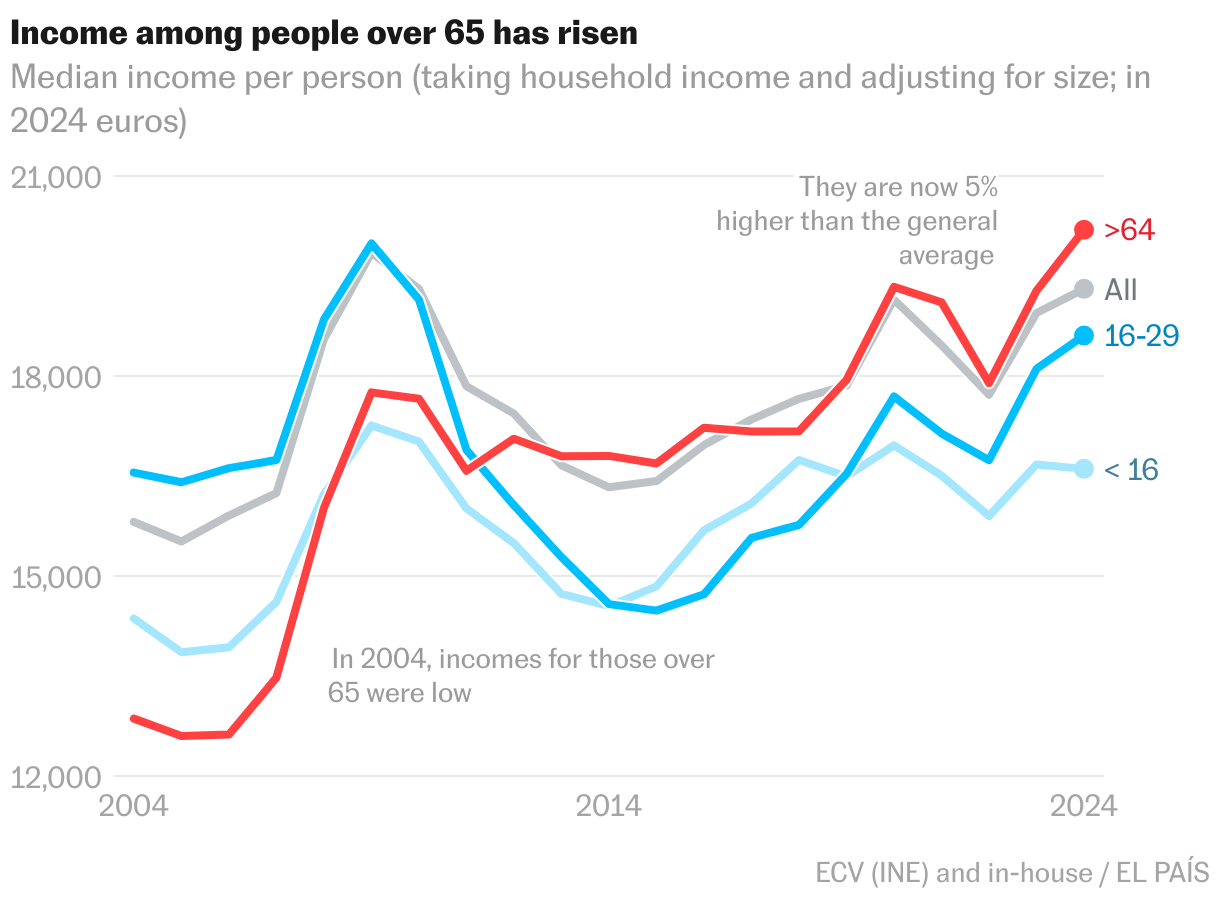
It is visible in incomes. In 2004, people aged over 65 had a median income 20% lower than the general population; today, it is 5% higher. The group with the lowest incomes? Households with children. Over two decades, the income of older people has risen, that of young people has fallen, and families with children have ended up at the bottom.
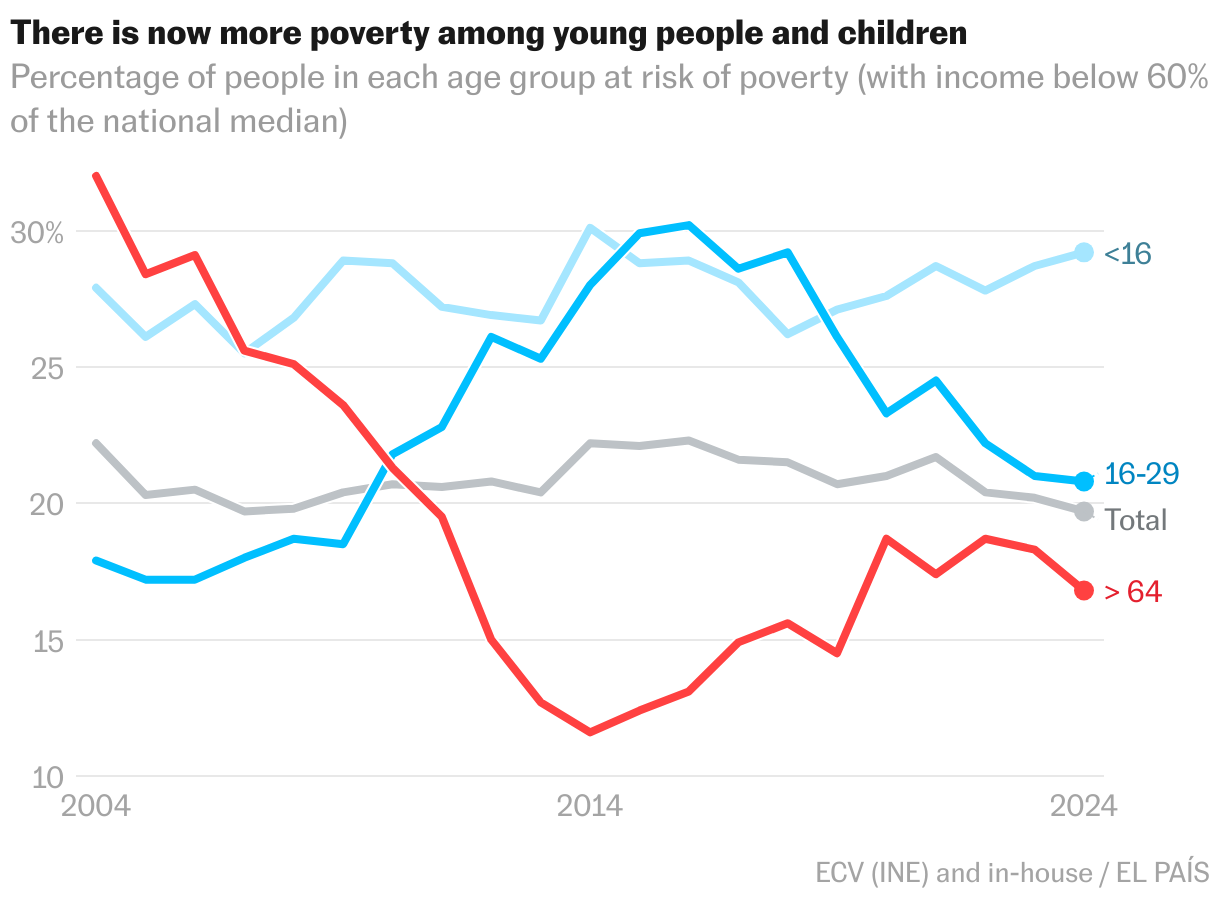
Poverty statistics point to the same trend. In 2004, people of retirement age were the group most at risk of poverty: 30% were in that situation. By 2024, that figure has been cut in half (16.8%), while poverty now affects young people (21%) and children (29%) the hardest.
What’s more, the gap is widening when it comes to wealth. Before the financial crisis (and the property bubble), the richest households were those aged 45 to 64; today, it’s the older groups — those over 65 or 75… but it’s the same people! The cohort born between 1940 and 1960. In 2005, when they were 45–64, they held the highest wealth. In 2024, they still do. Meanwhile, younger households have become poorer. The typical 40-year-old household had twice as much wealth in 2002 (€132,000 / $154,000) as in 2022 (€77,000 / $89,830).
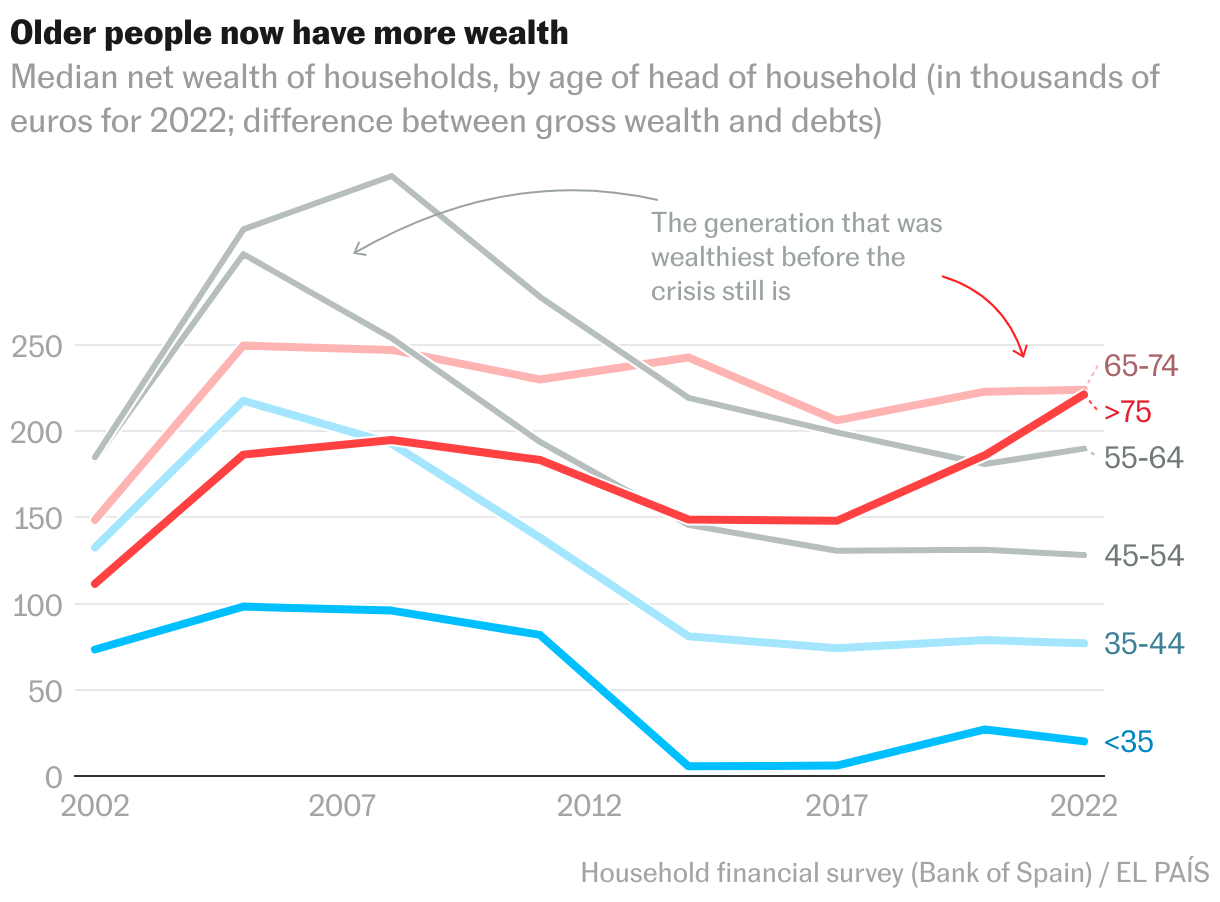
Housing is a key factor in the chart above. One generation bought their home and then saw its value increase. Those who came afterward had a harder time because prices had already risen. But this isn’t the only driver behind the chart. Since 2002, households headed by 75-year-olds have also moved from the tail to the top in “financial assets” and “real estate other than the main residence” (those who own such property went from 22% to 57%).
What can we take from these figures?
The data justify the generational conversation. We’ve gone from a country where older people were more likely to be poor to one where the opposite is true. Of course, there is heterogeneity: there are retirees with low incomes and young people who will inherit fortunes.
This fact is often used to counter criticism against the boomers. The argument goes: “The supposed generational gap is a distraction from talking about rich and poor.” But there’s another way to read it: universal benefits for the elderly — those given without regard to income, with their advantages and drawbacks — have become more regressive than 20 years ago, precisely because the retiree population is now more heterogeneous and includes more wealthy individuals. A visible example is the government-funded travel program for seniors and senior public transportation discounts. Benefits that decades ago reached mostly low-income Spaniards now go to a more economically diverse group.
Should we rebalance our social spending? I believe so. Spain spends about 5% more than the EU average on retirement and survivors’ pensions, according to Eurostat. In contrast, we spend less on housing, less on combating social exclusion, and far less — half as much — on families and children. I’m not saying there are magical solutions. Any redistribution is delicate: because of acquired rights, because it upsets balances, and because it’s never certain that what you gain compensates for what is lost.
I’ll settle for highlighting one element that doesn’t get the attention it deserves: growth.
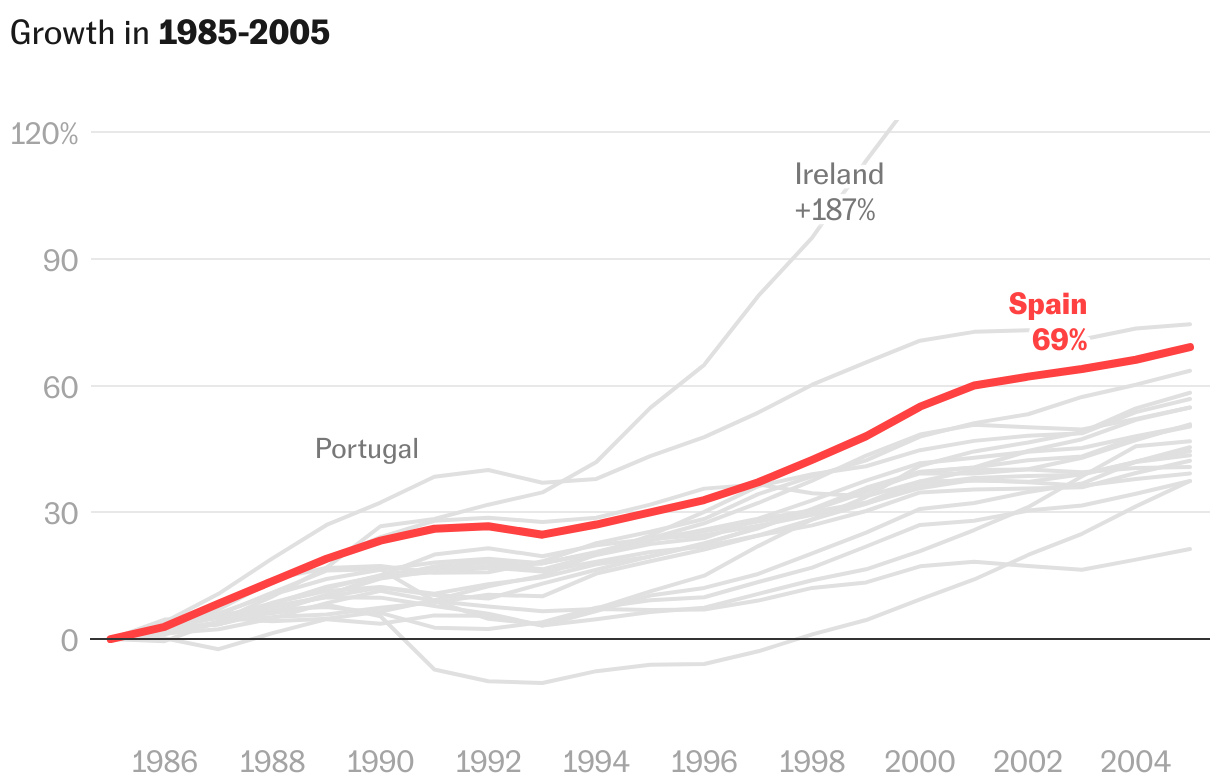
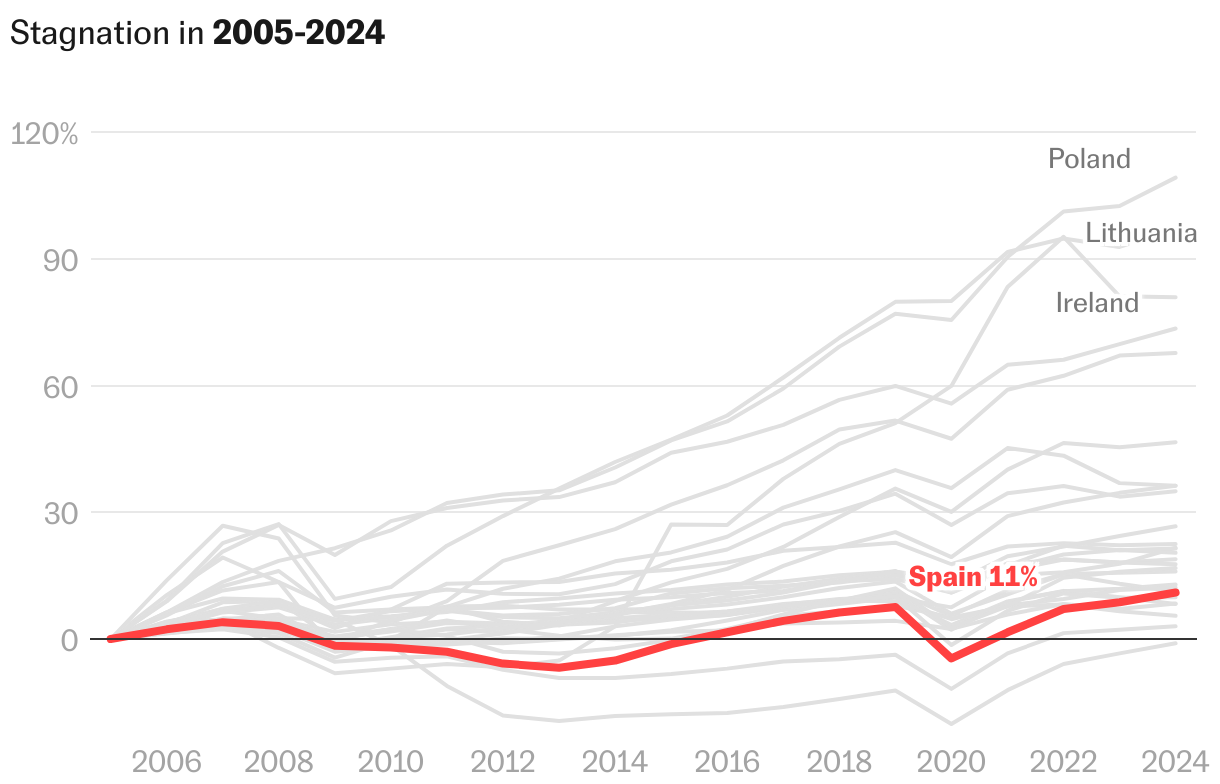
Spain experienced an extraordinary economic leap between 1960 and 2005. That’s the boomers’ great advantage: their generation witnessed and captured that takeoff. The problem is that cycle has ended. Look at the chart: between 1985 and 2005, Spain’s per capita GDP rose by 70%, but since 2005 it has increased by only 11%.
Change in GDP per capita in Spain compared to 1985 and 2005
OurWorldInData / EL PAÍS
The end of growth fuels the current tension. When the economy is expanding, it’s easier to distribute resources, reach agreements, and be patient: all classes and generations improve, even if unevenly. But when growth stagnates, inequality weighs more heavily, and we slip into zero-sum thinking. This, in turn, drives conflict — between classes, between generations, and even within the same family.
Sign up for our weekly newsletter to get more English-language news coverage from EL PAÍS USA Edition









































