
China is developing the world’s most ambitious network to transport its clean energy
Beijing is betting on an ultra-high voltage transmission system to integrate its huge renewable energy production into an interconnected national grid
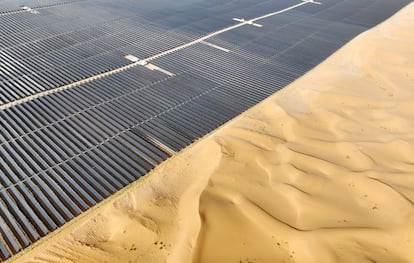

On the edge of the Tengger Desert in northern China, the whistling wind filters through the blades of an army of wind turbines, while the sun beats down on a sea of solar panels. From this remote landscape of light and sand, in the Ningxia Autonomous Region, a power line stretches across mountains, plateaus and valleys to reach Hengyang, in the industrial heart of Hunan Province in the south. Along more than 1,000 miles of cables and steel towers flows part of the electricity that keeps the country running: the ultra-high voltage (UHV) infrastructure that China is using to protect its grid from blackouts and redraw its energy map in the midst of its race toward ecological transition.
“Those towers have been there since last year,” a villager from Quanhu, 22 miles from Hengyang, points out from the entrance of her house. Her husband works the land and watches, puzzled. They live next to a gas station nestled among small hills. Nearby stands a transmission tower, one of the many that dot the horizon along the road to this place. She knows there’s a receiver nearby that generates electricity, but she doesn’t understand what the reporter means when she asks about “renewable energy.”
The Ningxia-Hunan UHV line is one of the most ambitious power grids rolled out by the Asian giant. Designed to transmit direct current at ±800 kilovolts, it has a capacity of 8,000 megawatts and can deliver more than 36,000 gigawatt-hours (GWh) of electricity per year, enough to supply some 10 million homes, according to data from State Grid (the state operator responsible for the national power grid) cited by the Xinhua news agency.
The electricity travels through five regions (Ningxia, Gansu, Shaanxi, Chongqing and Hubei) before reaching its destination with a loss of less than 3% per 621 miles, compared to the 6% or 7% that would be lost in a conventional grid. Inaugurated this year and fully operational since August, it is also the first line of its kind designed to primarily transport green energy. It is powered by plants with a total capacity of 17.6 GW, of which 9 GW come from solar photovoltaics and 4 GW from wind power.
“Green technology leads the energy conversion and environmental awareness builds the future,” reads a sign outside one of the buildings at the Hengyang receiving station, where EL PAÍS recently traveled.
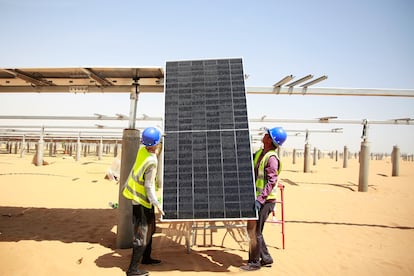
China is accelerating its energy transition at a pace exceeding its own projections: by 2024, it had already reached the wind and solar capacity projected for 2030, with over 1,630 GW installed, and in April, clean energy surpassed 25% of the national generation share for the first time. President Xi Jinping announced new targets for 2035 at the U.N. Climate Summit in September: 3,600 GW of installed capacity and a renewable electricity share exceeding 30%.
But the challenge is that much of that clean energy is produced in regions that generate far more than they can consume, in the vast deserts and plateaus of the north and west of the country, which are sparsely populated, and far from the large urban and industrial centers, concentrated along the east coast.
To connect them, China has opted to build a transmission system based on UHV networks that allows for the reorganization of electricity flow according to demand. This interregional dispatch capability, according to researchers Yubao Wang, Junjie Zhen, and Huiyuan Pan in an article published in the journal Sustainability, optimizes the use of renewables and increases the energy efficiency of companies by reducing dependence on more polluting local sources and improving coordination between different networks.
Ms. Hu, 55, ran a restaurant in Hengyang. She recalls that around 2005, there were, on average, three power outages a week. “It was almost always because the energy limit was exceeded,” she explains. She insists that little by little, “things have changed” and says that in the last 10 years, “there haven’t been any power problems.” Although she supports China’s environmental progress, she believes there is a “lack of awareness” about the health effects of living near transmission towers and exposure to electromagnetic fields.
The push for UHV lines began in 2009, when China became an engine of investment and employment following the global financial crisis. After the Fukushima nuclear accident in Japan in 2011, the Chinese government further strengthened its commitment; it halted the construction of reactors near cities and prioritized electricity transmission from remote areas.
Over the past five years, the total length of China’s UHV transmission lines has increased from 17,400 miles to more than 24,854, according to the latest figures from the National Energy Administration. The country currently has 45 UHV lines (one AC line at ±1,100 kilovolts, 21 AC lines at 1,000 kilovolts, and 23 DC lines at ±800 kilovolts). Beijing anticipates that by the end of 2025, the west-east transmission capacity will exceed 340 GW, a 25% increase over 2020, enough to power approximately 230 million Chinese households.
By comparison, in Europe, the most powerful electrical links (such as the Viking Link between the U.K. and Denmark, or the Nord Link between Germany and Norway) operate at ±500-525 kilovolts and can carry around 1,400 megawatts.
Although China’s National Energy Administration has made its expansion a priority, reality is moving at a different pace. Planning and building these lines takes time, and “even China can’t develop that fast,” notes David Fishman, an energy analyst based in Shanghai, in an exchange of messages.
Unused energy
In the first half of 2025, the proportion of solar energy that was not utilized increased from 3.9% to 6.6% year-on-year, and in the case of wind power it rose from 3% to 5.9%, partly because the grid was not able to transport all the production.
China has a voracious appetite for electricity, with a growth rate of 7% annually. The International Energy Agency (IEA) estimates that one in 10 cars on its roads is electric; in 2024, of the 17 million electric vehicles purchased worldwide, 11 million were acquired in China, according to the IEA. Furthermore, the fully electric operation of over 29,825 miles of high-speed rail lines and the progressive replacement of fossil fuels in various industries, such as steelmaking, have driven consumption to unprecedented levels.
This enormous demand means it remains heavily dependent on coal. It’s the other side of the coin: although China plans to reach its peak carbon dioxide (CO₂) emissions by the end of this decade, it is the world’s largest emitter in absolute terms — not per capita — and responsible for 30% of greenhouse gas emissions and 90% of the growth in CO₂ emissions since 2015, according to Carbon Brief, a specialized industry publication.
Fishman points out that China “needs” all the renewable energy it generates to “come online” to limit emissions growth. “That’s why UHV lines are now more important than ever,” he emphasizes. China’s CO₂ emissions fell 1.6% year-on-year in the first quarter of 2025 and 1% over the past 12 months. This is the first time a reduction has been directly linked to increased renewable energy capacity without a slowdown in energy demand, according to a study published in May by Carbon Brief.
Sign up for our weekly newsletter to get more English-language news coverage from EL PAÍS USA Edition









































