
Global opposition to Trump gains momentum
Statements made at the World Economic Forum in Davos reveal a change in Europe’s stance, with countries increasingly adopting policies of defiance similar to those of China, India, and Brazil
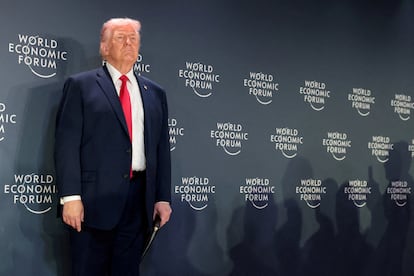
Trumpism is facing growing opposition on a global scale. The week at the World Economic Forum in Davos has strengthened the ranks of its opponents, with a shift among numerous European leaders — including figures from the far right, theoretically close to Trump — who have abandoned their usual conciliatory attitudes and are now opting for firm rejection in the face of his abuses and insults. In this way, albeit without formal coordination, they are joining the group of countries that refuse to yield, such as China, India, Canada, and Brazil.
This renewed momentum also stems from the fresh realization that an opposition capable of triggering market turbulence is an effective tool. Faced with European resolve and stock-market volatility, Trump withdrew within hours his threat to forcibly annex Greenland and his warning of new tariffs against European countries that defend Danish sovereignty over the territory.
Examples of the effectiveness of a firm stance combined with the ability to inflict economic damage were already evident. Last year, China mounted strong resistance to Trump’s tariff offensives by activating measures restricting key exports of strategic raw materials, forcing the White House to back down and opt for a negotiated truce — timed, not coincidentally, to last until the U.S. midterm elections in November.
The Gulf countries, flush with vast financial resources that enable lucrative business prospects and angered by Israeli excesses that culminated in the bombing of Hamas leaders in Qatar, were also decisive in compelling Trump to rein in Israeli Prime Minister Benjamin Netanyahu’s actions in Gaza.
Throughout Trump’s first year in office, Europeans opted for appeasement. Even where they possessed clear retaliatory capacity, such as in trade, they chose accommodation out of fear that the United States might abandon Europe on security matters, given the critical threat posed by Russia. But Trump’s threats to annex Greenland prompted a clear shift in attitude, one that was evident last week in Davos.
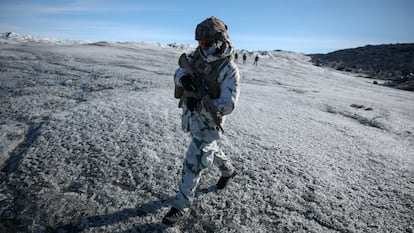
In the Swiss Alpine resort, for example, French President Emmanuel Macron said, in a passage that left no room for doubt: “We do prefer respect to bullies; we do prefer science to potism; and we do prefer rule of law to brutality.”
Perhaps even more interesting was the statement by Bart De Wever, the Belgian prime minister and leader of a party affiliated with the same far-right European group as Italy’s Giorgia Meloni: “So many red lines are being crossed,” he said. “Being a happy vassal is one thing. Being a miserable slave is something else. If you back down you are going to lose your dignity and that’s probably the most precious thing you can have in a democracy.”
De Wever’s remarks are representative of the growing distance between Trumpism and other figures in the heterogeneous world of the European far right, which is nominally allied with Trump. According to the National Security Strategy published last December, the United States seeks to strengthen this group as a way of undermining the European project.
Figures such as Marine Le Pen or Jordan Bardella from France’s National Rally party (RN), and Alice Weidel of Germany’s AfD, have spoken out strongly against Trumpist positions, which are too toxic not to oppose, particularly when they touch on the core issue of sovereignty.
Likewise, politicians from non-extreme sectors who in the past, for various reasons, had been very reluctant to criticize the United States have taken clear steps. Donald Tusk, the prime minister of Poland — a country traditionally close to the United States and highly exposed to the Russian threat — posted on X: “Europe cannot afford to be weak - neither against its enemies, nor ally. Appeasement means no results, only humiliation.”
Ursula von der Leyen, long known for a very cautious approach toward Trump, called for “a departure from Europe’s traditional caution” in a speech in Strasbourg. Keir Starmer, prime minister of the United Kingdom — a country strongly allied with the United States, to the point, according to some analysts, of bordering on submission — was forced to describe as “insulting and frankly appalling” Trump’s comments claiming that NATO allies stayed away from the front lines in Afghanistan, when in fact many countries suffered heavy casualties.
These shifts are changing the gravitational center of European politics vis-à-vis the United States, moving it closer to the position of the Spanish government, which over the past year has taken decisions unpopular in Washington — such as refusing to commit to military spending of 5% of GDP or recognizing the State of Palestine ahead of other European countries — and which last week, like others, rejected joining the Board of Peace promoted by Trump.
In Europe’s business world, too, there appears to be a sense that enough is enough. “We were being threatened with tariffs when this was not an economic issue,” said Anthony Gooch of the European Round Table for Industry (ERT). The secretary general of this influential lobby group, made up of major EU companies, argues that last summer the European private sector had already made an effort to “accommodate” U.S. concerns. It even backed the decision not to respond, in order to avoid escalating the trade war.
But last Monday, this organization issued a statement defending the sovereignty and territorial integrity of the Kingdom of Denmark and demanding dialogue to find a solution. The text made it clear that if this solution failed, they would support “necessary steps to defend the fundamental interests of Europe and EU Member States.”
Georgina Wright, an analyst at the German Marshall Fund, believes that the “change in the European approach” to dealing with the U.S. government began at the start of the year and “culminated” in Davos. The expert believes that “something changed in Brussels, but also even in the Baltic States and Poland, which, although highly dependent on the U.S. for security, no longer trust the U.S. as they once did.”
Wright believes this change is not due solely to the threat of tariffs against countries that offered military assistance to Greenland, but rather to a “combination” of factors, with that threat marking the culmination of “many” others: the national security strategy published at the end of last year, which revealed “how Trump views Europe”; the announcement of the Board of Peace, seen in Europe as “an attempt to create an alternative to the United Nations”; “all his threats to seize NATO territory”; and also “the indifference and lack of respect that many perceived in President Trump’s comments about Europe.”
All of this, she notes in a phone interview, “led to a truly significant change in Brussels.” In the EU, which continues to advocate diplomacy and negotiation — since, after all, the United States remains an ally with whom cooperation is necessary — there is nonetheless a growing conviction that Europe must be “much better prepared.” “We cannot afford to be caught off guard,” she sums up. And this shift, she adds, “is here to stay.”
With this turn, Europe is giving greater substance to the still-nebulous opposition to Trumpism. Within this loosely organized space, another traditional U.S. ally holds a prominent place: Canada.
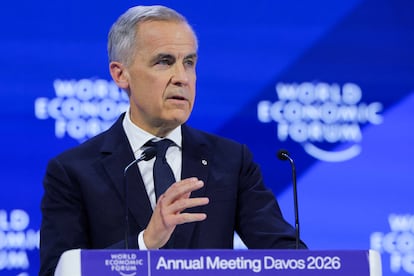
Canada’s prime minister, Mark Carney, delivered a speech in Davos that drew a standing ovation, in which he urged countries that had benefited in the past from the U.S.-led order to recognize that this order has come to an end. Carney called on them to embrace a strategy of diversification, to value strength as well as the strength of values, and to build flexible coalitions among countries that share objectives and do not wish to be subjected to the imperial impulses of others.
As part of this process, Ottawa has signed a new trade agreement with China. On Saturday, Trump moved to punish what he saw as the audacity of both the speech and the trade move by threatening 100% tariffs on all Canadian exports, after having criticized Carney in his own Davos address.
The episode highlights the extent to which Trump’s U.S. policy is blowing up traditional alliances and pushing former allies toward an urgent diversification that also entails closer ties with its great rival, China.
This same pattern has been taking shape through India’s maneuvers. Hit by a barrage of Trump-imposed tariffs justified, among other reasons, by its purchases of Russian crude — an action difficult to reconcile with an otherwise generally soft U.S. policy toward Russia — India has been pushed to rethink its relationship with China. Indian Prime Minister Narendra Modi paid a highly significant visit to Beijing last summer, and his government is considering steps such as once again allowing Chinese companies to participate in public procurement, according to Reuters.
And it is precisely India and the EU that are close to signing a free trade agreement, which would be yet another significant step in that direction for the European bloc, following recent deals with Mercosur, Indonesia, and Mexico. This is, of course, one of the countermeasures to Trump’s protectionist offensive.
Brazil, the largest member of Mercosur, is another prominent representative of the global opposition to Trump. The U.S. president hit the country with a barrage of tariffs in an attempt to undermine its institutions and protect his ally, Jair Bolsonaro, Brazil’s former president. Brazil did not back down, and Bolsonaro is now in jail. When asked about Bolsonaro’s arrest, Trump said it was “a shame.” Asked if he wanted to add anything further, he declined.
This emerging opposition is not a coordinated force. In Europe’s case, the future path is far from clear. The United States is an extraordinary military, technological, and economic power capable of inflicting considerable damage and swaying opinions. But it is clear that the forces opposing Trumpism have taken a step forward, and that within this disorganized mass, new interactions may emerge, giving rise to new frameworks.
Sign up for our weekly newsletter to get more English-language news coverage from EL PAÍS USA Edition









































