
The Gaza Board of Peace: 60 countries invited for a fee of $1 billion each
The project to rebuild and run the Gaza Strip gives broad powers to the US president but Israel objects to the composition of the new body
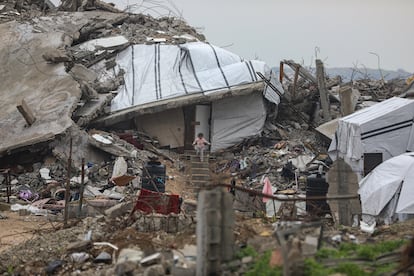

U.S. President Donald Trump has put the price that countries must pay for a permanent seat on the Gaza Board of Peace at $1 billion. The White House has invited at least 60 world leaders to join a body that Washington initially linked to the resolution of the war in the Palestinian enclave, but which takes the form of a global assembly that would have Trump as its leader, according to a draft of the founding charter to which Reuters and Bloomberg have had access.
The charter, which the U.S. has sent to the countries invited to participate, says that Trump will have the right to decide who aspires to join the club and when and where their meetings and votes will be held. He will also have the final say on the decisions of the board, described in the draft as an entity to “promote stability, restore dependable and lawful governance, and secure enduring peace in areas affected or threatened by conflict.”
Among the many leaders who have received the invitation are King Abdullah of Jordan and Pakistani Prime Minister Shehbaz Sharif. Giorgia Meloni, Italy’s prime minister, has made public her intention to join and Mark Carney, the Canadian prime minister, will also accept, according to Canadian media.
The U.S. draft indicates that when three states have approved the charter, the project will officially begin. Trump said in a recent interview with Reuters that the Board of Peace will address other conflicts when it has resolved the one in Gaza, where Israeli gunfire has killed 464 people since the start of the October truce, according to the Gaza Health Ministry.
For now, the priority is the Gaza Strip. A White House representative told Bloomberg on condition of anonymity that countries can join the Board of Peace at no cost for three years, but that their stay on the committee will depend on Trump. If countries pay $1 billion during the first year of the project, they will be guaranteed permanent membership. That money, he added, will be used for the reconstruction of Gaza.
The Board of Peace was first touted in the 20-point plan that Washington devised in September to end the conflict in Gaza, and which led to the current fragile truce in the enclave. This initial plan, which seeks to create a transitional model of governance that excludes Hamas, anticipates the establishment of a Palestinian technocratic committee, in charge of the day-to-day life of Gaza and supervised by the board, which would be headed and chaired by Trump.
The future of the ceasefire
The implementation of that part of the plan has gained momentum. On January 14, Palestinian factions, including Hamas, agreed to create the technocratic committee, which will be made up of Palestinians and will occupy the lowest rung of the new Gaza administrative ladder. A day later, Trump announced that the Board of Peace had been created. The statement did not include the identity of its members, who must be heads of state, but boasted that it would be “the most prestigious ever formed.”
On January 16, the White House made the formation of three additional bodies to the Board of Peace and the Palestinian committee official. The most influential is the Executive Board. “Each Executive Board member will oversee a defined portfolio critical to Gaza’s stabilization and long-term success, including, but not limited to, governance capacity-building, regional relations, reconstruction, investment attraction, large-scale funding, and capital mobilization,” it said.
Some members of the founding Executive Board of Peace attached to the wider Board of Peace will be members of the Trump administration, such as Secretary of State Marco Rubio, Middle East envoy Steve Witkoff, and Trump’s son-in-law and adviser, real estate tycoon Jared Kushner. Also named are former British prime minister Tony Blair, American billionaire Marc Rowan and World Bank President Ajay Banga. Operating beneath this body and with unspecified powers will be the wider Board of Peace. This entity should support the work of the Office of the High Representative — UAE-based Bulgarian diplomat Nickolay Mladenov — which seeks to act as a bridge between the board and the technocratic committee. Unlike the other two bodies, which do not have Palestinian or Arab participants, the Executive Board of Peace does. Among its members are the Qatari diplomat Ali al-Thawadi, the head of Egyptian intelligence, Hassan Rashid, and the Turkish foreign minister, Hakan Fidan.
Opposition and skepticism
Israeli Prime Minister Benjamin Netanyahu protested on January 17 over the configuration of Gaza’s Executive Board of Peace. As soon as the Sabbath ended, Netanyahu posted a statement in Hebrew in which he said that the composition of that body had not been coordinated with Israel and is contrary to Israeli policy. Although Netanyahu did not go into detail, his objection appears to be the inclusion of a minister from Turkey, and representatives of Qatar and Egypt, two countries that have condemned the Israeli offensive in the Gaza Strip, triggered by the October 7 Hamas massacre of Israelis.
The far-right Minister of National Security, Itamar Ben-Gvir, has also said that Gaza does not need executive boards to supervise construction, but a massive boost of voluntary migration, while Minister of Finance Bezalel Smotrich has blamed the prime minister for not having established a military government in Gaza that would work to promote the settlement of Israelis.
First phase
The peace board is being built regardless of Gaza’s ongoing deterioration. The first phase of the ceasefire, which came into force on 10 October, saw progress such as the release of all but one of the remaining hostages held by Hamas and the end of large-scale Israeli bombardments.
However, Israel has consistently flouted the terms of the truce, with daily shootings, the closure of the crossing with Egypt and restrictions on aid. On January 16, the Gazan authorities reported that a new baby died of hypothermia, the eighth this winter, while UN agencies report having winter materials blocked at the gates of the Strip.
The emergence of an administration that governs Gaza without the participation of Hamas is one of the pillars of the second phase of the agreement, which should turn the temporary truce into a permanent ceasefire. However, many are skeptical it can succeed. Israel opposes withdrawing its troops completely from the enclave, Hamas refuses to disarm without the promise of a Palestinian state, and it is unclear what the movement of billions of dollars among potential Board of Peace members has to do with either of these two objectives.
Sign up for our weekly newsletter to get more English-language news coverage from EL PAÍS USA Edition









































