
Gazans view Trump’s plan, and the future, with pessimism: ‘Things will go back to the way they were or even worse’
Palestinians in the Strip have no illusions about the possibility of a lasting peace or the promised reconstruction
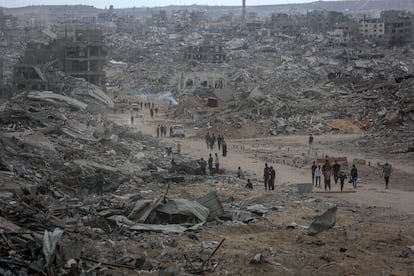
Fidaa al-Araj has not yet been able to return to her home in the Al Nasr neighborhood of Gaza City, but she already knows the house has been damaged by Israeli bombs. The structure is still standing, and this Palestinian woman is planning to “use plastic sheeting or pieces of broken furniture to improvise windows, doors, and cover the walls” and move in with her husband and six children, aged 16 to four. In Gaza, there is no construction material to repair the 92% of buildings completely destroyed or severely damaged by bombing, according to UN estimates, as winter sets in. Many Gazans have no home to return to at all.
The priority for this 40-year-old psychologist right now, she explains via text messages from her shelter in the center of the Strip, is to “clean up and fill in the holes” in what remains of her house to have “a space” for herself and her family, “to rest, breathe a little, and be able to sleep a whole night in silence.” Another Gazan, Ohood Nassar, 23, says much the same thing, from Deir el-Balah, also in the center of the Strip: “Now, everyone is trying to rebuild a small place to live and find a project that will help them continue with their lives.”
The needs of the present — such as finding shelter — are so many and so pressing in Gaza that thinking about the future is a luxury this traumatized population cannot afford, days after the current ceasefire went into effect last Friday.
When they do, stresses Khalil Abu Shammala, former director of the NGO Addameer in Gaza, they are not “very optimistic.” Neither about the future nor regarding Trump’s peace plan, the first phase of which has almost overcome its main challenge — the 20 Israeli hostages still alive were exchanged for some 2,000 Palestinian prisoners — and now Hamas is waiting to hand over the bodies of the remaining captives, 28 in total. Abu Shammala believes there are “many unanswered questions in that plan” that loom over the future of Gaza.
The activist cites “reconstruction and how it will be carried out, given the current population density [the entire population is concentrated in just half of the territory; the rest remains occupied by Israeli troops].” Other questions include “whether the border crossings will be opened” and if “reconstruction will be used as a tool to exert further pressure on the Palestinians.”
Alaa Sbaih, 25, is also pessimistic. She doesn’t believe that, through Trump’s proposal or the ceasefire, Gazans “are on the verge of achieving a life of peace, security, and stability.” She believes that “the situation may calm down for a while, but inevitably things will go back to the way they were before, and maybe even worse.”
Neither Fidaa al-Araj nor Ohood Nasser, who earned her living as a translator, harbor any illusions about the possibility that peace will be lasting, or about the promised reconstruction that is supposed to follow. Jaco Cilliers, a United Nations Development Programme (UNDP) official for the Palestinian people, estimated Tuesday that this task will take about 15 years and cost $70 billion.
“Restrictions and delays”
Al-Araj believes that Israel will impose “all kinds of restrictions and delays” on the entry of essential construction materials. Since 2007, when it established the blockade of the Strip after Hamas took power in Gaza, Israeli authorities have required a lengthy list of permits and requirements for the introduction of these materials into the Strip, both from the private sector and from international organizations such as Oxfam, the NGO where the psychologist works.
Following the much less bloody military offensive in 2014, Israel only allowed less than 10% of the construction materials deemed necessary at the time into Gaza through the southern border crossing of Kerem Shalom, according to the Israeli NGO Gisha. Israel argued that Hamas was using these goods to build its tunnels.
This is assuming reconstruction ever begins and “Israel doesn’t deceive” the Gazans, Nassar assures. “Now that they have recovered their hostages, they could resume attacks at any moment.”
For Al-Araj, Trump’s plan contains an original sin: it doesn’t address what she considers the elephant in the room, the Israeli occupation of Gaza since 1967 and the blockade imposed in 2007, “before the October 7 attacks,” to which Israel responded by launching bombing raids and then invading Gaza by land.
Without ending that occupation, which of course is not mentioned in Trump’s plan — if it had been, Israel probably wouldn’t have signed it — the Palestinians of Gaza will not receive “what they deserve”: their “right to freely choose” their destiny and their rulers “through democratic elections.” Also, and above all, she emphasizes, “accountability for Israel’s genocide in Gaza."
“We know it’s not easy and that this won’t happen overnight,” she laments.
Gazans don’t even know “what political system will be implemented” as part of Trump’s plan, Abu Shammala points out. The text outlines, in very vague terms, a technocratic Palestinian administration subject to the authority of an international organization chaired by Trump himself.
Not wanting to wake up
In a text sent to EL PAÍS, Alaa Sbaih describes the difference between the young woman, “full of life,” she was before the Israeli invasion and the tired person she is now, someone who “doesn’t want to wake up” in the morning. This graduate in arts and humanities, who aspired to study film abroad and learn photography and directing, describes the same apocalyptic scenario indicated by data from international organizations.
In Gaza City, which she has not left for the past two years despite the bombing and famine, there are no “suitable places to live, no hospitals, no schools, no parks, not even roads suitable for transportation. It is a city devoid of the essentials of life.” Only 14 of Gaza’s 36 hospitals are partially functioning, and 90% of schools and 79% of university campuses have been destroyed, according to the UN. There are 170,000 people injured, more than 40,000 of them with disabling conditions. At least 5,000 children have undergone amputations.
“Before the war, we were a people who loved life, like everyone else. Now, I don’t expect people to have the strength or the desire to try again,” she says, alluding to the horror revealed in these figures.
The young woman doesn’t trust “any plan coming from any foreign politician.” In Gaza, “thousands of families have lost at least one of their loved ones,” she says. “Our blood has been shed in murders carried out with horrific methods by the [Israeli] occupation soldiers against our people.”
Even in devastation, Gaza remains the land of the Palestinians who live there. Ohood Nassar says he wants to die there, although before the war ended, he thought about “leaving so I could survive.”
Many Palestinians like her are torn between “the tragedy” of leaving Gaza, says Al-Araj, and the imperative of providing a future for their families, which the Israeli offensive has made nearly impossible. This woman points to her children, who “have missed two years of school and are already on the way to missing a third.” For this reason, thinking about their education, she says that, at some point, she will have to consider leaving her homeland.
Sign up for our weekly newsletter to get more English-language news coverage from EL PAÍS USA Edition









































