
Israel closes a dark chapter in its history as captives return: ‘We can finally breathe’
The crowd gathered in Tel Aviv greeted the return of the hostages with tears of joy

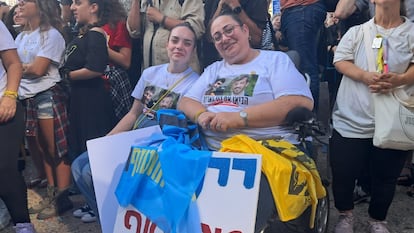
“You’re finally back home,” read the banner Korin Cohen Ben Yakar held on her lap in her wheelchair on Monday in Tel Aviv’s Hostages Square. In that place that has witnessed so many tears in the two years since the Hamas-led attacks of October 7, 2023, those tears on Monday, however, were of joy, of “happiness,” said the 57-year-old woman, and those at her side could not contain their tears either. A giant screen simultaneously showed how the cars carrying the first hostages freed in Gaza — seven of the last 20 still alive — were already driving along an Israeli road. Shortly beforehand, Hamas had handed them over to the Red Cross, which then transferred them to the Israeli army.
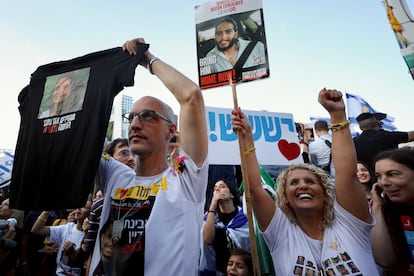
“They’re already in Israel; that’s Israel,” the woman shouted, also laughing at the same time, while her 25-year-old daughter Ofir hugged her. “I’ve been demonstrating for their return for two years; I’ve come to this square every day; I’ve gone to demonstrate in front of parliament,” she said, as she dialled Silvia Cuneo, the mother of David and Ariel Cuneo, aged 28 and 38, two of the hostages who were released Monday. “She’s happy,” but “she doesn’t want to talk to journalists. She says today is the time to be with her children,” explains Ben Yakar, pointing to the T-shirt printed with a photo of the two brothers, who hold dual Israeli and Argentine nationality and who were kidnapped two years ago in Kibbutz Nir Oz, near the border with Gaza.
On Monday, the counter that since October 7, 2023, has been keeping track of the time the Cuneos and the rest of the hostages had been held, read 737 days and five hours when the first seven freed captives from the group of 20 set foot on Israeli soil. Their arrival was greeted with a general outburst of elation by the thousands of people who, like the woman in a wheelchair, watched the broadcast of their return to Israel shortly after 8:00 a.m. local time.
The square was packed. Dozens of people had started to gather at 4 a.m., wrapped in Israeli flags with the yellow ribbon — the symbol of the hostages — intertwined with the Star of David. Others held signs with the faces of those captives who, over the past two years, have become an omnipresent image in Israel, where the feeling has been that, with their kidnapping, a sacred pact had been broken: that Israel, the nation-state of the Jews, leaves none of its people behind.
The atmosphere in the square — a place of remembrance for the deceased hostages and a place of clamor for the return of the living — was that of the end of a dark chapter; the closure of a mourning process that had been impossible until now without the captives returning home, in a country that had never seen so many of its own taken — 251 people were captured during the October 7 attacks — in its 76-year history. “Bring them home now” was the motto of the organization that has made this square its open-air headquarters and brings together the majority of the captives’ families: the Forum of Families of Hostages and the Disappeared.
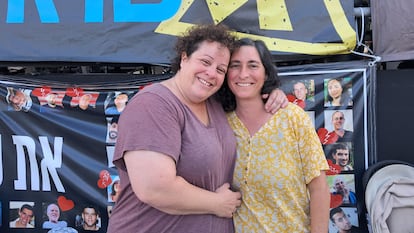
“We can finally breathe,” Efrat (42) and Tamar Madeson-Grossman (47) said, also with tears in their eyes, hugging their two-year-old son Shajar, a boy born “two weeks” after October 7, said Efrat. Tamar celebrated the ceasefire that has allowed the exchange of the hostages for some 2,000 Palestinian prisoners. She then added that the solution to the “conflict” cannot be a military one; that peace “is made with enemies,” referring to Hamas.
The idea that the return of the last hostages opens the door to Israel’s “healing” after the trauma of October 7 — explains a 27-year-old man who prefers not to give his name — coexisted Monday with another phrase repeated by many of those present in the square. Two of the Israelis who arrived early in the morning even had it printed in English on their cycling jerseys: “No forget nor forgive.” Even Tamar, who advocates making peace with Hamas, confesses to being “unable to forgive” the Islamist militant group for the 251 hostages taken and 1,200 people killed on October 7, 2023.
Most of the people watching childhood photographs of the captives displayed on the giant screens in Hostages Square on Monday didn’t know them personally. It doesn’t matter, says 28-year-old Sagi Dalahsan: “The hostages were our brothers and sisters. This is a very small country, and even if we don’t know them, we all know someone who does; or someone who died on October 7.”
“Thank you, Trump”
Dozens of people rushed, screaming, to one of the screens installed in Hostages Square when images appeared of U.S. President Donald Trump at the beginning of his speech to the Israeli parliament. If there was a star in Tel Aviv on Monday morning, it was Trump. Many people held American flags in their hands.
“Thank you, Trump; thank you, Mr. President,” said the anchorwoman. Many of those present to witness the hostages being handed over celebrated the appearance of the Republican leader. “If it weren’t for Trump, the hostages wouldn’t be released,” they said repeatedly. On the screen, Trump reiterated that Israel had the right to “defend itself” by launching the offensive in Gaza that caused more than 67,000 deaths, mostly civilians, before the ceasefire went into effect last Friday.
Guy, a 48-year-old Israeli who declined to give his last name, waved a Star-Spangled Banner while declaring himself “proud” of the United States’ support and attributing the agreement to implement the first phase of the plan — which led to the release of the remaining hostages — to “Trump’s extensive pressure on regional countries, which has subsequently been passed on to Hamas.” The captives have returned, he emphasized, “Thanks to Trump, not Netanyahu.”
The joy, however, was not complete. “It can’t be,” laments Noa, as the return of the living will be followed by the return of the dead: the 28 bodies Hamas was supposed to begin handing over on Monday. The Islamist militia returned only four in the afternoon, one of them allegedly that of Nepalese student Bipin Yoshi, whose fate was unknown. The list of the 20 captives still alive published by Hamas early the previous morning did not include Bipin or the other hostage whose death has not been confirmed, soldier Tamrin Nimrodi.
At one end of the square, Adi weeps inconsolably. She claims she was the person in charge of informing Yoshi’s family in Nepal of his situation. Now she’s just waiting for Israel to officially confirm his death. Above her, a huge blue banner reads: “Peace be upon Israel.”
Sign up for our weekly newsletter to get more English-language news coverage from EL PAÍS USA Edition









































