
The unfinished mourning of Hamas’ attack on Israel: ‘Why doesn’t the grief stay here, in the cemetery?’
Two years after the raids, Kibbutz Nir Oz solemnly remembers the dead. The wound will only heal with the return of the remaining hostages


There are only a few hours left until the sirens mark the beginning of the Jewish holiday of Sukkot. This year (it varies, as it follows the Hebrew calendar) it falls on October 7, the same day that hundreds of members of Hamas and other Palestinian militias launched a surprise attack that claimed nearly 1,200 lives, triggered the bloody invasion of Gaza, and changed the face of the Middle East. It was 2023, but no one in Israel needs to include the year when mentioning the date. Not here, in Nir Oz, one of the kibbutzim that suffered the most fatalities (47) and where the most people were taken hostage: 76 of the 251 in total. Almost all of them were forcibly taken from their homes at dawn. This Monday, hundreds of people held vigils, mourning, and embracing in front of the tombstones in their cemetery, before attending a solemn ceremony to mark the second anniversary of the massacre. Their faces show that the wound is still fresh and open: nine residents of Nir Oz (only four of them still alive) are among the remaining 48 hostages, whose release Israel and Hamas have been negotiating in Egypt since last Tuesday.
Sagui Dekel Chen, captured in Nir Oz and released six months ago in a prisoner exchange, sets foot in the cemetery for the first time after 15 months in Gaza. His voice and pulse tremble, and his arm is still in a sling: “Why doesn’t the grief stay here, in the cemetery?” he cries. “Why does it always accompany me? Why does it also reach my daughters?”
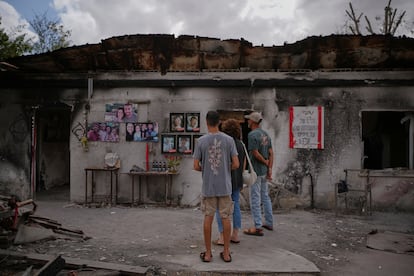
The still-burned houses. The flags bearing the words “liberated” or “killed” at the entrances. The signs of shrapnel or gunfire on the doorways of the so-called “safe rooms,” where most people took refuge after hearing gunshots, still unaware of the scale of the attack. Much in Nir Oz still harks back to that day, when it was subjected to a particularly lethal combination.
Up to 500 Palestinians (including militiamen and civilians who took advantage of the barrier’s collapse to cross into Israel) managed to enter the kibbutz and spent hours there, facing no resistance other than the handful of residents in charge of the first line of defense. Army reinforcements arrived 40 minutes after all the militiamen had left, having raided virtually all of the kibbutz’s homes — about 100. “The command failed to understand that the situation in Nir Oz was particularly serious and that a massacre and kidnappings were taking place there on a large scale, so it did not prioritize the deployment of forces over other locations,” admitted the internal military investigation, made public last March.
At the cemetery, relatives, neighbors, and friends place heart-shaped stones or pour water to remove the dust on the grave of Elad Katzir, kidnapped in the attack. Israeli troops recovered his body in April 2024 in Khan Younis, southern Gaza. With glassy eyes, his sister, Carmit Palti-Katzir, prefers to remember him “just as he was.” “Full of life, a person who lived according to his beliefs, who enjoyed hikes and beers with friends,” she tells this newspaper.
― What is the best way to honor his memory?
― Fighting for a better Israel
Oren, Elad’s nephew, sums it up this way at the graveside: “I haven’t healed. I’ve simply learned to live with grief and loss. And with the understanding that I’ll miss them every day.”
One of the images that went viral around the world during the first ceasefire between Israel and Hamas is that of one of the kidnapped children, Ohad Munder-Zijri, running to hug his family in the hospital. The first to do so was his father, Avi. Standing next to the graves, he recalls the last thing he said to him on the phone on the morning of October 7, 2023: “They’re coming into the house. We’re holding the handle of the safe room so they can’t get in.” What mattered most to him was that the terrorists didn’t realize there was a family on the other side of the door, he recalls.
Living memory
Avi Zijri says that a month later, the army allowed him to enter the kibbutz to take DNA samples from relatives. “It was all burned to a crisp. There wasn’t even a roof. I couldn’t find anything useful, but I found a piece of Roee’s Liverpool cap.” He’s referring to his brother-in-law Roee Munder, Ohad’s uncle. Avi keeps that piece of cap hanging in his house. “This is how I keep his memory alive,” he says. “I had promised to take him to Wembley. I didn’t have time.” Liverpool FC was his life. In fact, scarves of the English soccer team hang from his tombstone.
The event begins with an on-stage performance of a Hebrew version of Leonard Cohen’s Who by Fire. It moves many of the people present, but no one applauds. It’s not the right day. The background sound of the bombing of nearby Gaza (the rhythm barely differs from other days, despite the Israeli army’s claim that it is only carrying out “defensive operations”) cuts through the music and speeches. Some participants wear yellow ribbons (the symbol for the return of the hostages), and one T-shirt reads: “Military pressure [the strategy advocated by Prime Minister Benjamin Netanyahu] kills; the agreement will save them.”

The ceremony concludes with the national anthem. The bus departure time for Kiryat Gat, halfway between Jerusalem and Gaza, is announced over the PA system. This is where part of the community lives, because around 25% of the kibbutz is still destroyed, explains Rita Lifshitz, who will return permanently this year to help renovate it. Hamas kidnapped her in-laws, Yocheved and Oded, during its attack. “The memory of those who are gone is with us, but only when everyone returns can we begin to mourn them,” she concludes.
Some houses remain empty, unfurnished, but with freshly painted walls. These are the same ones where, just days after the attack, traces of blood could be seen on the floor, and even a coffee cup from that morning, still intact. There were also burned-out cars and many remains of broken lives scattered among the green gardens.
Six of the dead in Nir Oz were fleeing the worst massacre of the attacks: the Nova festival. The barrage of rockets Hamas launched as a decoy caught hundreds of young people still dancing in the early morning, after a night of partying. They didn’t understand what was happening until the militiamen opened fire on them, as if it were a shooting gallery, while they fled in terror, on foot or in cars.
Today, the largest memorial, located on a forest plain in another kibbutz, Beeri, commemorates them. It’s a sea of structures bearing the names and photos of all of those killed or kidnapped; 364 of the former (almost a third of the total) and 44 of the latter. For each of them, a tree is planted in their memory.
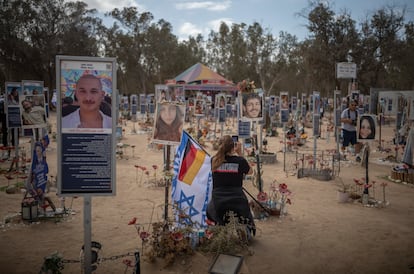
The site has sparked a debate on how to honor the memory of the victims. The challenge is to maintain the line between respectful commemoration and morbidity, political exploitation, or so-called dark tourism, as is the case at other sites commemorating tragic events, such as Chernobyl, Srebrenica, or the Nazi concentration and extermination camps.
Hundreds of people come every day. A small group smelling of alcohol dances to loud techno music. Others, the majority, arrive on organized tours, such as those run by the Israeli trade union center. Four buses are parked with a sign reading “Land of Israel Package.” They belong to the evangelical Christians (one of Israel’s main supporters). Every year, thousands of them march through the streets of Jerusalem on the occasion of Sukkot, the Feast of Tabernacles, organized by the International Christian Embassy in Jerusalem.
They look at the photos of the dead. The visitors are Brazilians, Americans, Venezuelans, or Germans, like Henrike Seemann. He came from Hanover — where he organizes counter-demonstrations to the marches in solidarity with Gaza — and says he printed and hung the photos of the victims of the Hamas attack in his home so he’ll always remember them. “The best way to honor their memory is to never forget their names. To tell their stories, their hobbies, what they liked to do...” he emphasizes.
Seemann, 57, recalls that seven of the remaining 48 hostages hold German nationality, as well as Israeli. Berlin grants it to the descendants — without generational limits — of those Jews who were stripped of it by the Nazi regime under the Nuremberg Laws of 1935. They were demoted to “subjects of the state,” unlike people “of German or related blood,” who retained their rights.
Sign up for our weekly newsletter to get more English-language news coverage from EL PAÍS USA Edition









































